

What Is Madd? A Beginner’s Guide to Lengthening in Tajweed
Madd is the lengthening of a vowel sound in Quran recitation. It involves three letters—Alif (ا), Waw (و), and Ya (ي)—under specific conditions. Natural Madd lasts two counts, while other types require longer stretches according to the rule and the recitation tradition being followed.
This guide explains the Madd letters, the main types of beginner’s encounter, and how to practice without guessing the length.
What Does Madd Mean in Tajweed?
The Arabic word Madd (مدّ) means extension or lengthening. In Tajweed, it describes extending a long vowel for a prescribed duration.
Compare these two words:
- قَلْ — qal: the Fathah after Qaf is short.
- قَالَ — qāla: the Alif extends the preceding Fathah into a long ā sound.
The extra length belongs to the vowel. You should not add another syllable or repeat the consonant.
Understanding short vowels first makes this distinction easier. Our guide to Harakat in Arabic explains Fathah, Kasrah, and Dammah before you move on to their long-vowel counterparts.
What Are the Three Madd Letters?
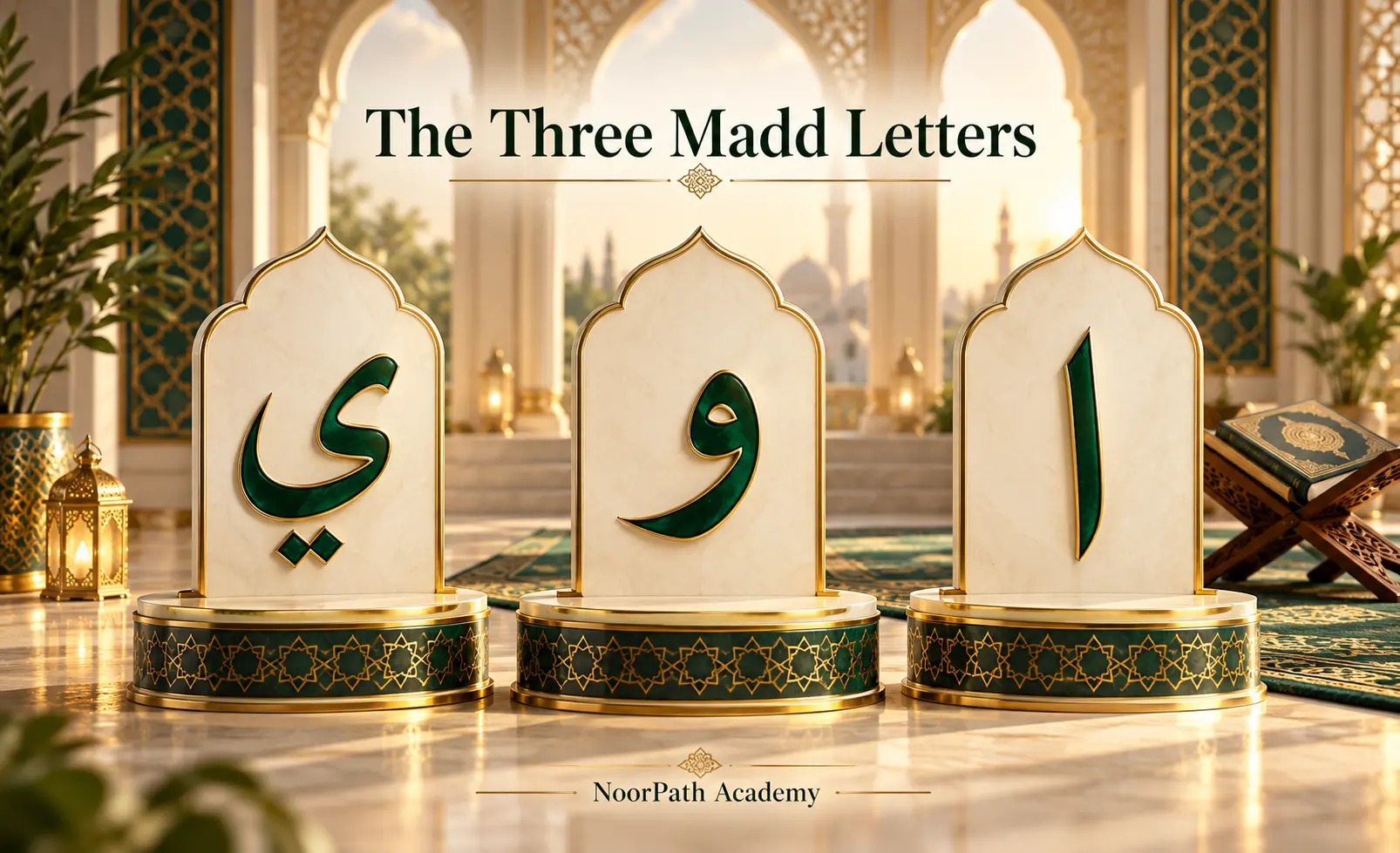
The three Madd letters produce ā, ū, and ī sounds when their conditions are met.
| Madd letter | Required condition | Sound | Example |
| Alif (ا) | Preceded by a letter with Fathah | ā | قَالَ — qāla |
| Waw (و) | Waw is Sakin and preceded by Dammah | ū | يَقُولُ — yaqūlu |
| Ya (ي) | Ya is Sakin and preceded by Kasrah | ī | قِيلَ — qīla |
Waw and Ya do not always function as Madd letters. Their role depends on their own vowel state and the vowel before them.
For example, the Waw in خَوْف follows Fathah. It is a Leen letter, rather than the Waw of natural Madd shown in the table.
How Long Is One Count in Madd?
One count, or Harakah, corresponds to the duration of a short vowel at your current recitation speed. Two counts last approximately twice that duration.
Counts are relative to your pace; they are not fixed seconds. A slower recitation has longer counted, while a faster recitation has shorter ones. The proportions should remain steady.
Start with natural Madd before practicing longer forms. If your two-count vowel changes length from word to word, distinguishing four and six counts becomes harder.
What Are the Main Types of Madd?
Madd has two broad categories:
- Madd Asli, or Madd Tabi‘i: natural lengthening.
- Madd Far‘i: additional lengthening associated with a cause, such as Hamzah or Sukoon.
The following table introduces five common types. It uses Hafs ‘an ‘Asim through the route of Ash-Shatibiyyah for the connected and separated Madd counts. Follow your teacher’s transmitted method consistently.
| Type | What causes it? | Length | Example |
| Madd Tabi‘i | A Madd letter without a cause for extra lengthening | 2 counts | قَالَ |
| Madd Muttasil | Hamzah follows the Madd letter in the same word | 4 or 5 counts when continuing | جَاءَ |
| Madd Munfasil | A word ends with a Madd letter and the next begins with Hamzah | 4 or 5 counts when joining | إِنَّا أَعْطَيْنَاكَ |
| Madd Lazim | A permanent Sukoon follows the Madd letter, including within Shaddah | 6 counts | الضَّالِّينَ |
| Madd ‘Arid Lis-Sukoon | Stopping creates a temporary Sukoon after a Madd letter | 2, 4, or 6 counts | الْعَالَمِينَ when stopping |
These are starting points, rather than an exhaustive list of every Madd rule and stopping variation.
Madd Tabi‘i: Natural Lengthening
Natural Madd is the foundation. Practise the ā in قَالَ, the ū in يَقُولُ, and the ī in قِيلَ for two even counts.
Keep the vowel smooth from beginning to end. Avoid letting it fade early or extending it because you enjoy the melody.
Madd Muttasil: Connected Lengthening
In جَاءَ, the Madd letter and the following Hamzah belong to the same word. This makes it connected Madd.
When continuing, the vowel is held for four or five counts within the method described above. Choose the duration taught by your teacher and maintain it consistently.
Madd Munfasil: Separated Lengthening
In إِنَّا أَعْطَيْنَاكَ, the Alif ends the first word, while Hamzah begins the next.
Look ahead before reciting: the trigger sits across the word boundary. When joining these words, apply the length required by your reading method. Other recognised routes of Hafs include different options, so a two-count recording is not automatically an error.
Madd Lazim: Necessary Lengthening
The Alif before the doubled Lam in الضَّالِّينَ is a familiar example of Madd Lazim.
Practise sustaining the vowel before entering the Lam. Do not use the Shaddah as a reason to rush the preceding sound.
Madd ‘Arid Lis-Sukoon: Lengthening When Stopping
Stopping changes how a word’s ending is pronounced. In الْعَالَمِينَ, stopping on the final Nun creates the condition for this type of Madd.
Understanding what Sukoon means helps you distinguish a permanent Sukoon from one introduced by stopping.
How to Recognise Madd While Reading the Quran
Use this sequence during practice:
- Find the potential Madd letter: Alif, Waw, or Ya.
- Check the preceding vowel: does it meet the long-vowel condition?
- Look at what follows: is there Hamzah, a permanent Sukoon, or Shaddah?
- Decide whether you are continuing or stopping.
- Apply the count you have learned for that situation.
You will also encounter a wave-like Madd sign in many Mushafs. Treat it as a reading aid: the surrounding letters and the relevant rule determine the length.
Work through one example at a time. Identifying the reason for a stretch is more useful than memorising the appearance of a word alone.
Common Madd Mistakes and How to Correct Them
Stretching Every Vowel
A short Fathah, Kasrah, or Dammah should not become a long vowel without the appropriate basis.
Practice tip: read a short-vowel example beside a natural-Madd example. Record both and check whether the difference is audible.
Using One Length for Every Madd
Learning one familiar stretch and applying it everywhere leads to inconsistent recitation.
Practice tip: organise your practice by rule. Master a small group of natural-Madd examples before mixing them with connected or necessary Madd.
Confusing Madd with Ghunnah
Madd concerns vowel lengthening. Ghunnah concerns a nasal sound associated with Noon and Meem.
For related nasal-sound practice, study the rules of Meem Sakinah. Keep a separate practice list for vowel timing so the two skills remain clear.
Losing the Rule While Joining Words
Reading isolated words correctly does not always translate into accurate connected recitation.
Practice tip: practise a word, then its surrounding phrase. This habit also helps when learning the letters of Ikhfa, where the following letter affects pronunciation.
Adding a Vowel to a Consonant Release
A brief consonant release should not turn into an extra long vowel. If you struggle to distinguish these sounds, review the Qalqalah letters alongside your Madd exercises.
A Simple Madd Practice Routine
Use this short routine during your next practice session:
- Identify: choose three examples and name the Madd rule in each.
- Listen: hear the same passage from a qualified reciter following your teacher’s reading method.
- Repeat: recite short phrases at a comfortable, steady pace.
- Record: listen for uneven lengths, extra syllables, and rushed endings.
- Get feedback: ask your teacher to check one specific difficulty.
A useful question is: “Am I holding this vowel for the correct duration at this pace?” It gives your teacher a clear issue to assess.
Practice Madd with NoorPath Academy
Recognising Madd on the page is the first step. Applying it consistently while reading requires listening, repetition, and correction.
In NoorPath Academy’s online Quran Tajweed course, you practise recitation one-to-one with a tutor who listens and corrects your pronunciation and timing.

Book a free trial class to have your recitation assessed and find your starting level. No credit card required.
Frequently Asked Questions About Madd
What is Madd in simple words?
Madd means holding a long vowel for its required duration during Quran recitation. The three Madd letters are Alif, Waw, and Ya when their conditions are met. Natural Madd lasts two counts. Other types involve additional rules, including whether Hamzah or Sukoon follows and whether you continue reading or stop.
Is Madd always two counts?
No. Two counts apply to natural Madd, but other types have different durations. Madd Lazim requires six counts, while certain stopping situations allow two, four, or six. Connected and separated Madd also depend on the transmitted recitation method. Learn the applicable pattern from your teacher and maintain consistent timing.
What is the difference between Madd and Harakat?
Harakat usually refers to short-vowel marks such as Fathah, Kasrah, and Dammah. Madd concerns long-vowel sounds. The word Harakah is also used as a unit of timing: natural Madd lasts two Harakat. This means two short-vowel durations at the current recitation pace, rather than a fixed number of seconds.
Can I learn Madd without a teacher?
You can learn the definitions, identify letters, and begin recognising rules through written guides. Accurate timing is harder to assess by yourself.
Listening and recording support practice, while feedback from a qualified teacher helps you identify whether a vowel is too short, too long, or uneven during connected recitation.