

Sukoon Meaning in Arabic and Quran Reading
Sukoon means a letter has no vowel of its own. Learn to recognize the sign, pronounce simple examples, and avoid adding extra sounds when reading Arabic and the Quran.
What Is the Sukoon Meaning in Arabic?
The sukoon meaning in Arabic reading is the absence of a vowel on a consonant. A letter with Sukoon is called saakin. Instead of pronouncing it with Fatha, Kasra, or Damma, you articulate the consonant without adding a following a, i, or u sound.
For example, بَ is ba, بِ is bi, and بُ is bu. In أَبْ, the Ba has Sukoon: read ab, not aba, abi, or abu.
The Arabic word سُكُون carries the general sense of stillness or rest. In a reading lesson, however, its practical meaning is specific: no vowel. It does not tell you to stop reciting, and it does not make the consonant silent.
What Does the Sukoon Sign Look Like?
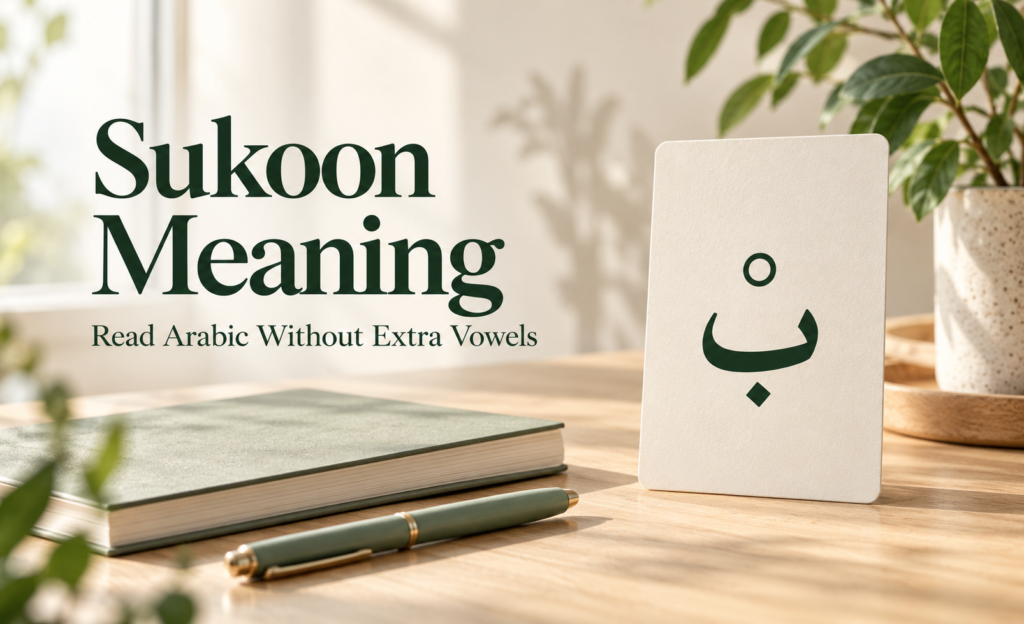
In many Arabic learning books, Sukoon appears as a small circle above a letter, as in بْ. Quranic notation can differ: some Mushafs use a small head-of-kha-shaped sign to indicate Sukoon rather than the circle familiar from beginner worksheets.
Use the notation conventions of the Mushaf you are reading. Not every circle-like mark in Quranic writing means Sukoon; some marks indicate letters that are not pronounced. Similarly, a consonant without a visible vowel mark does not always have an explicitly written Sukoon. Learn the markings with a teacher rather than guessing from shape alone.
The essential question is what the letter does in recitation: does it carry a vowel, or is it read without one?
Sukoon vs Fatha Kasra and Damma
The easiest way to understand sukoon meaning is to compare it with the three short vowels. Harakat supply a vowel sound; Sukoon indicates its absence.
| Mark | Example | Reading action |
| Fatha | بَ | Pronounce ba |
| Kasra | بِ | Pronounce bi |
| Damma | بُ | Pronounce bu |
| Sukoon | أَبْ | Pronounce ab without a vowel after b |
Read the last example as a complete practice unit. Trying to sound out a vowel-less consonant entirely on its own may tempt you to add a vowel just to make it easier to say.
If the vowel marks still feel unfamiliar, our Harakat Arabic guide explains Fatha, Kasra, and Damma with practice examples. Understanding those sounds makes their absence easier to recognize.
How to Pronounce a Letter With Sukoon?
Start with a vowelled letter followed by a saakin consonant. Connect the two while giving each consonant its correct articulation.
- Identify the vowel on the preceding letter.
- Locate the consonant carrying Sukoon.
- Move from the vowel into that consonant without adding another vowel.
- Continue into the next letter if the word or phrase continues.
- Check the example by listening and repeating it with your teacher.
For أَنْ, connect the initial a sound to Noon and read an. Avoid changing it to ana. For مِنْ, connect mi to Noon and read min, without a final a or u.
The sukoon meaning stays the same across these examples, but the consonants do not all sound alike. Some sounds can continue naturally, while others involve a closure and release. Do not force every saakin letter into an identical abrupt sound or hold every one for the same duration.
NoorPath Academy’s Quran Tajweed and recitation course includes live reading practice so a teacher can hear whether you are adding an unwanted vowel or changing a letter’s articulation.
Sukoon Examples for Beginners
These general Arabic practice examples help you locate a vowel-less consonant. Transliteration is only a reminder; listen to an accurate Arabic model for the sounds themselves.
| Example | Letter with Sukoon | Practice reading | What to notice |
| أَبْ | بْ | ab | No vowel after Ba |
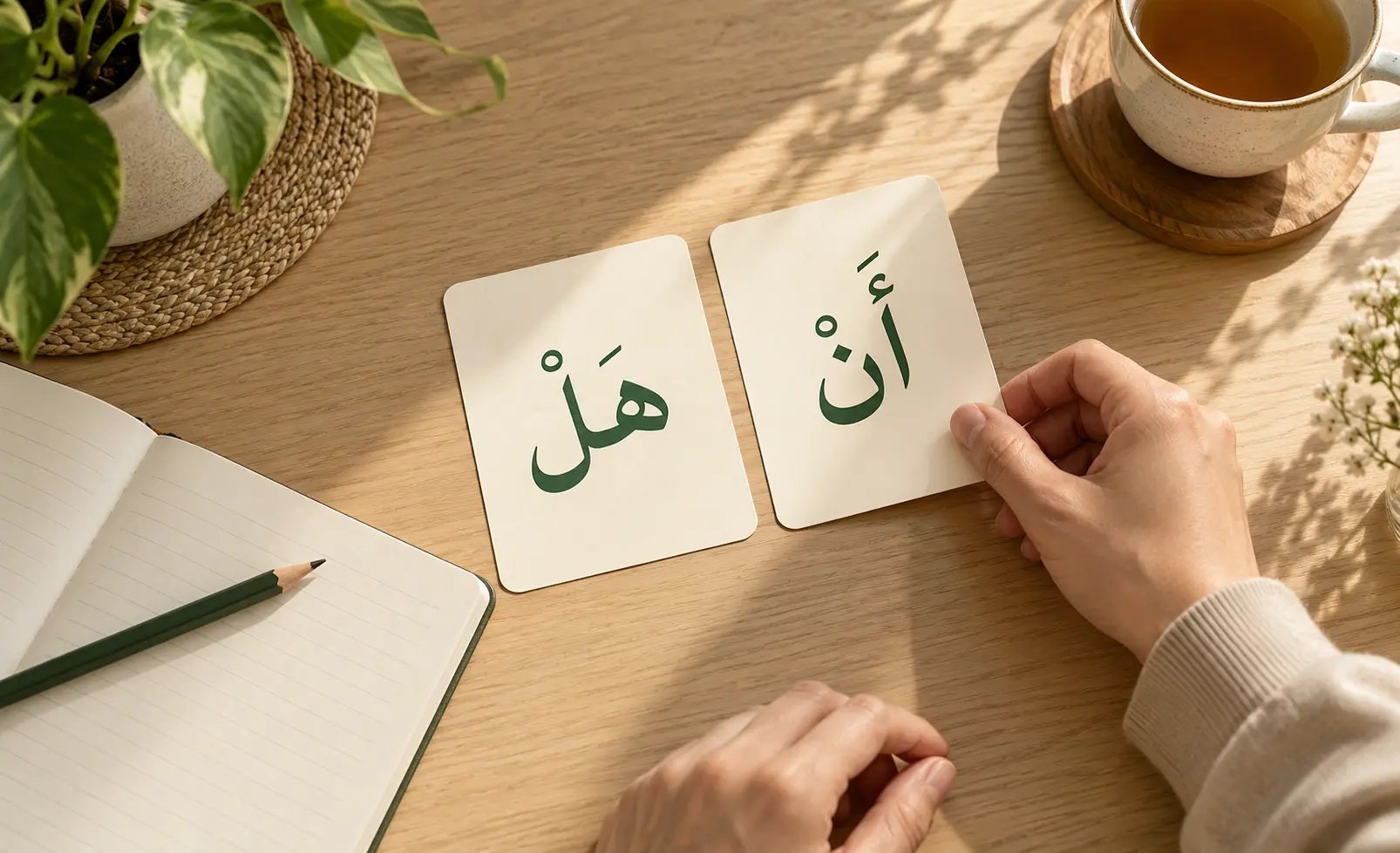
| أَنْ | نْ | an | No vowel after Noon |
| مِنْ | نْ | min | Kasra on Meem then vowel-less Noon |
| هَلْ | لْ | hal | No extra vowel after Lam |
| مَكْتَب | كْ | maktab | Sukoon can occur inside a word |
Reading Sukoon Inside a Word
In مَكْتَب, the Kaf is saakin. Move from مَ into كْ, then continue to تَ and the final consonant when reading this practice form. Do not insert an extra vowel between Kaf and Ta.
This example is especially useful because the word continues after the Sukoon. It shows that sukoon meaning concerns the letter’s vowel status, not a pause in the word.
Reading Sukoon at the End of a Practice Unit
In هَلْ, pronounce ha followed by Lam. Do not turn it into hala. Keep the Lam audible without adding a vowel to it.
When you move from isolated words to Quranic passages, the following letters and the decision to continue or stop can affect pronunciation. Practice the full connection, not only the word in isolation.
Does Sukoon Mean Stop Reading
No. Sukoon does not function as a stop sign. Waqf concerns where and how you stop the recitation; Sukoon concerns whether a consonant has a vowel.
You may encounter a saakin letter in the middle of a word and continue immediately. You may also stop on a word whose final consonant becomes vowel-less as part of the stopping rules, even though it has a vowel in connected reading.
Knowing sukoon meaning therefore helps you understand stopping, but it does not tell you where stopping is appropriate. Quranic stop signs and the meaning of the passage need separate attention.
Original Sukoon and Sukoon Caused by Stopping
An original Sukoon belongs to the consonant in its normal reading form. A temporary Sukoon can arise when you stop on a word that ends with a vowelled consonant during connected recitation.
For a simple practice comparison, كِتَابُ ends with bu in connected reading. When stopping on this form using the usual complete stopping pronunciation, the final Ba becomes vowel-less: kitaab. This illustrates a common pattern, not every possible stopping case.
Endings involving Tanween, Ta Marbutah, and other features need their own rules. Start with straightforward examples and ask your teacher to demonstrate the stopping form before applying a pattern to unfamiliar Quranic words.
How Sukoon Connects to Tajweed Rules
Understanding sukoon meaning is a foundation for several Tajweed topics. It helps you recognize the condition of a letter before deciding which recitation rule applies.
Noon Sakinah and Ikhfa
Noon Sakinah is a Noon without a vowel. Its treatment depends on the following letter. When an Ikhfa letter follows it, the Noon sound is concealed with ghunnah rather than pronounced as a fully clear Noon.
In مِنْ شَرِّ, Noon is followed by Sheen. This connection requires Ikhfa in continued recitation. Our guide to the letters of ikhfa explains the triggering letters, examples, and practice steps.
An explicitly printed Sukoon is not the only way Noon’s state can be indicated in a Mushaf. Some notation systems omit the Sukoon at particular rule connections. Learn both the rule and the notation rather than relying on a single symbol.
Saakin Letters and Qalqalah
The five Qalqalah letters are ق، ط، ب، ج، د. When one is saakin, it is articulated with Qalqalah, including when Sukoon arises through stopping under the relevant conditions.
Qalqalah does not mean adding a new Fatha, Kasra, or Damma. It is a controlled release of the consonant. Our Qalqalah letters guide explains this distinction and the examples you can practice with a teacher.
Sukoon and Shaddah
Sukoon indicates no vowel on a consonant. Shaddah indicates a doubled consonant, whose first part is saakin and whose second part carries a vowel.
These signs are related, but they are not interchangeable. A consonant with Sukoon should not automatically be doubled, and Shaddah should not be treated simply as a louder consonant.
Common Sukoon Mistakes and How to Correct Them
Adding an Extra Vowel
The most obvious error is reading أَبْ as aba or مِنْ as mina. Return to a short practice unit and listen to its ending. Keep the consonant present while removing the additional vowel sound.
Making the Consonant Silent
No vowel does not mean no consonant. If you leave out the final Lam in هَلْ, you have changed the word’s sounds. Pronounce the letter from its correct articulation point without giving it a vowel.
Pausing at Every Sukoon
Stopping whenever you see Sukoon breaks words and phrases unnecessarily. Practice an internal example such as مَكْتَب, then move to a connected phrase. Continue smoothly unless the stopping rules call for a stop.
Giving Every Letter a Bounce
Qalqalah applies to its five letters under the rule’s conditions. Do not add an echoing release to every consonant with Sukoon. Match each letter’s qualities and learn its relevant rules through guided listening.
A Short Daily Sukoon Practice Routine
Choose three examples with consonants you already pronounce comfortably. Locate the Sukoon, listen to a teacher’s model, and repeat each example slowly. Next, read a word with Sukoon inside it so you can practice continuing without an extra vowel.
Record one short attempt and check a single issue: an added vowel, a missing consonant, or an unnecessary pause. Once the isolated practice is accurate, use the same skill in a short passage with live correction.
Practice Sukoon in Guided Quran Lessons
Recognizing sukoon meaning helps you understand the written instruction. Consistent pronunciation comes from applying it while reading, hearing corrections, and repeating the corrected sound.
In NoorPath Academy’s online Tajweed course, you can practice vowel-less consonants, connected reading, and related Tajweed rules with a teacher. Book a free trial class to assess your reading and work on the sounds you find difficult. No credit card required.

Frequently Asked Questions
What is the sukoon meaning in Quran reading
Sukoon means a consonant has no vowel of its own. You pronounce the consonant without adding a short a, i, or u sound after it. In Quran reading, its articulation may also be affected by rules such as Ikhfa or Qalqalah. Sukoon does not make the consonant silent or independently instruct you to stop.
Is Sukoon a vowel or a pause
Sukoon is a diacritic indicating the absence of a vowel, not an additional vowel or a pause instruction. A saakin consonant can occur inside a word while reading continues. Pausing belongs to Waqf rules, which explain appropriate stopping points and how a word’s ending is pronounced when you stop rather than continue.
How is Sukoon different from Shaddah
Sukoon indicates a vowel-less consonant, while Shaddah indicates a doubled consonant. The first part of a doubled consonant is saakin, and the second carries a vowel. The two marks therefore describe different reading instructions. Practice short examples with your teacher so you can hear consonant doubling without confusing it with silence or added loudness.
Does every letter with Sukoon need Qalqalah
No. Qalqalah applies to the five letters Qaf, Ta, Ba, Jeem, and Dal when they are saakin under the relevant recitation conditions. Other saakin letters retain their own articulation qualities without automatically receiving Qalqalah. Even for the five letters, the release should not become an added short vowel or an extra syllable.