


Rules of Meem Sakinah: 3 Types with Quran Examples
Have you ever noticed the letter Meem (م) with a Sukoon while reading the Quran? Knowing how to pronounce it correctly is an essential part of learning Tajweed.
Meem Sakinah refers to the Arabic letter Meem (مْ) without a vowel. Its pronunciation changes depending on the letter that follows it.
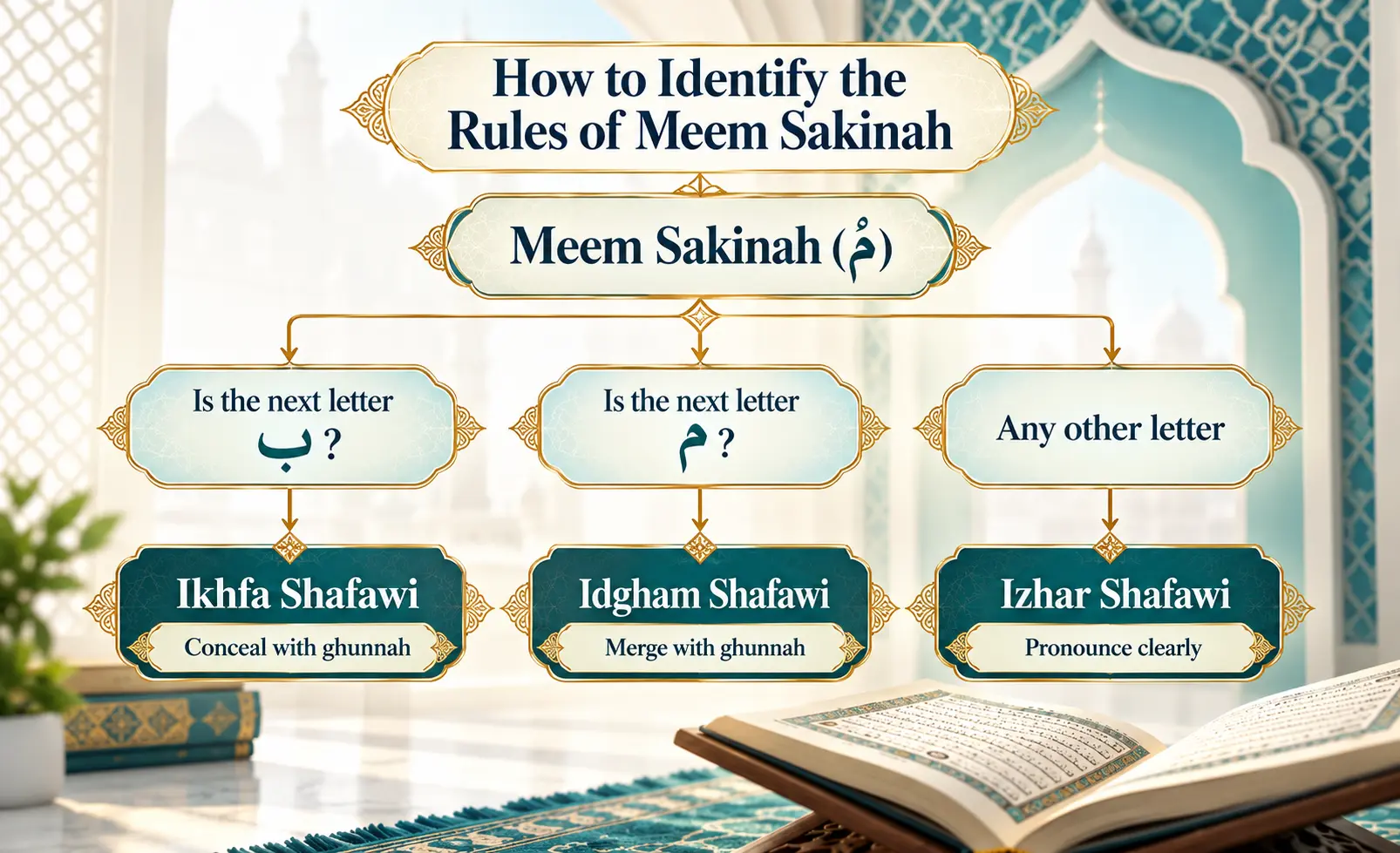
There are three main Meem Sakinah rules: Ikhfa Shafawi, Idgham Shafawi, and Izhar Shafawi.
In this guide, you will learn what each rule means, how to recognize it, and how to apply it using real examples from the Quran.
What Is Meem Sakinah in Tajweed?
Meem Sakinah (الميم الساكنة) is the Arabic letter Meem (م) that carries a Sukoon (ْ), meaning it has no Fatha, Kasra, or Damma.
Unlike a moving Meem, which carries a short vowel, Meem Sakinah has no vowel of its own.
For example:
- مَ — Meem with Fatha
- مِ — Meem with Kasra
- مُ — Meem with Damma
- مْ — Meem with Sukoon
The silent Meem can appear in the middle or at the end of a word.
Understanding the meaning of Sukoon in Arabic helps beginners recognize why certain letters are pronounced without a short vowel.
If you are still learning the basics of Arabic pronunciation, reviewing Arabic Harakat can also help you distinguish between vowelled letters and letters carrying Sukoon.
The rules of Meem Sakinah depend on the letter immediately following it when recitation continues.
What Are the 3 Rules of Meem Sakinah?
The three Meem Sakinah rules are collectively known as Ahkam Al-Meem Al-Sakinah (أحكام الميم الساكنة).
Each rule determines how Meem Sakinah should be pronounced depending on the following Arabic letter.
| Rule | Following letter | Pronunciation |
| Ikhfa Shafawi | ب (Baa) | Conceal Meem with Ghunnah |
| Idgham Shafawi | م (Meem) | Merge the two Meems with Ghunnah |
| Izhar Shafawi | All other 26 letters | Pronounce Meem clearly |
These rules are called Shafawi because the letter Meem is articulated using the lips.
Learning the three categories makes it easier to identify the correct pronunciation while reading Quranic verses.

-
Ikhfa Shafawi: Concealing Meem Sakinah
Ikhfa Shafawi (الإخفاء الشفوي) means oral concealment.
This rule occurs when Meem Sakinah (مْ) is followed by the Arabic letter Baa (ب).
Instead of pronouncing Meem with complete clarity, the reader partially conceals its sound while maintaining a nasal sound called Ghunnah.
How to Pronounce Ikhfa Shafawi
To apply this rule correctly:
- Identify Meem Sakinah followed by Baa.
- Bring your lips together gently without pressing them tightly.
- Maintain the nasal sound for approximately two counts.
- Move smoothly into the Baa.
The goal is to produce a natural transition without completely dropping the Meem sound.
Ikhfa Shafawi Examples From the Quran
Example 1: Surah Al-Fil (105:4)
تَرْمِيهِم بِحِجَارَةٍ
Tarmeehim bihijarah
The Meem at the end of تَرْمِيهِم is followed by Baa in بِحِجَارَةٍ.
Therefore, the rule of Ikhfa Shafawi applies.
Example 2: Surah Al-Baqarah (2:8)
وَمَا هُم بِمُؤْمِنِينَ
Wa maa hum bimu’mineen
The Meem in هُم is followed by Baa in بِمُؤْمِنِينَ.
The reader conceals the Meem slightly while maintaining Ghunnah.
Although both rules involve concealment, Ikhfa Shafawi differs from the rules involving Noon Sakinah and Tanween.
If you have already studied the letters of Ikhfa, remember that Ikhfa Shafawi applies specifically to Meem Sakinah followed by Baa, while Ikhfa Haqiqi involves Noon Sakinah or Tanween.
-
Idgham Shafawi: Merging Two Meem Letters
Idgham Shafawi (الإدغام الشفوي) occurs when Meem Sakinah is followed by another Meem (م).
The first Meem merges into the second Meem, producing one emphasized Meem with Ghunnah.
This rule is also called Idgham Mithlayn Sagheer.
How to Pronounce Idgham Shafawi?
When you encounter two consecutive Meem letters:
- Identify the first Meem carrying Sukoon.
- Recognize the second Meem immediately after it.
- Merge the two sounds into one emphasized Meem.
- Hold the Ghunnah for approximately two counts.
Avoid pronouncing the two Meems as separate sounds.
Idgham Shafawi Examples From the Quran
Example 1: Surah Quraysh (106:4)
الَّذِي أَطْعَمَهُم مِّن جُوعٍ
Alladhee at’amahum min joo’
The Meem in أَطْعَمَهُم is followed by another Meem in مِّن.
The two Meems merge into one emphasized sound with Ghunnah.
Example 2: Surah Al-Humazah (104:8)
إِنَّهَا عَلَيْهِم مُّؤْصَدَةٌ
Innaha alayhim mu’sadah
The Meem at the end of عَلَيْهِم merges into the next Meem.
This produces Idgham Shafawi with a clear nasal sound.
Practicing these examples helps develop smoother transitions between Quranic words.
-
Izhar Shafawi: Pronouncing Meem Clearly
Izhar Shafawi (الإظهار الشفوي) means oral clarity.
This rule applies when Meem Sakinah is followed by any Arabic letter except Baa (ب) or Meem (م).
There are 26 letters that trigger Izhar Shafawi.
Unlike Ikhfa and Idgham, Izhar requires Meem to be pronounced clearly without additional prolonged Ghunnah.
How to Pronounce Izhar Shafawi
To pronounce Izhar Shafawi correctly:
- Identify Meem Sakinah.
- Check whether the following letter is neither Baa nor Meem.
- Close your lips naturally to pronounce Meem.
- Release the sound clearly before moving to the next letter.
The Meem should remain distinct rather than merging with the following sound.
Izhar Shafawi Examples From the Quran
Example 1: Surah Al-Kafirun (109:6)
لَكُمْ دِينُكُمْ وَلِيَ دِينِ
Lakum deenukum wa liya deen
The Meem in لَكُمْ is followed by the letter Daal (د).
Therefore, Izhar Shafawi applies.
The Meem in دِينُكُمْ is also followed by Waw (و), requiring clear pronunciation.
Example 2: Surah Al-Fil (105:1)
أَلَمْ تَرَ كَيْفَ فَعَلَ رَبُّكَ بِأَصْحَابِ الْفِيلِ
Alam tara kayfa fa’ala rabbuka bi-ashabil feel
The Meem in أَلَمْ is followed by Taa (ت).
Since Taa is neither Baa nor Meem, the rule is Izhar Shafawi.
Be particularly careful when Meem Sakinah is followed by Faa (ف) or Waw (و), as their nearby articulation can lead beginners to conceal the Meem unintentionally.
Meem Sakinah vs. Noon Sakinah: What’s the Difference?
Both Meem Sakinah and Noon Sakinah are important parts of Tajweed, but they follow different sets of rules.
| Feature | Meem Sakinah | Noon Sakinah |
| Arabic letter | مْ | نْ |
| Number of rules | 3 | 4 |
| Main rules | Ikhfa, Idgham, Izhar | Izhar, Idgham, Iqlab, Ikhfa |
| Articulation | Lips | Tongue tip, with nasal resonance in applicable rules |
| Following letters | Determine the applicable rule | Determine the applicable rule |
One significant difference is that Noon Sakinah and Tanween have the rule of Iqlab, while Meem Sakinah does not.
Understanding this distinction helps learners identify which Tajweed rule to apply without confusing similar pronunciation techniques.
Common Meem Sakinah Mistakes Beginners Should Avoid
Learning Meem Sakinah rules theoretically is useful, but incorrect pronunciation habits can develop without regular practice.
Here are five common mistakes to watch for.
-
Confusing Ikhfa With Izhar
Some learners pronounce Meem clearly even when it is followed by Baa.
Remember that Meem Sakinah followed by Baa requires Ikhfa Shafawi, including Ghunnah.
-
Separating the Two Meems in Idgham
When Meem Sakinah is followed by another Meem, pronouncing each independently interrupts the natural flow.
Instead, merge them into one emphasized sound.
-
Adding Extra Ghunnah During Izhar
Izhar Shafawi requires clear pronunciation, not an extended nasal sound.
Although Meem naturally has nasal resonance, it should not be unnecessarily prolonged during Izhar.
-
Confusing Meem Sakinah With Qalqalah
Another common mistake is applying an echoing sound to Meem Sakinah.
Meem Sakinah rules govern how a silent Meem interacts with the following letter, while the rules of Qalqalah letters involve a distinct echoing sound produced by five specific Arabic letters when they carry Sukoon.
Recognizing the difference helps learners avoid unnecessary echoing or nasalization during Quranic recitation.
-
Ignoring the Following Letter
The correct rule cannot be determined by looking at Meem Sakinah alone.
Always examine the letter immediately after it when reciting continuously.
Learning to recognize these patterns is an important step toward more accurate Quran pronunciation.
How to Practice Meem Sakinah Rules Effectively?
The easiest way to improve your Meem Sakinah pronunciation is to combine visual recognition, listening, and daily recitation.
Start with this simple practice routine.
Step 1: Identify the Meem
Open a page of the Quran and look for the letter م carrying Sukoon.
Step 2: Check the Following Letter
Determine whether the next letter is Baa, Meem, or another letter.
Step 3: Apply the Correct Rule
Practice concealing, merging, or clearly pronouncing the Meem according to the rule.
Step 4: Listen to a Qualified Reciter
Choose a slow, accurate Quranic recitation and repeat the examples.
Step 5: Practice With a Tajweed Teacher
Ask your teacher to check your lip movement, Ghunnah timing, and pronunciation.
Even 10 minutes of focused daily practice can help you recognize the three rules more confidently over time.
Quick Meem Sakinah Practice Quiz
Test your understanding by identifying the correct Tajweed rule in each example.
| Quranic example | Correct rule |
| تَرْمِيهِم بِحِجَارَةٍ | Ikhfa Shafawi |
| أَطْعَمَهُم مِّن جُوعٍ | Idgham Shafawi |
| أَلَمْ تَرَ | Izhar Shafawi |
| وَمَا هُم بِمُؤْمِنِينَ | Ikhfa Shafawi |
| لَكُمْ دِينُكُمْ | Izhar Shafawi |
A useful memorization technique is to remember just two letters:
ب = Ikhfa, م = Idgham, everything else = Izhar.
This simple rule makes it easier to recognize the correct pronunciation during recitation.
Learn Meem Sakinah With NoorPath’s Online Tajweed Classes
Understanding Meem Sakinah rules is an important step toward reading the Quran accurately and confidently.
However, knowing the rules and applying them correctly are two different skills.
At NoorPath Academy, our personalized online Quran Tajweed course helps learners practice pronunciation through live, one-to-one sessions with qualified Al-Azhar tutors.
Students benefit from:
- Individual pronunciation correction.
- Step-by-step explanations of Tajweed rules.
- Practical Quranic recitation exercises.
- Flexible scheduling for international learners.
- Lessons suitable for beginners and improving reciters.
Whether you are learning Tajweed for the first time or correcting long-standing pronunciation mistakes, guided practice helps turn theoretical knowledge into confident recitation.
Book Your Free Tajweed Trial Class — No credit card required.
Frequently Asked Questions About Meem Sakinah
What are the three rules of Meem Sakinah?
The three Meem Sakinah rules are Ikhfa Shafawi, Idgham Shafawi, and Izhar Shafawi. Ikhfa occurs before Baa, Idgham occurs before another Meem, and Izhar applies before the remaining Arabic letters. Each rule determines whether Meem should be concealed, merged, or pronounced clearly when reciting the Quran.
How many letters are used in Meem Sakinah rules?
All 28 Arabic letters are accounted for in the rules of Meem Sakinah. One letter, Baa (ب), triggers Ikhfa Shafawi, and one letter, Meem (م), triggers Idgham Shafawi. The remaining 26 letters trigger Izhar Shafawi, where the Meem is pronounced clearly without additional prolonged nasalization.
What is the difference between Ikhfa Shafawi and Idgham Shafawi?
Ikhfa Shafawi occurs when Meem Sakinah is followed by Baa, requiring partial concealment with Ghunnah. Idgham Shafawi occurs when Meem Sakinah is followed by another Meem, requiring both Meems to merge into one emphasized sound. Both rules involve Ghunnah, but their pronunciation techniques are different.
Is Ghunnah required in all Meem Sakinah rules?
No. A prolonged Ghunnah of approximately two counts is required in Ikhfa Shafawi and Idgham Shafawi. During Izhar Shafawi, the Meem is pronounced clearly without an added two-count nasal sound. Understanding this difference helps learners avoid common pronunciation mistakes and maintain the proper rhythm of Quranic recitation.
Can beginners learn Meem Sakinah easily?
Yes. Meem Sakinah is relatively straightforward because it has only three rules. Beginners can start by recognizing Meem with Sukoon, identifying the next letter, and practicing the corresponding pronunciation. Listening to reliable Quranic recitations and receiving feedback from a qualified Tajweed teacher can make the learning process more effective.
Your goal should be to turn the parent page into a conversion-focused course landing page, while supporting blog articles handle definitions, explanations, Quranic examples, and detailed Tajweed rules.