
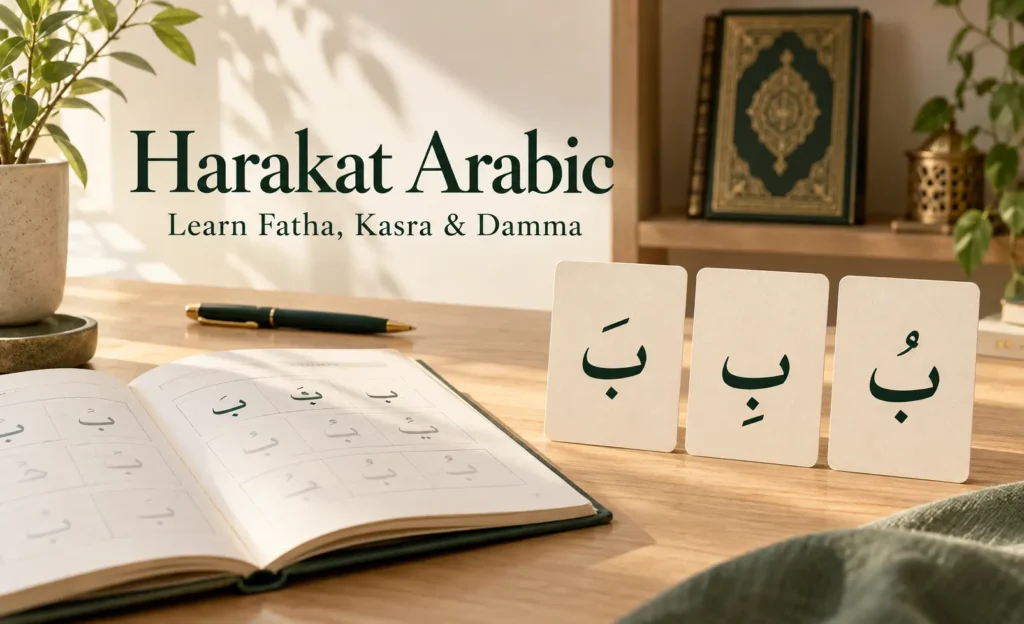

Harakat Arabic A Beginner Guide to Short Vowel Marks
Harakat in Arabic show the short vowel sounds that help you read words correctly. Learn Fatha, Kasra, and Damma with clear examples, then practice using them in Quran reading.
What Are Harakat in Arabic?
Harakat (حَرَكَات) are vowel marks placed above or below Arabic letters. The three basic short vowel marks are Fatha (َ), Kasra (ِ), and Damma (ُ). They tell you whether to pronounce a consonant with a short a, i, or u sound.
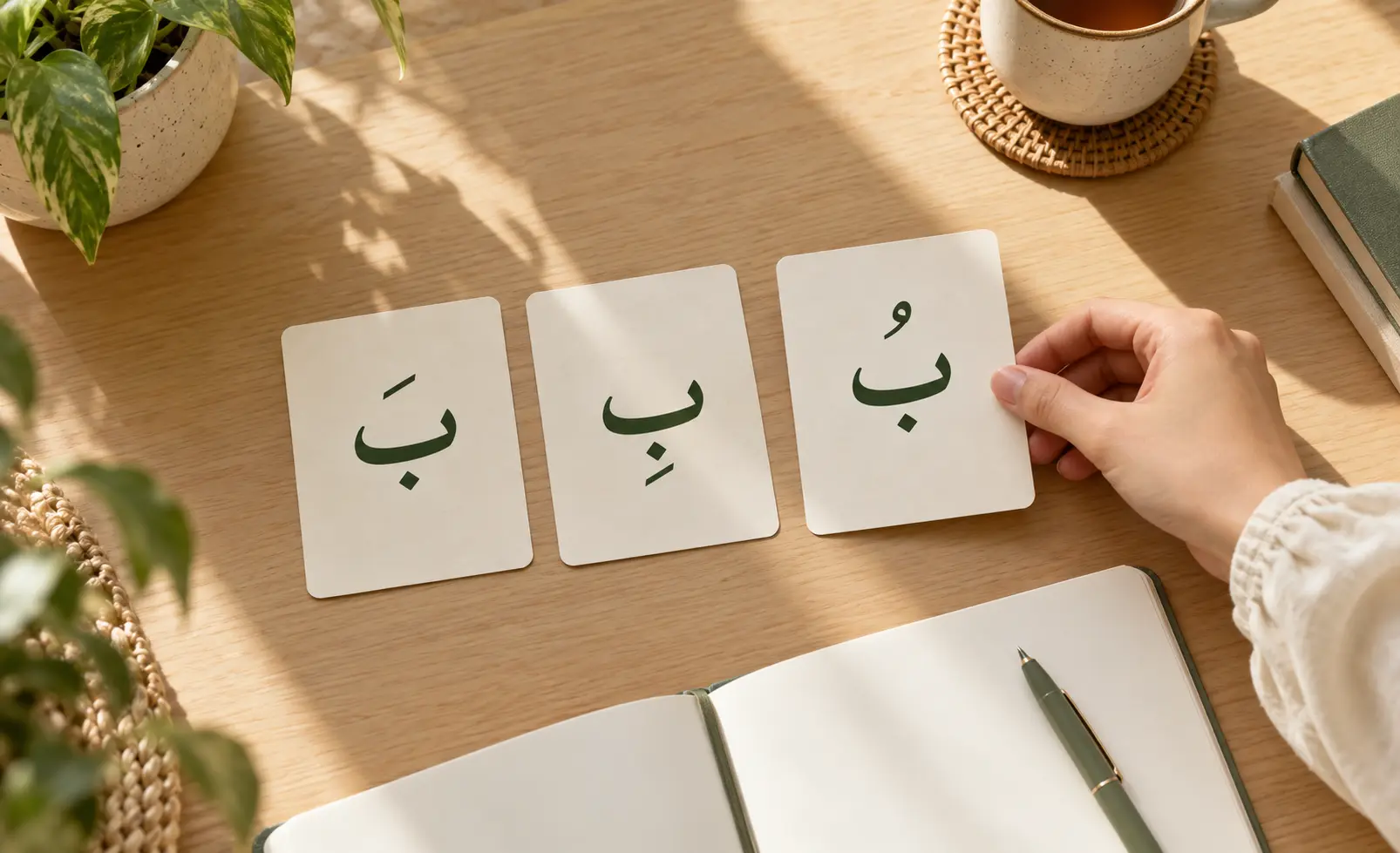
For example, the same letter ب sounds different with each mark:
| Mark | Arabic example | Reading |
| Fatha | بَ | ba |
| Kasra | بِ | bi |
| Damma | بُ | bu |
The letter stays the same; the vowel changes. If you searched for “harakat Arabic” because you recognize letters but struggle to read words, learning these three marks is your next practical step.
In beginner resources, “harakat” is sometimes used broadly for Arabic reading marks. More precisely, Sukoon and Shaddah are related diacritics with different jobs: Sukoon indicates no vowel, and Shaddah indicates a doubled consonant.
Why Harakat Matter for Quran Reading?
Recognizing Arabic letters does not always tell you how to pronounce a word. Harakat supply vowel information that may otherwise be unclear to a beginner. Reading each mark carefully helps you avoid replacing one sound with another.
Vowels can also distinguish meanings. Compare عَلَم (ʿalam, flag) with عِلْم (ʿilm, knowledge). Both use the same basic consonants, but their vowel patterns differ. Harakat therefore support accurate reading, rather than serving as optional decoration.
A vowel chart is a useful starting point. Listening and guided practice help you turn recognition into pronunciation. NoorPath Academy’s online Tajweed course includes foundational reading practice before introducing more advanced recitation rules.
The Three Basic Harakat Arabic Learners Need First
Fatha The Short a Sound
Fatha is a small diagonal stroke above the letter. It produces a short a vowel, as in بَ, تَ, and مَ: ba, ta, and ma.
Keep this vowel brief. بَ is ba, whereas بَا is baa with a long vowel. Do not stretch every Fatha into an aa sound. The English spelling is a reminder, not a complete pronunciation model; the sound also reflects the qualities of the Arabic consonant.
Kasra The Short i Sound
Kasra is a small diagonal stroke below the letter. In بِ, تِ, and مِ, it produces bi, ti, and mi.
Pay attention to its position. A quick glance can cause you to confuse Kasra with Fatha, especially in small text. Read from a clearly printed page and connect the letter to its mark before moving on.
Damma The Short u Sound
Damma looks like a small curved mark above the letter. In بُ, تُ, and مُ, it produces bu, tu, and mu.
Round your lips for the short u sound without adding an extra w sound. Keep بُ shorter than بُو. Listen to a teacher’s model and repeat the contrast until you can hear and produce the difference.
Harakat Arabic Chart With Practice Examples
Practice one row at a time. Read from right to left when following Arabic text, while using the English labels only as support.
| Letter | With Fatha | With Kasra | With Damma |
| ب | بَ ba | بِ bi | بُ bu |
| ت | تَ ta | تِ ti | تُ tu |
| م | مَ ma | مِ mi | مُ mu |
| ن | نَ na | نِ ni | نُ nu |
| س | سَ sa | سِ si | سُ su |
Start by reading across a row, then mix the examples. If you always repeat ba, bi, bu in the same order, you may learn the sequence without actually checking the marks. Random practice tests whether you recognize the vowel itself.
How to Read Arabic Words with Harakat?
Move from individual sounds to short, fully marked words. Begin with a word whose letters you already recognize and read each letter with its vowel before connecting the sounds.
Example One كَتَبَ
كَتَبَ means “he wrote.” Its three parts are كَ, تَ, and بَ: ka, ta, ba. Connect them as kataba, keeping each vowel short.
Do not pronounce the letter names kaf, ta, and ba as the word. Letter names identify the alphabet; vowel marks tell you how those letters sound during reading.
Example Two كُتِبَ
كُتِبَ means “it was written.” Read كُ, تِ, and بَ: ku, ti, ba. The consonants match the previous example, but Damma and Kasra change the vowel pattern and meaning.
Compare kataba and kutiba slowly. This exercise shows why checking every mark matters, even when a word looks familiar.
Example Three سَمِعَ
سَمِعَ means “he heard.” The vowel sequence is Fatha, Kasra, Fatha. The letter ع needs its own articulation practice; English transliteration cannot reproduce its sound fully.
These are general Arabic practice words, not quoted Quranic verse extracts. Once you can read them accurately, practice a short Quran passage with a qualified teacher and learn its connected and stopping forms.
Short Vowels and Long Vowels What Changes
Short vowels and long vowels are related, but their durations differ. For basic natural lengthening, a matching long vowel letter extends the preceding sound.
| Short sound | Long sound | Basic connection |
| بَ ba | بَا baa | Fatha followed by Alif |
| بِ bi | بِي bee | Kasra followed by vowel Yaa |
| بُ bu | بُو boo | Damma followed by vowel Waw |
These examples illustrate the basic patterns. Waw and Yaa can also function as consonants, so their presence alone does not automatically create a long vowel.
In Quran recitation, natural Madd is two counts under its conditions. Other Madd rules have different lengths. Learn the short-to-long contrast first rather than applying a single duration to every vowel or Madd sign.
Related Marks Tanween Sukoon and Shaddah
Tanween Adds an Ending Noon Sound
Tanween uses double vowel marks: ً, ٍ, and ٌ. In basic connected reading, these represent an, in, and un endings. For example, بًا, بٍ, and بٌ can illustrate the three sounds in isolation as a learning drill.
The following letter affects how the Tanween’s Noon sound is recited in the Quran. Stopping also changes the ending, so do not assume every Tanween is pronounced identically in every context.
Sukoon Means No Vowel
Sukoon indicates that a letter has no vowel of its own. In مِنْ, the Meem has Kasra, while the Noon has no following vowel. Avoid turning it into mina by adding a sound that is not written.
Sukoon is not an instruction to pause the recitation. A vowel-less letter may occur inside a word or in a connected phrase. Stopping instructions belong to a different part of Quran reading.
Shaddah Doubles the Consonant
Shaddah indicates a doubled consonant: the first part is vowel-less, and the second carries a vowel. In رَبَّ, the Ba is doubled. Give it its full consonant duration without treating the word as two unrelated sounds.
Shaddah does not simply mean “say it louder.” The task is to pronounce the doubled consonant correctly. These related marks are introduced here so you can distinguish them from the three short vowels; each deserves focused practice.
Common Harakat Mistakes and How to Fix Them
Guessing From a Familiar Word
You may recognize a word’s shape and skip checking its marks. Slow down and verify each vowel. Use pairs such as كَتَبَ and كُتِبَ to practice reading what is actually written.
Stretching Short Vowels
A short vowel should not become a long vowel unintentionally. Alternate بَ with بَا, بِ with بِي, and بُ with بُو. Ask your teacher to check the contrast rather than relying only on how it sounds to you.
Adding a Vowel After Sukoon
If you insert a vowel after a vowel-less consonant, return to a short example such as مِنْ. Connect the sounds without adding an extra syllable. Then practice the same skill in a longer word.
Depending Entirely on English Transliteration
Transliteration can help you remember a pattern, but it cannot show every Arabic articulation quality. Move gradually toward reading the Arabic letters and marks directly, with audio or live feedback to support your pronunciation.
A Simple Daily Harakat Practice Routine
Spend a few minutes reviewing the three vowel marks, then read the same consonant with all three. Next, mix the examples so you have to inspect each mark. Finish with two or three short words and compare your reading with a teacher’s model.
Keep a note of the mistake you repeat most often. If you confuse Fatha and Kasra, focus on their positions. If you stretch vowels, practice short and long pairs. Choose a clear goal for each session rather than repeating a whole page without feedback.
Learn Harakat Through Guided Quran Reading
Harakat help you connect letters into readable sounds. The next step is using those sounds accurately within words and Quranic passages, while learning how connected reading differs from stopping.
In NoorPath Academy’s Quran Tajweed and recitation course, a teacher can assess your starting level and guide your reading through live one-to-one lessons. Book a free trial class to work on your vowels, articulation, and reading accuracy. No credit card required.

Frequently Asked Questions
What does harakat mean in Arabic?
Harakat is the plural of harakah and refers to vowel marks in Arabic. The three basic short vowels are Fatha, Kasra, and Damma, producing a, i, and u sounds. Beginner lessons may use the term more broadly, but related marks such as Sukoon and Shaddah perform different functions from these short vowels.
How many basic harakat are there?
There are three basic short vowel marks: Fatha above the letter, Kasra below it, and Damma above it. Tanween uses doubled vowel marks to represent additional ending sounds. Sukoon and Shaddah are also important for reading, but they should not be counted as extra short vowels alongside Fatha, Kasra, and Damma.
Can Arabic be read without harakat?
Yes. Fluent readers often understand unvowelled Arabic through vocabulary, grammar, and context. Beginners usually benefit from vowelled text because the marks make pronunciation clearer. Quran reading requires learning the relevant vocalization and recitation signs, so guessing from an unmarked word’s shape is not a substitute for accurate, guided practice with a teacher.
What is the difference between harakat and Tajweed?
Harakat identify vowel sounds in written Arabic, while Tajweed covers the correct articulation and recitation behavior of letters and sounds in the Quran. Learning vowel marks supports Tajweed study, but it does not replace it. You also need to learn rules such as lengthening, nasalization, and stopping, then apply them in recitation.