


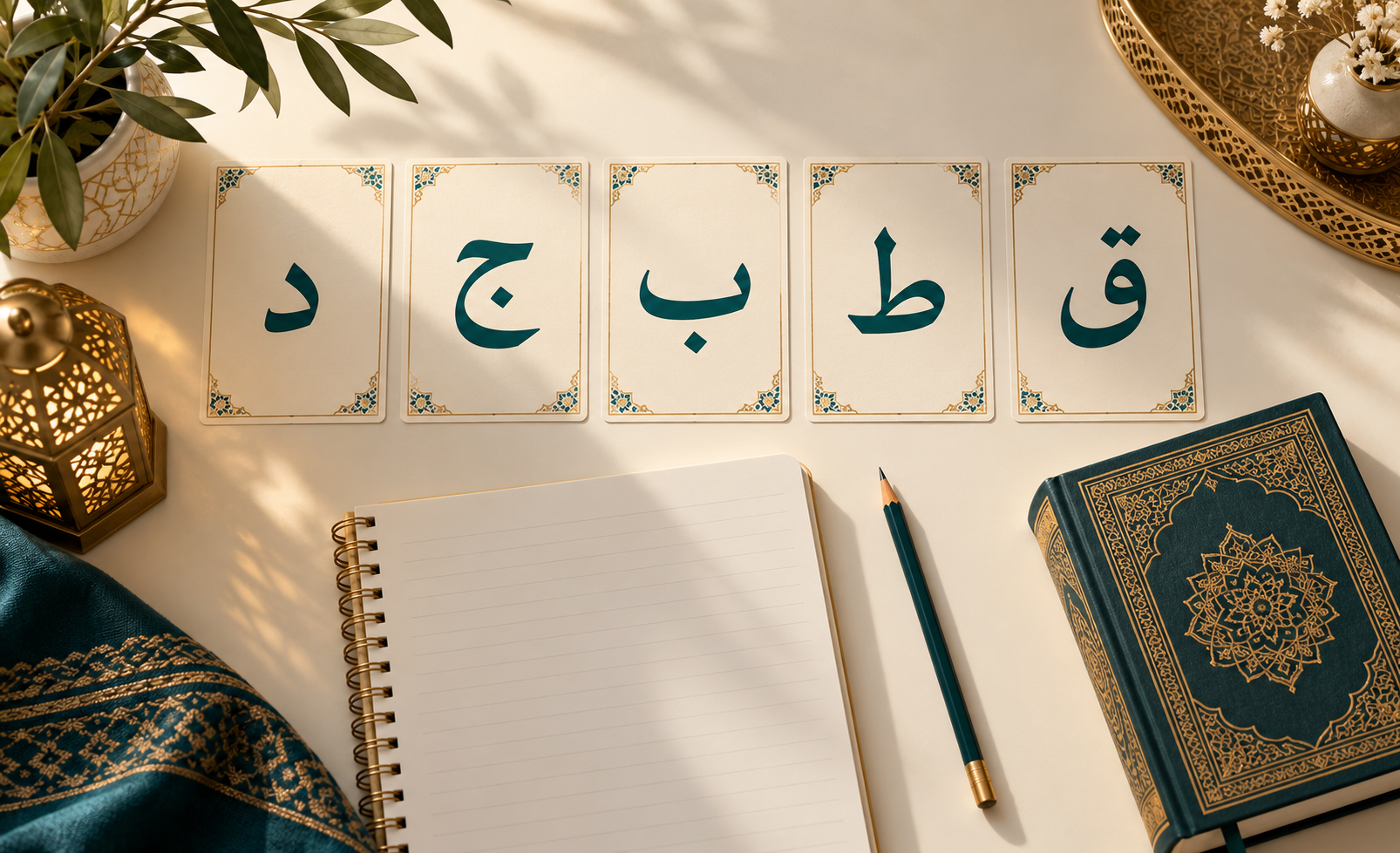
The qalqalah letters are ق، ط، ب، ج، د, remembered through قطب جد. Learn when their sound needs a controlled release, how stopping changes the rule, and how to practice without adding an extra vowel.
What Are the Qalqalah Letters?
The five qalqalah letters are Qaf (ق), emphatic Ta (ط), Ba (ب), Jim (ج), and Dal (د). Qalqalah becomes audible when one of these letters is sakin—without a vowel—either during recitation or because you stop on it.
The mnemonic قطب جد, commonly written in English as Qutb Jad, helps you remember the group.
| Arabic letter | Letter name | Important distinction |
|---|---|---|
| ق | Qaf | Different from Kaf: ك |
| ط | Emphatic Ta | Different from ordinary Ta: ت |
| ب | Ba | Articulated using the lips |
| ج | Jim / Jeem | Keep its correct articulation during the release |
| د | Dal / Daal | Different from Dhal: ذ |
Learn to recognize these letters in connected Arabic words as well as individually. Knowing the list is the first step; applying it depends on the letter’s condition.
What Is Qalqalah in Tajweed?
Qalqalah is a brief, controlled release of sound that makes a sakin letter from this group clearly audible. It is often described to beginners as a “bounce” or “echo.”
The release follows the closure at the letter’s articulation point, known as its makhraj. It should clarify the consonant without turning it into another syllable.
For example, a final د should remain a clear Dal. Avoid turning it into “da,” “di,” or “du.”
A written explanation helps you identify the rule, but hearing a demonstration and receiving correction helps you judge the sound.
When Do You Apply Qalqalah?
Look for two conditions:
- The letter belongs to ق، ط، ب، ج، د.
- It is pronounced without a vowel at that point.
This can happen because the letter already has sukoon or because stopping makes the final letter sakin.

When the Letter Has an Original Sukoon?
In يَقْرَءُونَ from Quran 85:20, the قْ is sakin within the word. Its release remains light as recitation continues.
Do not pause after the Qaf or insert a new vowel between it and the following letter.
When Stopping Makes the Final Letter Sakin?
In أَحَدٌ from Quran 112:1, stopping removes the pronounced ending of tanween and leaves the final Dal sakin. Apply qalqalah to that Dal when stopping.
The stopping position matters. The presence of a qalqalah letter at the end of a word does not automatically mean the same sound applies during continued recitation.
When the Letter Has a Pronounced Vowel?
Do not add a separate bounce to a letter being pronounced with fathah, kasrah, or dammah.
Compare قَ with قْ: the first has a vowel; the second is sakin. This distinction is essential when identifying qalqalah letters in a passage.
Qalqalah Sughra and Kubra: What Is the Difference?
A useful beginner classification distinguishes lighter qalqalah during continued recitation from stronger qalqalah at a stop.
| Type | Situation | Example |
|---|---|---|
| Qalqalah Sughra | A sakin qalqalah letter during continued recitation | قْ in يَقْرَءُونَ |
| Qalqalah Kubra | Stopping on a final qalqalah letter | Final د when stopping on أَحَدٌ |
| Strongest stopping case | Stopping on a final qalqalah letter with shaddah | Final بّ when stopping on وَتَبَّ |
Qalqalah is most pronounced when stopping on a doubled final letter carrying shaddah.
Why Do Some Lessons List Three Types?
Some teaching systems separate the strongest stopping case into a third category, often called Qalqalah Akbar. Others discuss it within Kubra.
Names and subdivisions can differ between teaching materials. Focus on the practical distinction:
- A lighter release while continuing.
- A clearer release when stopping.
- The strongest case when stopping on a doubled final letter.
Follow your teacher’s terminology consistently while learning the sound.
Does Qalqalah Kubra Only Happen at the End of an Ayah?
No. The relevant condition is stopping on the letter, rather than simply reaching an ayah number.
Choose stopping places according to appropriate Waqf and Ibtida guidance. Do not stop at an unsuitable point just to demonstrate qalqalah.
Qalqalah Examples for All Five Letters
The examples below identify the target letter and whether the practice involves continuing or stopping.
| Letter | Quranic word or excerpt | Reference | What to notice |
|---|---|---|---|
| ق | يَقْرَءُونَ | 85:20 | Qaf has an original sukoon; continue through the word |
| ط | مُّحِيطٌ | 85:20 | Apply qalqalah to final Ta when stopping |
| ب | وَتَبَّ | 111:1 | Stopping on doubled Ba produces the strongest stopping case |
| ج | الْفَجْرِ | 97:5 | Jim has an original sukoon within the word |
| د | أَحَدٌ | 112:1 | Apply qalqalah to final Dal when stopping |
These examples occur in Surah Al-Buruj, Al-Masad, Al-Qadr, and Al-Ikhlas.
For الْفَجْرِ, the Jim remains sakin whether you continue or stop on the word; the final letter is Ra, which is not a qalqalah letter.
Practice note: The table identifies sounds to study. Ask your teacher to demonstrate each example in its verse context, especially when comparing stopping with continued recitation.
How to Pronounce Qalqalah Without Adding a Vowel
The goal is to make the consonant audible while preserving its identity.
Step 1: Establish the Letter’s Articulation
Begin with the correct makhraj.
If you confuse Qaf with Kaf or emphatic Ta with ordinary Ta, work on that distinction before increasing the strength of the release.
Step 2: Hear a Clear Demonstration
Listen to the target word in a reliable recitation.
Pay attention to the target consonant and what follows it. Compare an example within a word with an example at a stop.
Step 3: Repeat the Complete Word
Practice the target sound within the word rather than relying only on isolated letters.
This helps you maintain the connection to surrounding sounds and avoid inserting an extra syllable.
Step 4: Check Your Recitation
Recite to a qualified teacher and ask specific questions:
- Is the letter clearly audible?
- Am I adding a vowel?
- Is the release exaggerated?
- Am I keeping the correct articulation?
- Is the stopping sound stronger than the continuing example?
Noor Path Academy’s online Tajweed course includes live one-to-one recitation and correction, with qalqalah listed in its curriculum. 1-on-1 Online, Free Trial
Common Qalqalah Mistakes and How to Correct Them
Adding “Ah,” “Ee,” or “Oo”
A learner may make the consonant audible by attaching a recognizable vowel.
Correction: Slow down, hear the teacher’s model, and repeat the complete word. Check whether you have created an additional syllable.
Making Every Release Equally Strong
Using a stopping-style release inside a word can interrupt the flow.
Correction: Practice one continuing example and one stopping example side by side. Ask your teacher to assess the difference.
Losing the Letter at the End
The opposite problem is making the final consonant too weak to hear clearly.
Correction: Work on the closure and release at the correct articulation point. Avoid solving the problem by simply becoming louder.
Applying Qalqalah to the Wrong Letter
Ordinary ت is not part of the group, even though its English name resembles that of ط.
Correction: Learn the Arabic shapes ق، ط، ب، ج، د and locate them directly in the Mushaf.
Treating Shaddah as Two Separate Bounces
When stopping on وَتَبَّ, avoid splitting the doubled Ba into two separately echoed sounds.
Correction: Preserve the doubled consonant, then release it once at the stop under your teacher’s guidance.
Stretching Qalqalah Like Madd
Qalqalah is not a long vowel to hold for a memorized number of counts.
Correction: Keep the release brief and controlled. Study elongation separately under the rules of Madd.
A Simple Qalqalah Practice Routine
Use a short routine that moves from recognition to application:
- Recall the letters: Identify ق، ط، ب، ج، د without relying on English names.
- Find the condition: Check whether the target letter is sakin or becomes sakin at a stop.
- Listen: Hear the word in its verse context.
- Repeat: Practice slowly while preserving the surrounding sounds.
- Receive correction: Address one recurring error at a time.
- Apply the rule: Recite the passage again at a comfortable pace.
Keep a small practice record:
| Example | Error noticed | Next practice focus |
|---|---|---|
| يَقْرَءُونَ | Extra vowel after Qaf | Connect Qaf directly to the following sound |
| أَحَدٌ at a stop | Final Dal unclear | Correct closure and release |
| وَتَبَّ at a stop | Doubled Ba weakened | Preserve shaddah before releasing |
These are possible learning errors, not an assessment of every beginner.
How Qalqalah Fits into Broader Tajweed Learning
Qalqalah works alongside other recitation skills.
Recognizing harakat helps you distinguish a vowelled letter from a sakin one. Understanding shaddah helps you preserve doubled consonants. Learning stopping rules helps you know when a final letter changes its pronounced condition.
You do not need to memorize every technical term before practicing. Learn the relevant rule, hear it demonstrated, and apply it to manageable passages.
Get Feedback on Your Qalqalah
You may recognize the five letters correctly and still be unsure whether your release sounds natural.
A live teacher can listen for extra vowels, weak consonants, exaggerated releases, and incorrect stopping.
Noor Path Academy offers personalized lessons and flexible scheduling through its Quran Tajweed and recitation course. Book a free trial through the course page to discuss your recitation level and the sounds you want to improve. No credit card is required for the trial. 1-on-1 Online, Free Trial
Frequently Asked Questions
How many qalqalah letters are there?
There are five qalqalah letters: ق، ط، ب، ج، د. The mnemonic قطب جد helps you remember them. Learn their Arabic shapes as well as their names, then check the condition of each letter in a word before deciding whether an audible qalqalah release applies.
What does Qutb Jad mean in Tajweed?
Qutb Jad represents قطب جد, a memory aid containing the five letters. Its purpose here is to help you recall the group, rather than provide a Quranic quotation. Knowing the mnemonic is useful, but you also need to recognize sukoon and understand how stopping affects pronunciation.
Does qalqalah apply whenever these letters appear?
No. Do not add a separate bounce to every occurrence of Qaf, Ta, Ba, Jim, or Dal. Check whether the letter is pronounced sakin at that point. A vowelled letter during continued recitation has a different condition from the same letter made sakin by stopping.
What is the difference between Qalqalah Sughra and Kubra?
Sughra describes the lighter release associated with a sakin letter during continued recitation. Kubra describes the stronger stopping case. Stopping on a final doubled letter produces the strongest case. Some teaching systems give that case a separate name, so follow your teacher’s classification while learning the practical difference.
Does qalqalah always require a printed sukoon?
No. An original sukoon may be visible in the word, but stopping can also make a final letter sakin even when the printed text shows a vowel or tanween. Read the notation together with the stopping context rather than looking only for a sukoon symbol.
Should I add a vowel after a qalqalah letter?
Avoid adding a distinct fathah, kasrah, or dammah. The release should make the consonant audible without creating an extra syllable. If your recitation sounds like it ends in “da,” “di,” or “du,” ask your teacher to demonstrate the word and check your repetition.
Is qalqalah held for two counts?
Qalqalah is a brief consonant release, rather than an elongation rule measured like Madd. Do not stretch it into a sustained vowel. Practice the appropriate release with a teacher, particularly when stopping on a doubled letter, and keep it distinct from rules involving prolonged sounds.
Is the letter ت one of the qalqalah letters?
No. The group includes ط, the emphatic Ta, rather than ت, ordinary Ta. Similar English spellings can cause confusion, so memorize the Arabic letters themselves. Correct articulation also matters: applying a release cannot compensate for replacing one consonant with a different letter.
Can I learn qalqalah from recordings alone?
Recordings help you hear examples and prepare for practice. They do not assess whether your own recitation contains an extra vowel, weak release, or articulation error. Combine listening with feedback from a qualified teacher, then use the corrected examples for independent review.
Which surahs can I use to practice qalqalah?
Short passages from Al-Ikhlas and Al-Masad provide useful stopping examples, while Al-Buruj includes original-sukoon and stopping cases. Choose a small passage with your teacher. Practice it in context and follow appropriate stopping guidance rather than pausing anywhere a qalqalah letter appears.