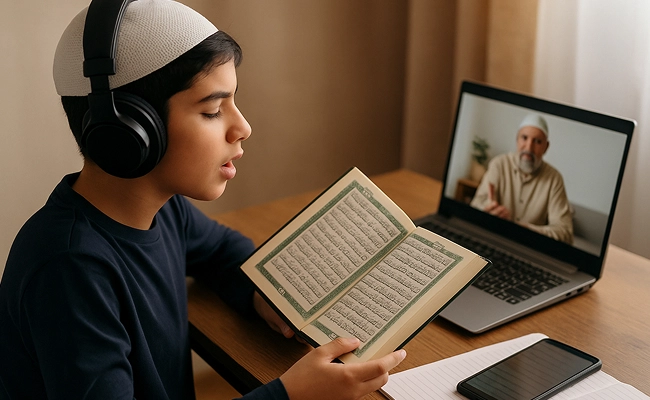
As parents, we dream of our children carrying the light of the Quran in their hearts. The journey of Hifz (memorizing the Quran) is one of the most profound spiritual goals we can encourage. But let’s be honest, it can also feel daunting. You see the long path ahead and wonder, “How can I make this journey smoother and more joyful for my child? Is there a secret to help them remember?”
The truth is, while dedication and technique are vital, the most powerful tool in your arsenal is something deeply spiritual: Dua. It’s the direct line to Allah (SWT), the source of all knowledge. Many parents ask us at NoorPath Academy, “What dua is used to memorize the Quran?” It’s a beautiful question, and it gets to the very heart of this blessed endeavor.
This article is our heartfelt answer. We’ll explore not just which duas to recite, but why turning to Allah is the cornerstone of successful memorization. We’ll share practical tips from our experience teaching hundreds of children in our online Quran memorization programs and show you how to blend spiritual practice with effective learning strategies. This isn’t just about memorizing words; it’s about opening the heart to receive them.
The Importance of Memorizing the Quran in Islam
Before we dive into the specific duas, it’s essential to connect with the “why.” Why is this journey so cherished in Islam? Understanding the immense reward and honor associated with Hifz fuels our motivation and purifies our intentions. It transforms the task from a mere memory exercise into a profound act of worship.
The status of a Hafiz (one who has memorized the Quran) is elevated in this life and, more importantly, in the Hereafter. The Prophet Muhammad (peace and blessings be upon him) gave us beautiful glimpses into this honor.
Hadith about Virtues of Memorizing Quran
The rewards are not just personal; they extend to the family. Imagine the honor on the Day of Judgment. The Prophet (ﷺ) said:
“It will be said to the companion of the Quran: Recite and rise in status, recite as you used to recite in the world, for your status will be at the last verse that you recite.” (At-Tirmidhi, Abu Dawud)
Think about that for a moment. Every verse your child memorizes elevates their rank in Jannah. It’s a direct, measurable path to a higher station with Allah. This isn’t about competition; it’s about striving for the best possible place in the Hereafter. In our online hifz classes, we often remind students that each verse is a step up a beautiful ladder to Paradise.
Furthermore, the one who carries the Quran in their heart is likened to the noblest of angels. The Prophet (ﷺ) said:
“The likeness of the one who reads the Quran and memorizes it is that he is with the righteous honorable scribes. The likeness of the one who reads it and tries hard to memorize it even though it is difficult for him, he will have two rewards.” (Al-Bukhari)
This Hadith is a source of immense comfort. It tells us that the effort itself is rewarded. For the child who struggles, who repeats a verse again and again, there is a double reward: one for the recitation and one for the struggle. It’s a journey where every step, easy or hard, is blessed.
Memorizing the Quran is also a means of preserving the Deen. It makes the heart a vessel for Allah’s words, protecting it from corruption. As parents in the West, we know the constant pull of dunya. Giving our children the Quran is giving them an anchor, a guiding light that will stay with them long after we are gone.
The Power of Dua in Seeking Knowledge
Now, you might be wondering, “How does saying a prayer actually help with memory?” It’s a fair question. The power of dua goes far beyond wishful thinking. It is an act of worship that acknowledges our complete dependence on Allah (SWT). It’s us, as humble servants, admitting that true success, focus, and retention come only from Him.
Quranic Verses and Hadiths Encouraging Seeking Knowledge
Islam is a faith built on knowledge. The very first word revealed was “Iqra!” (Read!). Allah (SWT) constantly encourages us to learn and reflect. He says in the Quran:
“…Allah will raise those who have believed among you and those who were given knowledge, by degrees. And Allah is Acquainted with what you do.” (Surah Al-Mujadila, 58:11)
And the Prophet (ﷺ) made seeking knowledge an obligation, telling us that Allah makes the path easy for those who seek it. Dua is the key that unlocks that ease.
Why Does Dua Strengthen Memory and Focus?
Let’s be practical. When a child sits down for their quran memorization classes, their mind can be buzzing with thoughts of video games, friends, or what happened at school. It’s completely normal. Dua acts as a spiritual reset button. Here’s how:
- It Purifies Intention (Niyyah): Before reciting a dua, you naturally pause and remember why you’re doing this. It’s for Allah. This pure intention (niyyah) is the foundation of any accepted deed and brings immense barakah (blessing) into the effort.
- It Fosters Humility: Making dua is an admission that we can’t do it alone. This humility opens the heart to receive. Pride and arrogance are barriers to knowledge, while humility is the gateway.
- It Reduces Anxiety: The pressure to memorize can be stressful for a child. Turning to Allah and placing their trust in Him (Tawakkul) calms the heart and reduces the anxiety that often blocks memory. A calm mind is a receptive mind.
- It Seeks Divine Assistance: Ultimately, memory is a gift from Allah. Through dua, we are asking the Giver of all gifts to grant us a strong, retentive memory. We are asking Him to clear the fog from our minds and illuminate our hearts with His words.
So, when we explore the question, “What dua is used to memorize the Quran?“, we’re not just looking for a set of words. We are looking for a state of being—a state of humble, focused reliance on Allah.
What Dua Is Used to Memorize the Quran?
So, let’s get to the core question. While there are many powerful supplications, there isn’t one single “magic” dua. Rather, it’s a collection of beautiful prayers, each serving as a key to unlock a different aspect of learning. When parents ask us, “What dua is used to memorize the Quran?“, we encourage them to build a habit of supplication, using different duas at different times.
Commonly Recited Dua Before Studying or Memorizing
A beautiful and comprehensive dua to make a habit before any study session, whether it’s for an online quran memorization course or school homework, is this:
اللَّهُمَّ انْفَعْنِي بِمَا عَلَّمْتَنِي، وَعَلِّمْنِي مَا يَنْفَعُنِي، وَزِدْنِي عِلْمًا
Allahumman-fa’ni bima ‘allamtani, wa ‘allimni ma yanfa’uni, wa zidni ‘ilma.
“O Allah, benefit me with what You have taught me, teach me what will benefit me, and increase me in knowledge.”
This dua is wonderfully holistic. It’s not just asking for knowledge; it’s asking for beneficial knowledge. It’s a prayer that what your child learns will be a source of good for them in this life and the next. It shifts the focus from simply passing a test to truly internalizing and benefiting from the sacred words of the Quran.
Example: “رَبِّ زِدْنِي عِلْمًا” (O my Lord, increase me in knowledge)
Perhaps the most famous and concise dua for knowledge comes directly from the Quran itself. It’s the prayer Allah taught the Prophet Muhammad (ﷺ) to say:
رَّبِّ زِدْنِي عِلْمًا
Rabbi zidni ‘ilma.
“My Lord, increase me in knowledge.” (Surah Ta-Ha, 20:114)
The beauty of this dua is its simplicity and power. It’s easy for even a very young child to memorize and recite. It’s a direct, humble plea to the ultimate source of all knowledge. Encouraging your child to say this before they open the Quran is a powerful habit that instills a lifelong reliance on Allah for learning.
Other Recommended Supplications from Scholars and Tradition
Scholars and righteous predecessors have shared many other supplications that are powerful for this purpose. Here is another beautiful dua that specifically asks for ease in memorization:
اللَّهُمَّ إِنِّي أَسْأَلُكَ فَهْمَ النَّبِيِّينَ، وَحِفْظَ الْمُرْسَلِينَ، وَإِلْهَامَ الْمَلَائِكَةِ الْمُقَرَّبِينَ
Allahumma inni as’aluka fahman-nabiyyeen, wa hifdhal-mursaleen, wal-ilhamal-mala’ikatil-muqarrabeen.
“O Allah, I ask You for the understanding of the Prophets, the memory of the Messengers, and the inspiration of the close angels.”
This dua sets a high aspiration. It asks Allah not just for memory, but for the deep understanding and retention that was granted to His most beloved servants. It’s a way of connecting your child’s small effort to the grand tradition of divine revelation and preservation. The answer to “What dua is used to memorize the Quran?” is often found in these prayers that broaden our perspective and elevate our goals.
Additional Duas and Quranic Verses for Memory and Understanding
Beyond the initial duas for starting a study session, there are others that address specific needs like clarity, focus, and overcoming difficulty. Integrating these into your child’s routine can provide comfort and strength at every stage of their quran memorization course.
Dua of Prophet Musa (AS): “رَبِّ اشْرَحْ لِي صَدْرِي…” (Surah Ta-Ha 20:25–28)
When Prophet Musa (AS) was given the monumental task of confronting Pharaoh, he made a beautiful and comprehensive dua for strength and clarity. This dua is perfect for any student facing a challenge, whether it’s a difficult Surah or a feeling of being overwhelmed.
رَبِّ اشْرَحْ لِي صَدْرِي وَيَسِّرْ لِي أَمْرِي وَاحْلُلْ عُقْدَةً مِّن لِّسَانِي يَفْقَهُوا قَوْلِي
Rabbish-rahli sadri, wa yassir li amri, wahlul ‘uqdatam-min lisani, yafqahu qawli.
“My Lord, expand for me my breast [with assurance], and ease for me my task, and untie the knot from my tongue, that they may understand my speech.” (Surah Ta-Ha, 20:25-28)
Let’s break this down for a parent:
- “Expand for me my breast”: This is a plea for confidence and relief from anxiety. It’s asking Allah to open the heart and remove any feelings of tightness or fear.
- “Ease for me my task”: A direct request to make the difficult easy. It’s perfect for when a child feels stuck on a particular set of verses.
- “Untie the knot from my tongue”: This is about fluency and clear recitation. It’s a prayer to be able to recite the Quran beautifully and correctly, which is the goal of any Quran Tajweed Online course.
Duas for Increasing Wisdom and Focus
Sometimes the challenge isn’t memory, but focus. In our hyper-connected world, a wandering mind is a common struggle. This dua is excellent for seeking clarity and warding off distraction.
اللَّهُمَّ لا سَهْلَ إِلاَّ مَا جَعَلْتَهُ سَهْلاً، وَأَنْتَ تَجْعَلُ الْحَزْنَ إِذَا شِئْتَ سَهْلاً
Allahumma la sahla illa ma ja’altahu sahla, wa ‘anta taj’alul-hazna ‘idha shi’ta sahla.
“O Allah, there is no ease except in that which You have made easy, and You make the difficult, if You wish, easy.”
This dua instills a profound sense of Tawakkul (reliance on Allah). It reminds the student that even the most difficult passage can become easy by Allah’s will. It’s a powerful mindset shift from “This is too hard” to “Allah can make this easy for me.”
Duas Narrated from Scholars and Students of Knowledge
Here is another gem, a heartfelt plea to make the Quran the center of one’s life. It’s less about the mechanics of memory and more about the spiritual connection.
اللَّهُمَّ اجْعَلِ الْقُرْآنَ رَبِيعَ قَلْبِي، وَنُورَ صَدْرِي، وَجَلَاءَ حُزْنِي، وَذَهَابَ هَمِّي
Allahumma-ja’alil-Qur’ana rabi’a qalbi, wa noora sadri, wa jala’a huzni, wa dhahaba hammi.
“O Allah, make the Quran the spring of my heart, the light of my chest, the remover of my sadness, and the reliever of my anxiety.”
Teaching your child this dua helps them see the Quran not as a textbook to be memorized, but as a companion, a source of comfort, and a healing for the soul. This is the ultimate goal of any Islamic education, whether it’s Hifz or an islamic studies online course.
Practical Tips for Memorizing the Quran
Dua is the soul of the Hifz journey, but it needs to be paired with a body of practical, consistent effort. At NoorPath Academy, we’ve seen that the most successful students are those who combine spiritual reliance with a smart, structured approach. Here’s what we’ve noticed works best for families in the West.
- Consistency Over Quantity: It’s far better to memorize two verses a day, every day, than to memorize two pages once a week. Create a dedicated “Quran time” that fits your family’s schedule, even if it’s just 15-20 minutes. Consistency builds momentum and makes memorization a natural part of the daily rhythm, just like brushing teeth.
- The Power of Repetition: There’s a famous method where you read a new verse 20 times, then the next verse 20 times, then both together 20 times. It might sound like a lot, but it works! Repetition moves information from short-term to long-term memory.
- Understand Before You Memorize: Memory hooks onto meaning. Before your child starts memorizing a new passage, take a few minutes to read the translation and discuss the story or message. What is Allah telling us here? When a child connects with the meaning, the verses become a story, not just a string of words. This makes the process more engaging and the memory more durable.
- Listen, Listen, Listen: Have your child listen to a recording of their favorite Qari (reciter) reciting the verses they are memorizing. They can listen in the car, while getting ready for bed, or during quiet playtime. This attunes their ear to the correct pronunciation (Tajweed) and rhythm, making memorization much easier.
- The Three-Part Method: New, Recent, and Old: A successful Hifz plan has three components every day:
- New Lesson (Sabq): The new verses for the day.
- Recent Revision (Sabaqi): The verses memorized over the last 7 days. This is crucial for consolidation.
- Old Revision (Manzil): A larger chunk of what has been memorized in the past. This keeps the entire memorized portion fresh.
- Find the Right Teacher: Let’s be honest, as parents, we can’t do it all. A dedicated, experienced teacher provides structure, accountability, and expert correction. A good teacher in a Quran Memorization Online Course can spot Tajweed mistakes you might miss and knows how to motivate a child when they feel stuck. They become a mentor and a guide on this beautiful journey. This is why one-on-one instruction is so effective; it’s tailored to your child’s unique pace and learning style.
Combining these practical steps with the spiritual power of asking, “What dua is used to memorize the Quran?” and then reciting it, creates a powerful formula for success, Insha’Allah.
Spiritual Etiquette Before and After Memorization
The act of memorizing the Quran is an act of worship. Approaching it with the right adab (etiquette) invites more blessings and makes the experience more spiritually fulfilling for both you and your child.
Purify Intentions (Niyyah) for Allah’s Sake
Before each session, take a moment to renew your intention. Remind yourself and your child that you are doing this solely for the pleasure of Allah, not for praise, competition, or worldly status. A pure intention is the secret ingredient that multiplies the reward of any action.
Make Wudu and Find a Quiet Place
Performing wudu (ablution) before handling or reciting the Quran is a sign of respect for Allah’s words. It physically and spiritually prepares the student for their sacred task. Find a clean, quiet, and dedicated space for memorization, free from the distractions of screens and noise. This signals to the brain and the heart that it’s time to focus on something special.
Begin with Dua and End with Gratitude
Start every session by raising your hands and making one of the duas we’ve discussed. Ask Allah for ease, understanding, and acceptance. When the session is over, no matter how much or how little was accomplished, end by saying “Alhamdulillah.” Thank Allah for the opportunity to engage with His book. This gratitude fosters a positive attitude and ensures that every session, productive or challenging, ends on a note of worship.
Common Challenges and How Dua Helps Overcome Them
The path of Hifz is not always a straight line. There will be bumps along the way. We know juggling work, school pickups, and Islamic education feels overwhelming at times. Acknowledging these challenges is the first step to overcoming them, and dua is the ultimate source of strength.
- The Challenge of Forgetting: It’s completely normal to forget. The Prophet (ﷺ) himself described the Quran as being “faster to run away than camels from their tying ropes.” When your child feels frustrated by forgetting, remind them to make dua and ask Allah to help them retain what they’ve learned. The dua “Allahumma inni astawdi’uka ma hafiztu…” (O Allah, I entrust to You what I have memorized…) is beautiful for this.
- Waning Motivation: Enthusiasm can dip. When this happens, reconnect with the “why.” Read the hadiths about the virtues of a Hafiz. But most importantly, make dua. “O Allah, renew the love of the Quran in my child’s heart.” Dua can reignite the spark when it feels like it’s fading.
- Lack of Time: This is a huge one for families in the West. It can feel like there aren’t enough hours in the day. Here, dua is for barakah (blessing) in your time. Ask Allah, “O Allah, put barakah in our time, and make our small efforts fruitful.” You’ll be amazed how a sincere dua can make a 20-minute session feel more productive than an hour of distracted effort. This is also where the flexibility of Quran hifz online programs can be a lifesaver, allowing you to schedule classes around your busy life.
For every challenge, the answer begins with turning back to Allah. This teaches our children a vital life lesson: no problem is too big to take to the Lord of the Worlds.
In Conclusion: Your Partner in Memorization
The question “;What dua is used to memorize the Quran?” opens the door to a beautiful realization: the journey of Hifz is powered by our connection to Allah. It’s a partnership between our effort and His divine assistance. By teaching our children these powerful duas, we are giving them more than just a memory aid; we are giving them a lifelong tool for seeking help, finding comfort, and building a relationship with their Creator.
Memorizing the Quran is a marathon, not a sprint. There will be days of triumph and days of struggle. On all those days, let dua be your constant companion. Pair it with consistent effort, a positive attitude, and the support of a good teacher, and you will be giving your child a gift that will illuminate their heart in this life and elevate their status in the next, Insha’Allah.
FAQs
What is the dua for memorizing the Quran?
While there are many, a powerful and commonly recited dua is Rabbi zidni ‘ilma from Surah Ta-Ha. Another comprehensive one is Allahumman-fa’ni bima ‘;allamtani, wa ‘allimni ma yanfa’uni, wa zidni ‘ilma . The key is to make supplication a consistent habit.
How to memorize the Quran quickly?
While speed shouldn’t be the only goal, quick memorization comes from a combination of factors: a strong intention, consistency, minimizing distractions, and using a proven method like repetition and revision. Most importantly, making dua for barakah in your time can make your efforts more fruitful. A structured quran memorization course with an experienced teacher can also significantly accelerate progress by providing accountability and expert guidance.
Which dua is for increasing memory?
A specific dua for strengthening memory is Allahumma inni as’;aluka fahman-nabiyyeen, wa hifdhal-mursaleen…. Also, consistently reciting Rabbi zidni ‘ilma is a direct plea to Allah to increase the faculties of knowledge, which includes memory.
How to memorize the Quran in old age?
It is absolutely possible! The key is patience, consistency, and a positive mindset. The Hadith about the one who struggles having a double reward is especially encouraging for older learners. Focus on understanding the meaning, as this aids memory. Listen to recitation frequently. Most importantly, lean heavily on dua, asking Allah to make it easy. Many older students find great success and fulfillment in our flexible online hifz classes, where they can learn at their own pace with a supportive teacher.