
✦ Hifz – Course Details
Online Quran Memorization Course Master Hifz from Home
A structured, personalized Hifz Quran program designed for busy students in the USA, UK, and Europe. Learn 1-on-1 with expert Arab tutors who speak fluent English.
- Flexible scheduling (study at your own pace)
- Certified Al-Azhar tutors with fluent English
- Proven Hifz methodology (500+ graduates)
No credit card required

500+
Students
Avg Rating
Certified
What Students Say About Our Hifz Course

Which learning path is right for you or your child?
Multiple specialized learning tracks
Qur'an Recitation, Tajweed, Islamic Studies, and Arabic — each tailored to your level.
Native certified teachers with Ijazah
Learn from qualified native teachers with years of experience and formal certification.
Structured learning & clear progress
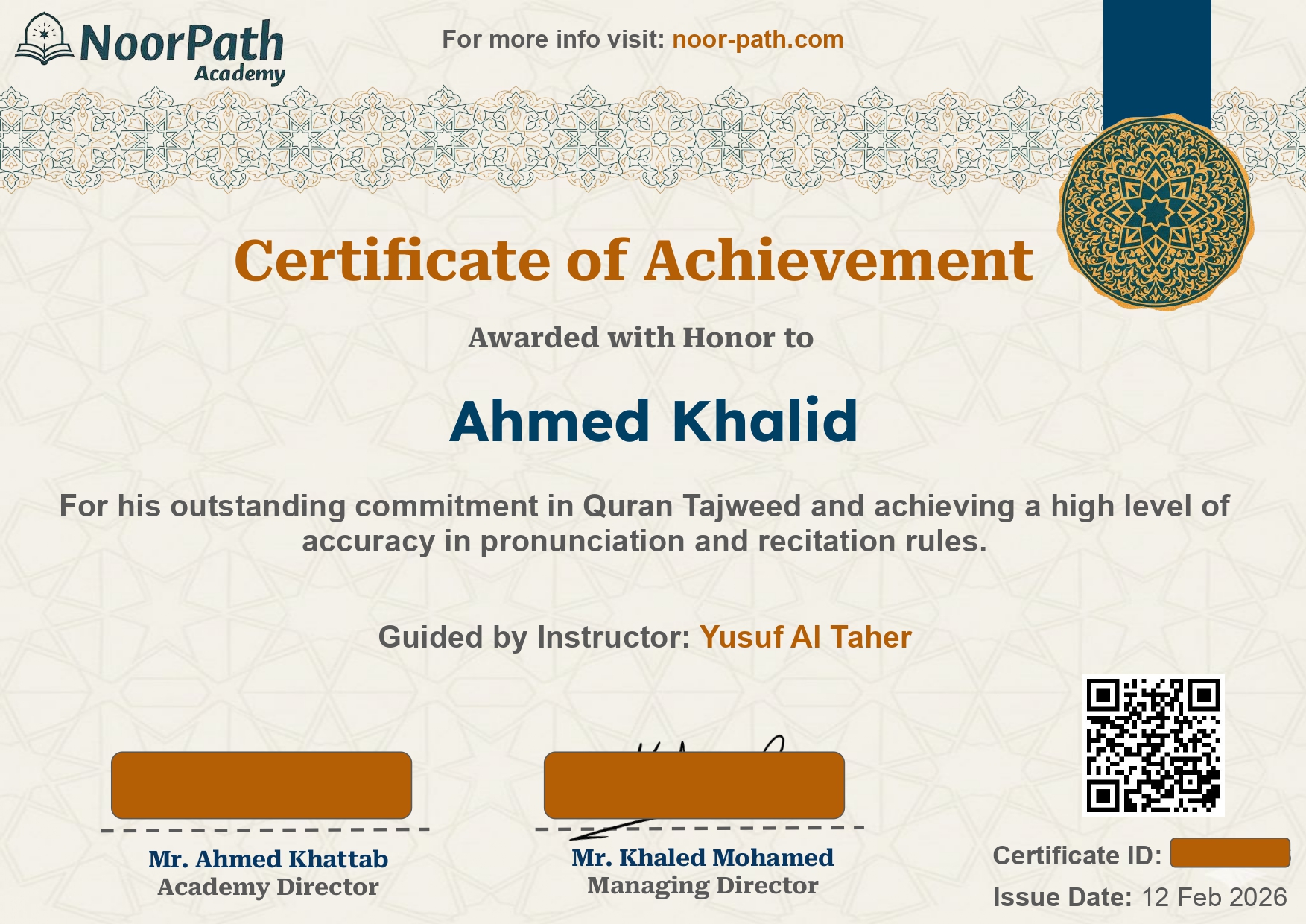
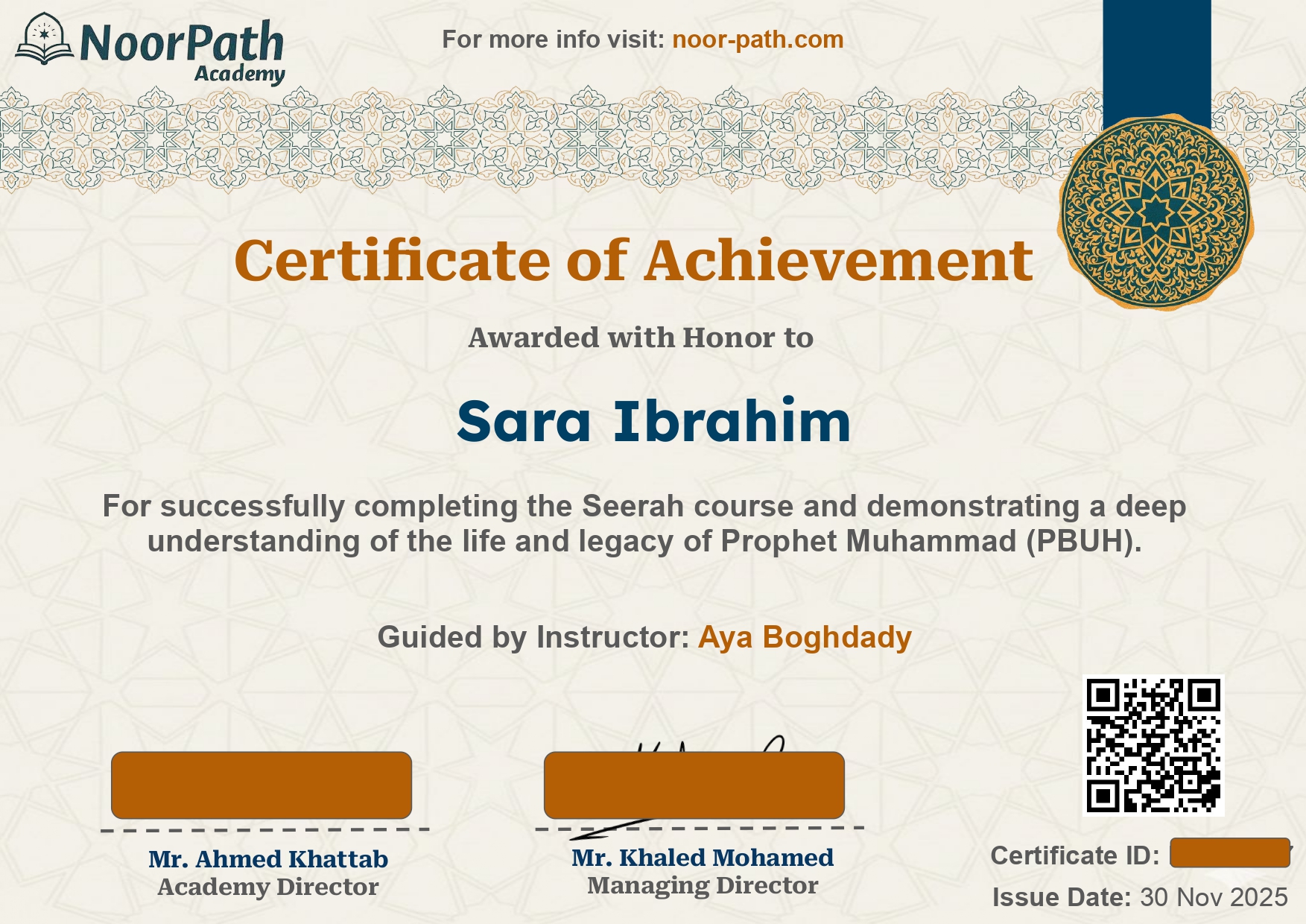
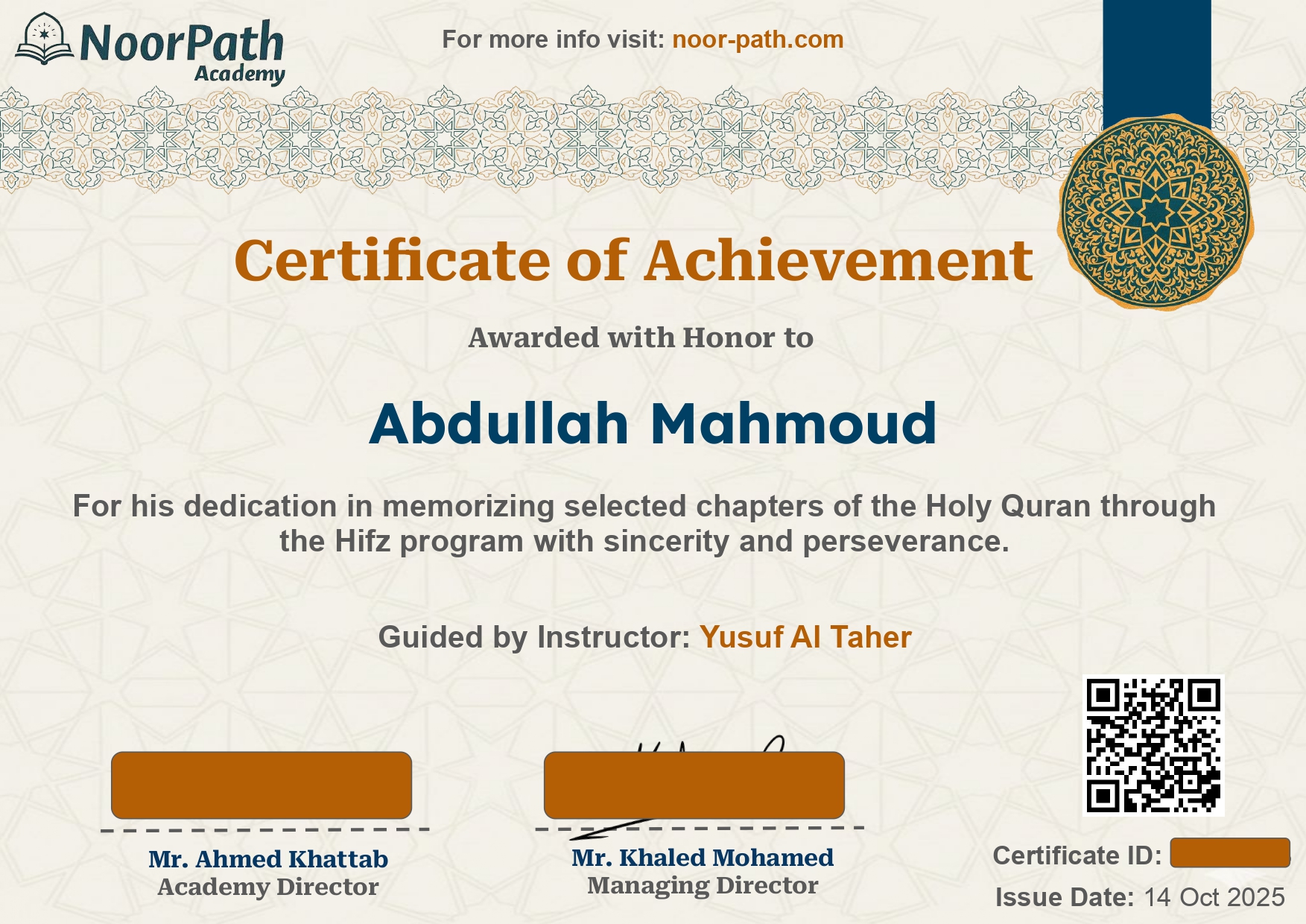
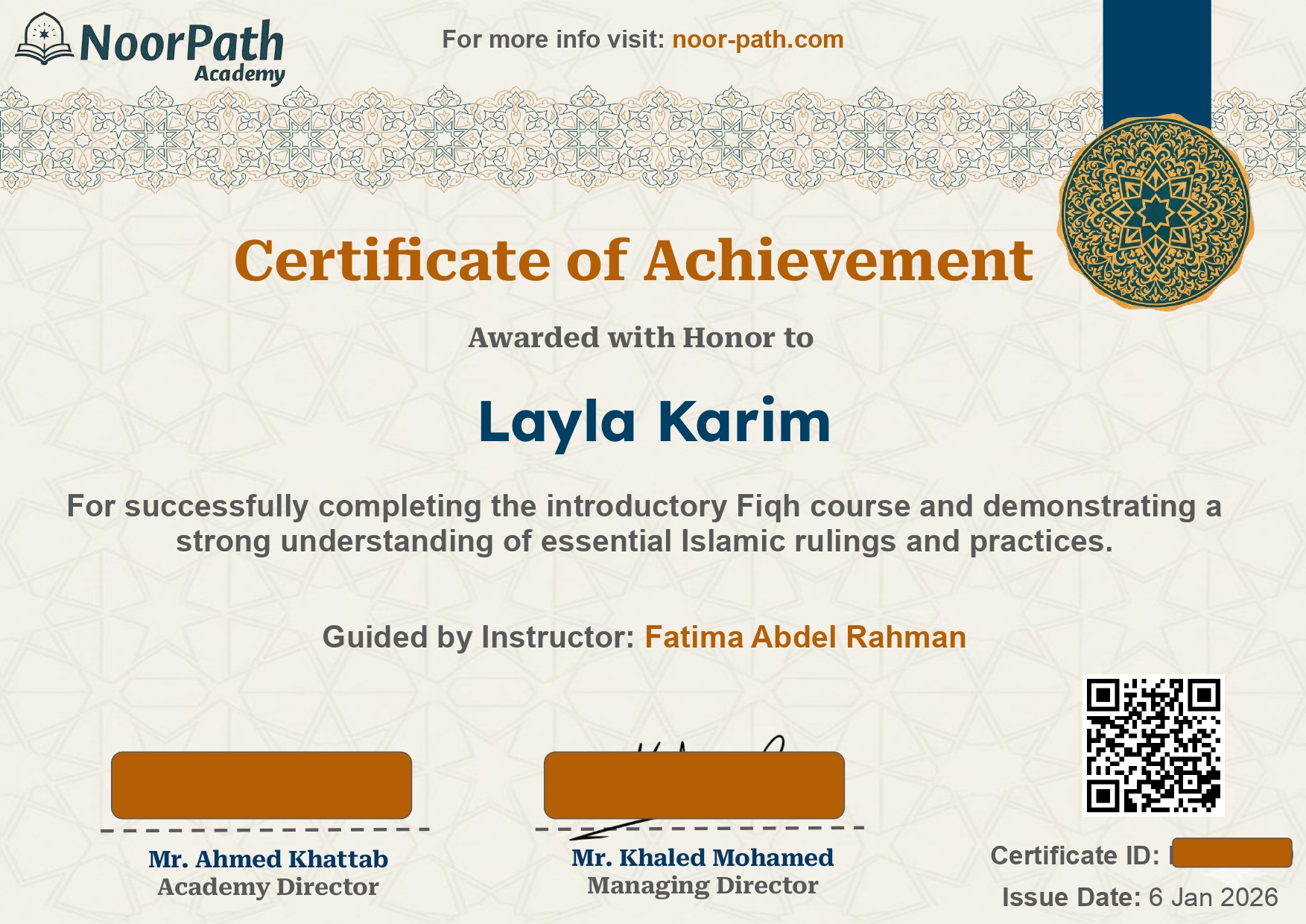
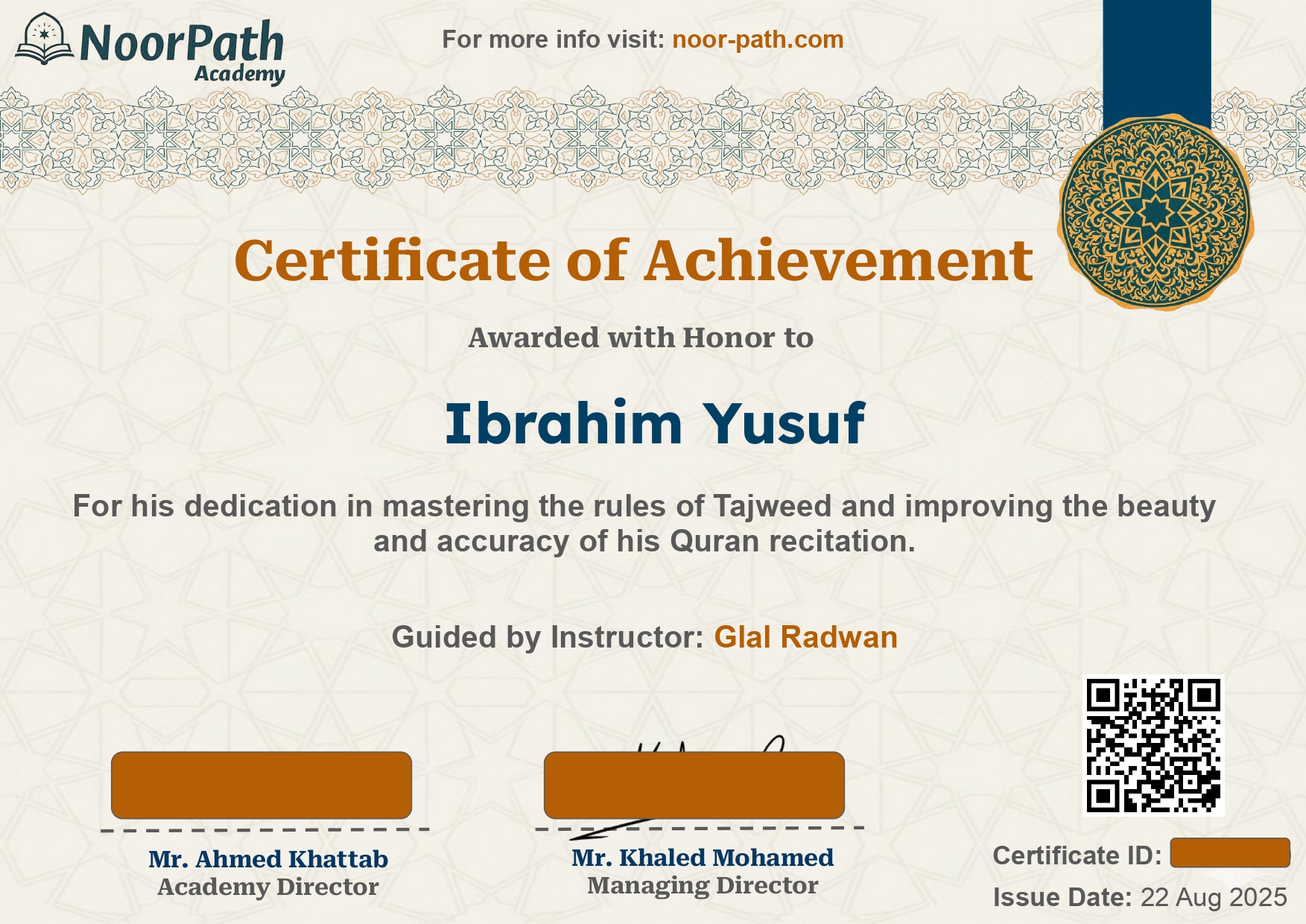
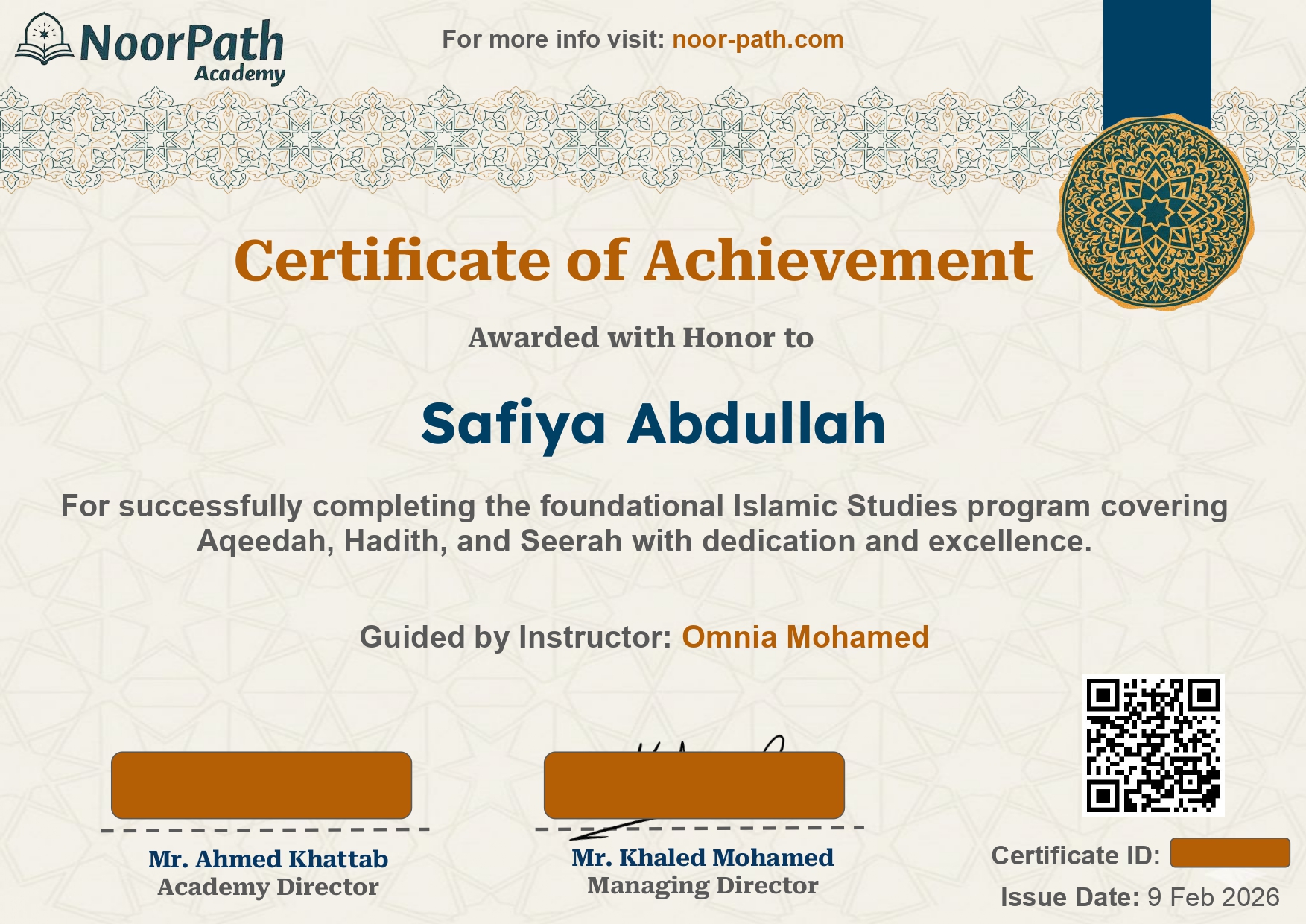
Clear levels, monthly progress reports, and a certificate upon completion.
Personalized one-to-one lessons
Individual attention and a learning plan built around your schedule and goals.
Course overview
Online Quran Memorization Course
- 500+ students enrolled worldwide
- Serving 42+ countries - UK, USA, Canada & more
- Certificate of completion included
- 5.0 rating on Trustpilot
What Is Hifz-ul-Quran? (Definition & Meaning)
Hifz (حفظ), from the Arabic root meaning “to preserve” or “to guard,” refers to the memorization of the Quran in its entirety, word for word, in the order it was revealed. A person who completes this journey is called a Hafiz (male) or Hafizah (female) — literally, “one who preserves.” Hifz is more than rote memorization; classical scholars describe it as combining three elements: correct pronunciation (Tajweed), accurate memorization (Hifz), and understanding and acting upon the meaning (Tadabbur).
If you’re searching for an online hifz course or trying to find a structured Quran memorization (Hifz) course for adults, it helps to know that authentic Hifz training has always relied on Talaqqi — direct, face-to-face transmission from a qualified teacher — rather than self-study alone. This is why a guided quran hifz classes online format with a live tutor, rather than pre-recorded videos, remains closest to the traditional method scholars have used for over 1,400 years.
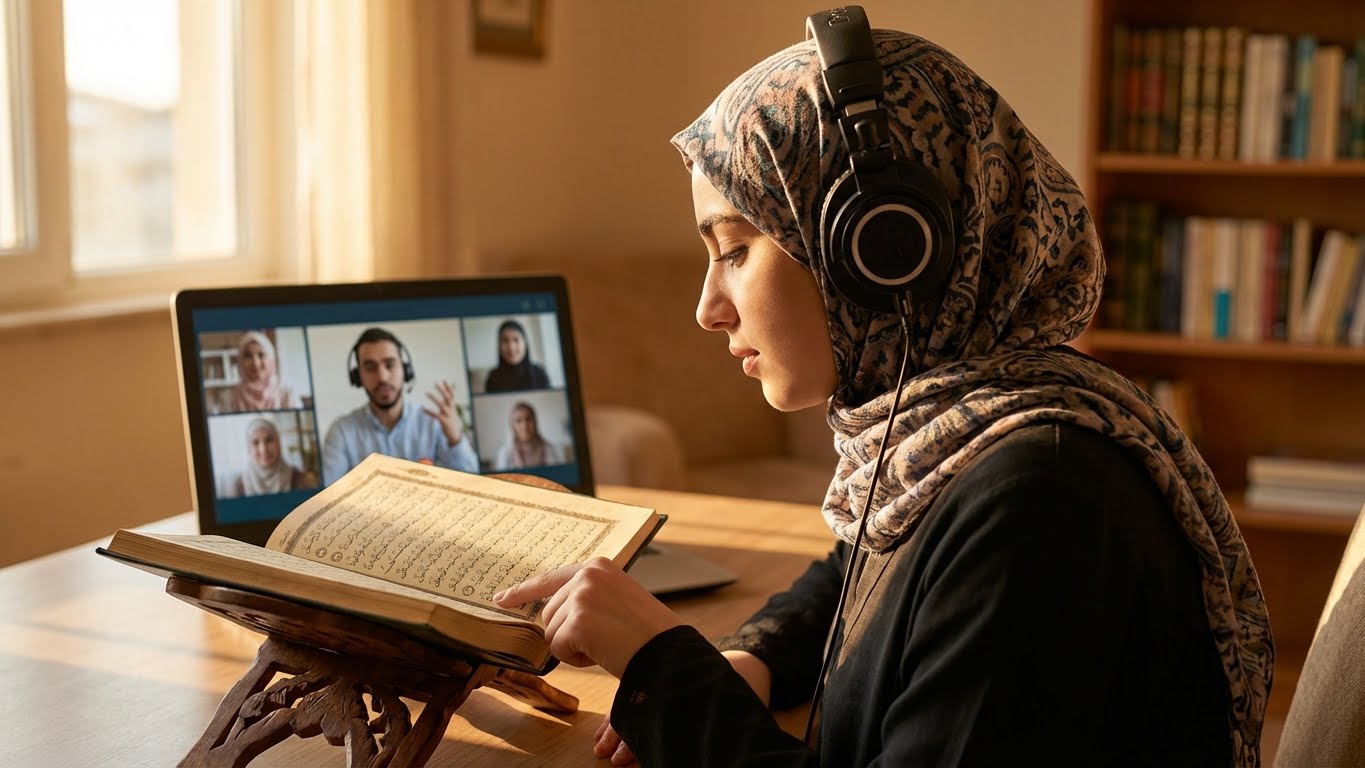
A Clear Path from Beginner to Hafiz
Whether you want to memorize the last Juz or the whole Quran, we have a plan for you
- Level 1: The Foundation (Tajweed & Juz Amma) Correct your recitation with expert tutors. We ensure your Tajweed is flawless before starting your Quran memorization journey to avoid unlearning mistakes later.
- Level 2: The Momentum (Selected Surahs) Build a strong Hifz Quran habit. Memorize key Surahs (Yasin, Al-Mulk, Al-Kahf) and Juz Tabarak while mastering rhythm and tone.
- Level 3: The Dedication (Full Hifz) Commit to the complete journey. Our structured revision schedule ensures you retain every Juz you learn using spaced repetition techniques.
- Level 4: Ijazah Mastery (Certification) For advanced students. Recite the entire Quran from memory to a Sanad-holding Sheikh and receive a formal Ijazah linked to the Prophet (SAW).

Common Mistakes Students Make When Memorizing Quran Alone
Many students attempting Hifz without a structured quran memorization course fall into a few predictable traps:
- Memorizing new Surahs without reviewing old ones — this is the single most common cause of forgetting previously memorized portions.
- Prioritizing speed over Tajweed accuracy — memorizing verses with mispronunciation locks in mistakes that become much harder to correct later.
- Skipping meaning (Tafseer) — verses that are understood are retained significantly longer than verses memorized as pure sound.
- Irregular, unscheduled practice — Hifz depends on consistency more than intensity; a shorter daily session beats a long, infrequent one.
A guided online quran hifz academy environment solves each of these by pairing every new page with review of prior pages, correcting Tajweed in real time, and holding students accountable to a fixed schedule.
Struggling with Quran Memorization on Your Own?
Living in the West offers opportunities, but finding quality Islamic education is a struggle. Many students attempt Hifz Quran alone but face these common barriers:
You don’t need more time. You need a better system. Noor Path fits your life, not the other way around.
You don’t need more time. You need a better system. Noor Path fits your life, not the other way around.
Steps to Achieve Perfect Tajweed & Memorization
Retain What You Learn Our “4R” Hifz Quran Methodology
We don’t just ask you to repeat; we teach you how to remember. Our Quran memorization technique ensures long-term retention.
1. Read (Correcting Tajweed)
We ensure your pronunciation is perfect before you start memorizing. No more unlearning mistakes later.
3. REFLECT (Tafseer & Meaning)
Hifz is 3x faster when you understand the meaning. We explain the context.
4. REVIEW (Spaced Repetition)
A strict revision schedule ensures you never move to a new Juz until the previous one is solid.
Quran Memorization Techniques Used Within Our 4R Method
The 4R Method — Read, Recite, Reflect, and Review — gives every student a clear structure for learning. Within that framework, NoorPath tutors use several practical Quran memorization techniques based on the student’s age, current level, available study time, and retention needs.
- Chunking: Instead of attempting an entire page at once, the student divides it into short sections of one to three lines. Each section is corrected, repeated, and memorized before it is connected to the next.
- Guided repetition: The student listens to the correct recitation, reads the selected verses with the tutor, and repeats them until pronunciation and word order become stable.
- One-Mushaf consistency: Students are encouraged to use the same Mushaf edition throughout their Hifz journey. Keeping the same page layout can strengthen visual familiarity with the location of verses.
- Ayah linking: Rather than memorizing every verse in isolation, the tutor helps the student connect the ending of one Ayah to the beginning of the next. This reduces hesitation during longer recitation.
- Mutashabihat comparison: Similar verses are studied side by side so the student learns the small differences in wording, sequence, and context that can otherwise cause confusion during revision.
- Tafsir-linked memorization: The tutor explains the general meaning and context of the selected passage. Understanding how the verses connect gives the student additional cues for recall and supports reflection alongside memorization.
- Cumulative Muraja’ah: Previously memorized portions remain part of the weekly plan while new verses are added. This prevents new memorization from replacing material the student has already learned.
Among the most effective Quran memorization techniques, consistent revision remains essential. NoorPath tutors adjust the balance between new memorization and Muraja’ah according to the strength of the student’s previous portions. When earlier pages need reinforcement, the amount of new material is reduced until the foundation becomes stable.
Short, regular practice is generally more sustainable than attempting long sessions only once or twice a week. For this reason, every student receives a realistic plan that can be followed consistently at home as well as during live classes.

Why Choose Our Online Hifz Program?
By the end of this Hifz Course, you won’t just recite the Quran; you will carry it in your heart.
Unshakeable Memorization (Hifz)
You will develop a "photographic" memory of the Quran. Using our revision strategies, you will be able to recite any Surah fluently without stumbling, anytime, anywhere.
Flawless Tajweed Application
You won't just know the rules; you will apply them naturally. From Makharij (articulation points) to Sifaat (characteristics), your recitation will sound professional and melodious.
Spiritual Connection & Discipline
Building a Hifz habit creates structure in your chaotic life. Our students report better focus at work and a deeper spiritual connection in their Salah.
The Ultimate Goal: Ijazah Certification
For advanced students, we offer a pathway to a formal Ijazah linked to the Prophet (SAW). This is a recognized certification allowing you to teach others in the future.
The Virtue (Fadl) of Memorizing the Quran in Islam
Islam places extraordinary emphasis on learning and preserving the Quran. The Prophet Muhammad ﷺ said:
“The best among you are those who learn the Quran and teach it.” (Sahih al-Bukhari, Hadith 5027)
Scholars explain that this hadith honors both the learner and the teacher equally — meaning every student enrolled in an online hifz course is already participating in one of the most beloved acts of worship in Islam, not only those who eventually become teachers themselves.
Regarding the reward of the Hafiz in the Hereafter, it was narrated that the Prophet ﷺ said:
“It will be said to the companion of the Quran: Recite and rise in rank, and recite as you used to recite in the world, for your rank will be at the last verse you recite.” (Sunan Abi Dawud 1464; Jami’ at-Tirmidhi 2914 — graded hasan sahih by al-Tirmidhi and authenticated by al-Albani)
Scholars such as those cited by Islamqa.info clarify that “companion of the Quran” in this hadith refers specifically to one who memorizes the Quran and acts upon it — not merely one who reads it occasionally. This is an important, evidence-based distinction: the virtue is tied to sustained memorization and practice, not casual recitation, which is precisely what a structured Hifz program is designed to build.
(Note on scholarly nuance, included for accuracy: some scholars caution against over-literalizing “rank” as a numeric Paradise level, noting the hadith describes a general elevation in status tied to one’s relationship with the Quran, not a fixed hierarchy above all other good deeds such as jihad or charity. This should be presented as a level of status/nearness, not a competitive ranking against other believers.)
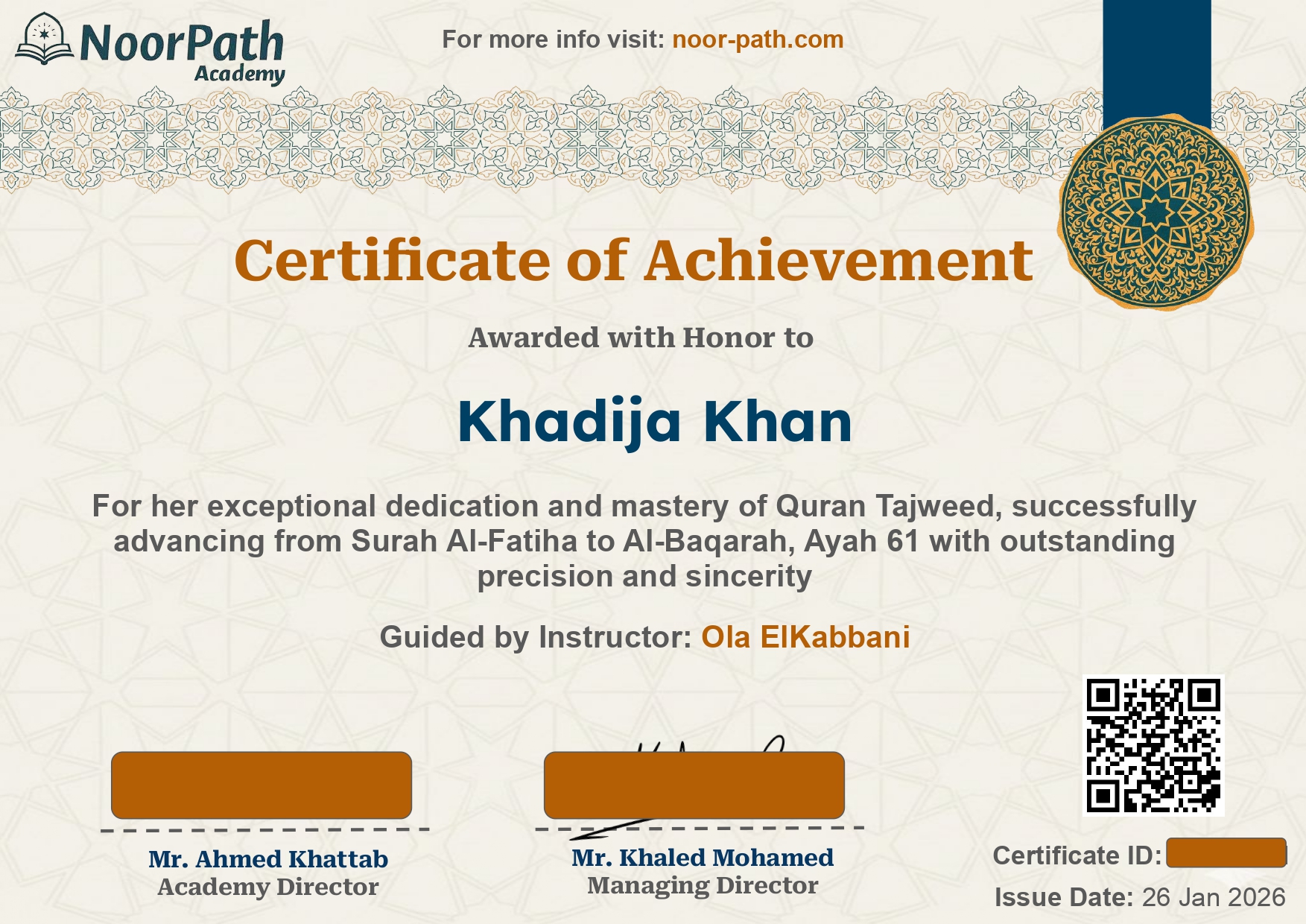
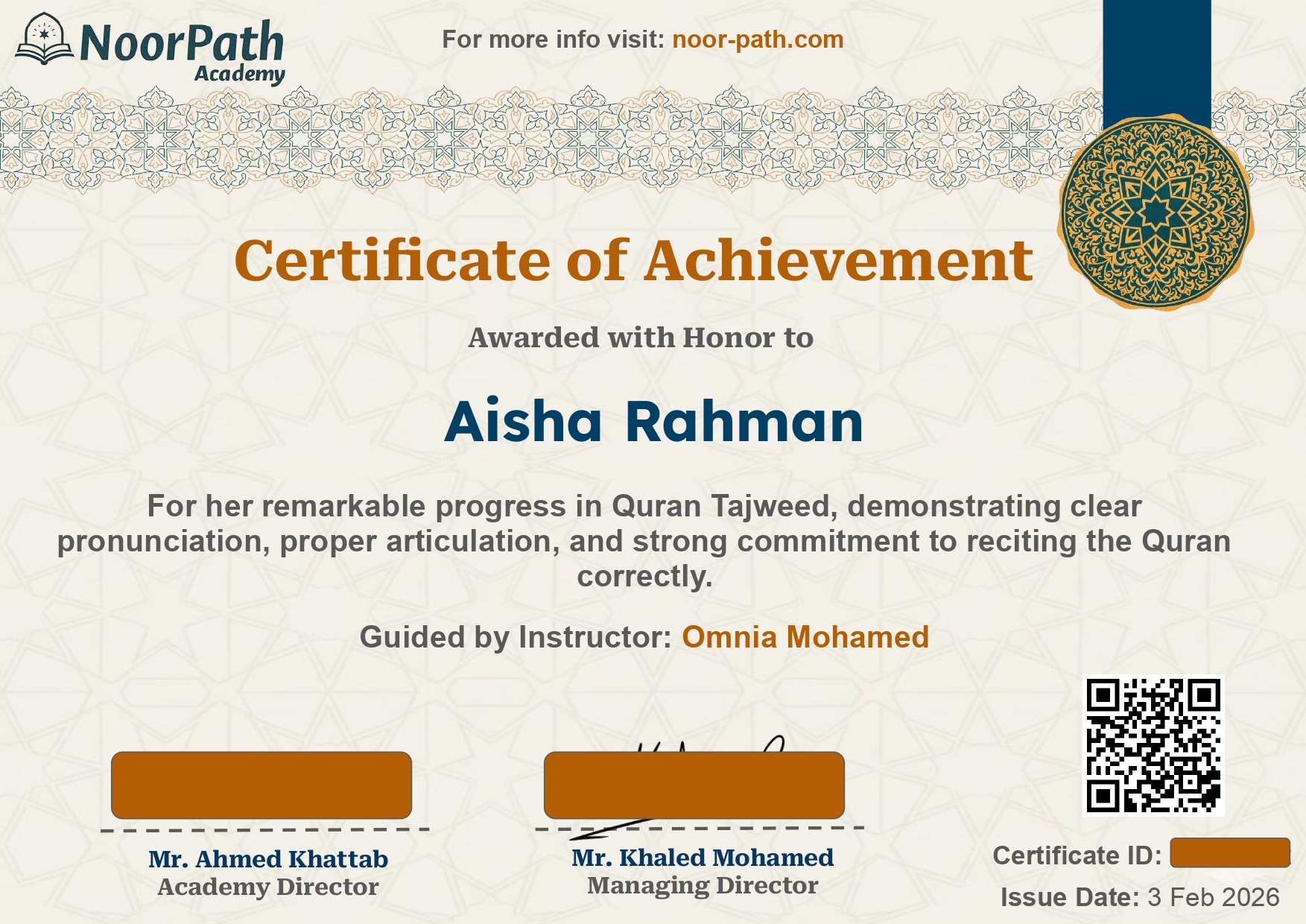
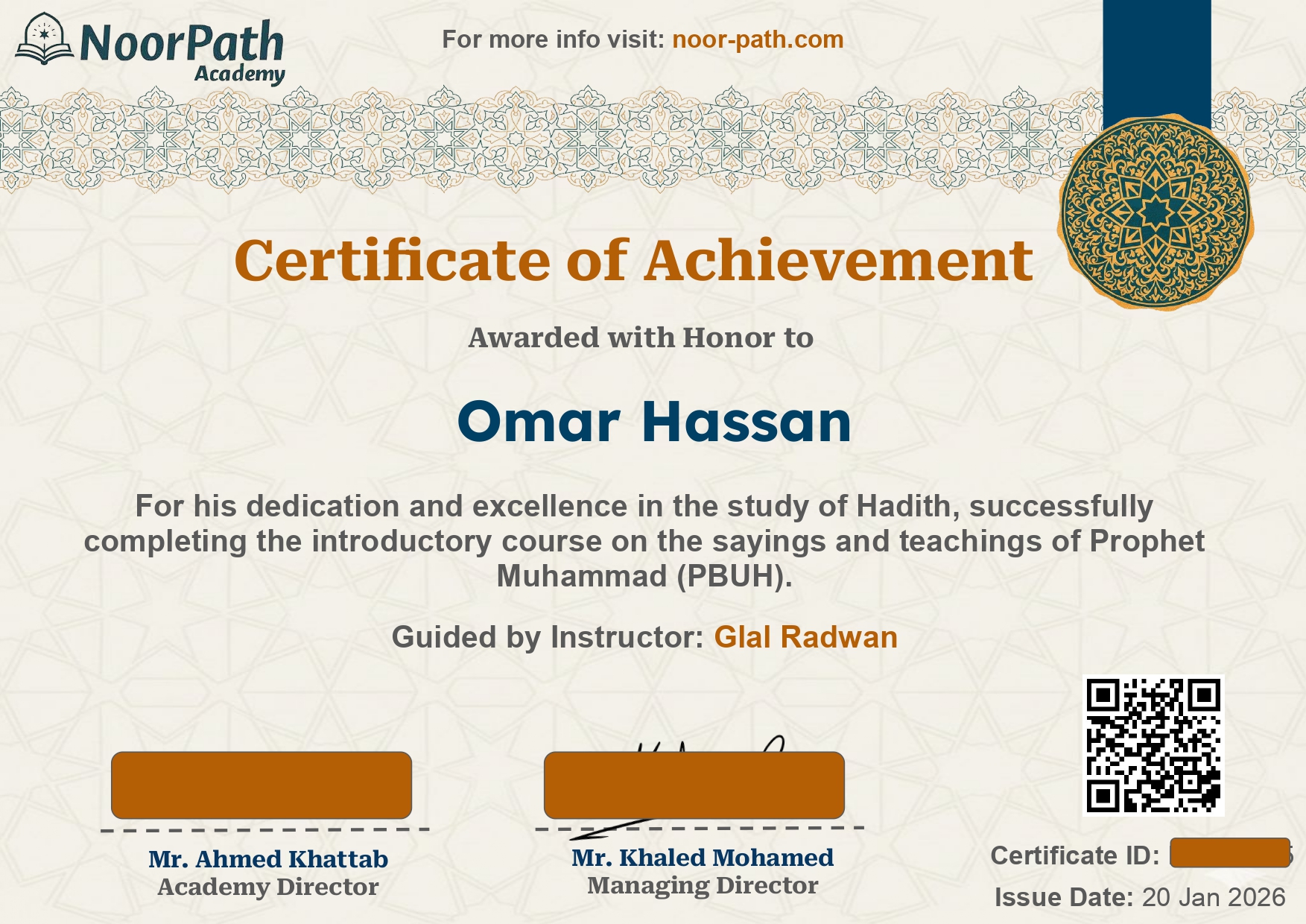
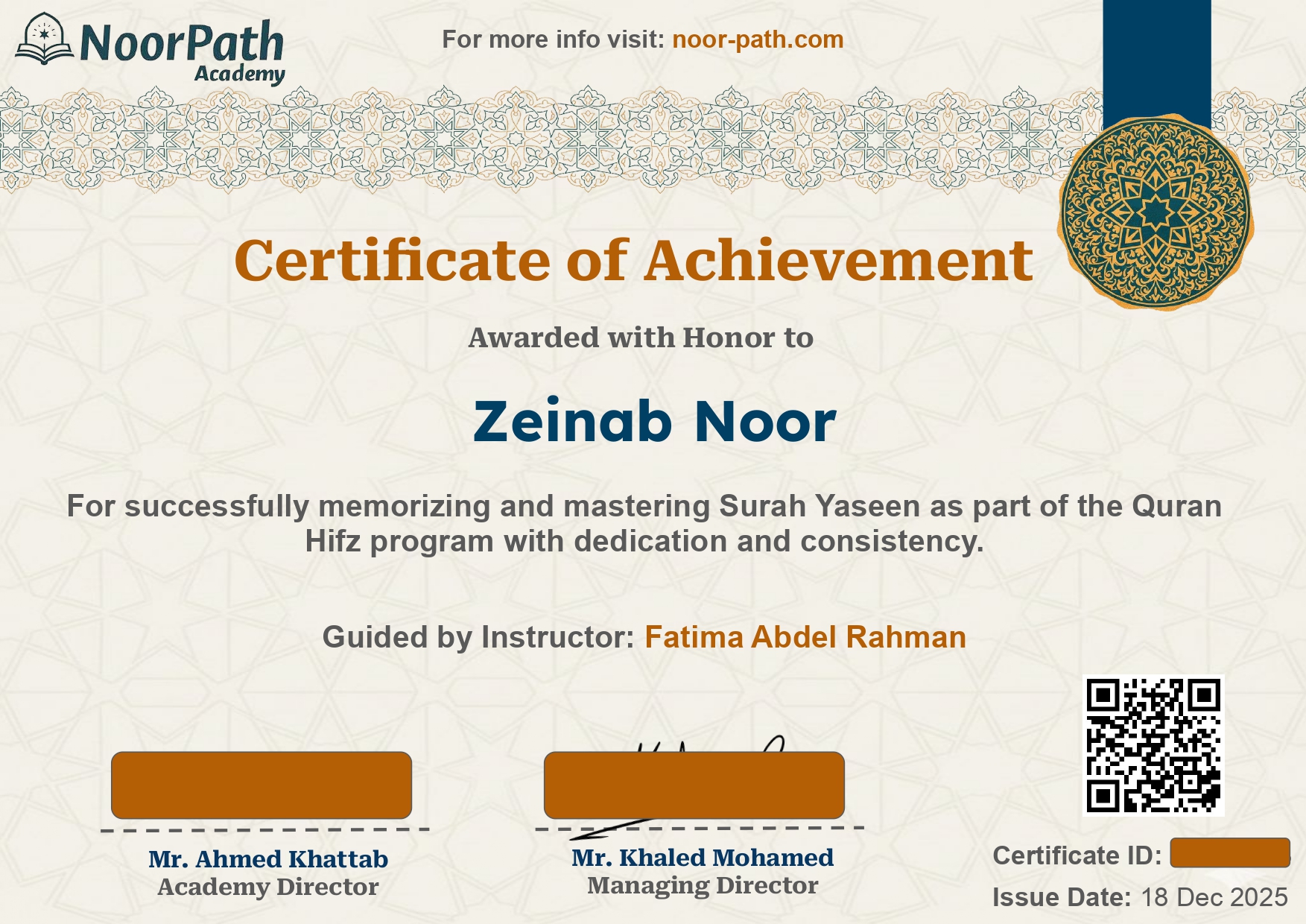
Detailed Hifz Curriculum: Step-by-Step to Mastery
Level 1 - The Foundation (Tajweed & Start)
• Stage 1: Tajweed & Pronunciation Foundation
Makharij Al-Huruf and correction of major recitation mistakes.
• Stage 2: Quran Memorization Basics
Memorization of Juz Amma using simple memory techniques.
• Stage 3: Recitation Mastery
Consolidating everything learned in Stages 1 and 2 through supervised, fluent recitation of Juz Amma, ensuring the student can recite without hesitation before advancing to Level 2.
Level 2 - The Momentum (Essential Surahs)
• Stage 1: Essential Surah Memorization
Memorizing frequently recited Surahs like Al-Mulk, As-Sajdah, and Yasin.
• Stage 2: Recitation Flow & Tone
Connecting Ayahs smoothly and improving rhythm and vocal control.
• Stage 3: Retention & Daily Hifz Habits
Using a 3-day review system to strengthen memorization and consistency.
Level 3 - The Dedication (Full Hifz)
• Stage 1: Full Quran Memorization Plan
Following a personalized Juz-by-Juz roadmap to complete the remaining Quran.
• Stage 2: Advanced Hifz Techniques
Mastering similar verses (Mutashabihat) and understanding meanings through basic Tafseer.
• Stage 3: Long-Term Revision & Completion
A cumulative revision cycle covering all previously memorized Juz alongside new material, using the spaced-repetition schedule to guarantee full-Quran retention by the end of Level 3.
Level 4 - Advanced Ijazah (Certification)
• Stage 1: Full Quran Recitation & Assessment
Reciting the entire Quran from memory to a certified Sheikh.
• Stage 2: Advanced Tajweed & Qira’at
Studying advanced Tajweed theory and introduction to different recitation modes.
• Stage 3: Ijazah & Teaching Preparation
Learning Hifz teaching methods and earning certification with a connected Sanad.
Understanding Quranic Signs Before Memorizing an Ayah
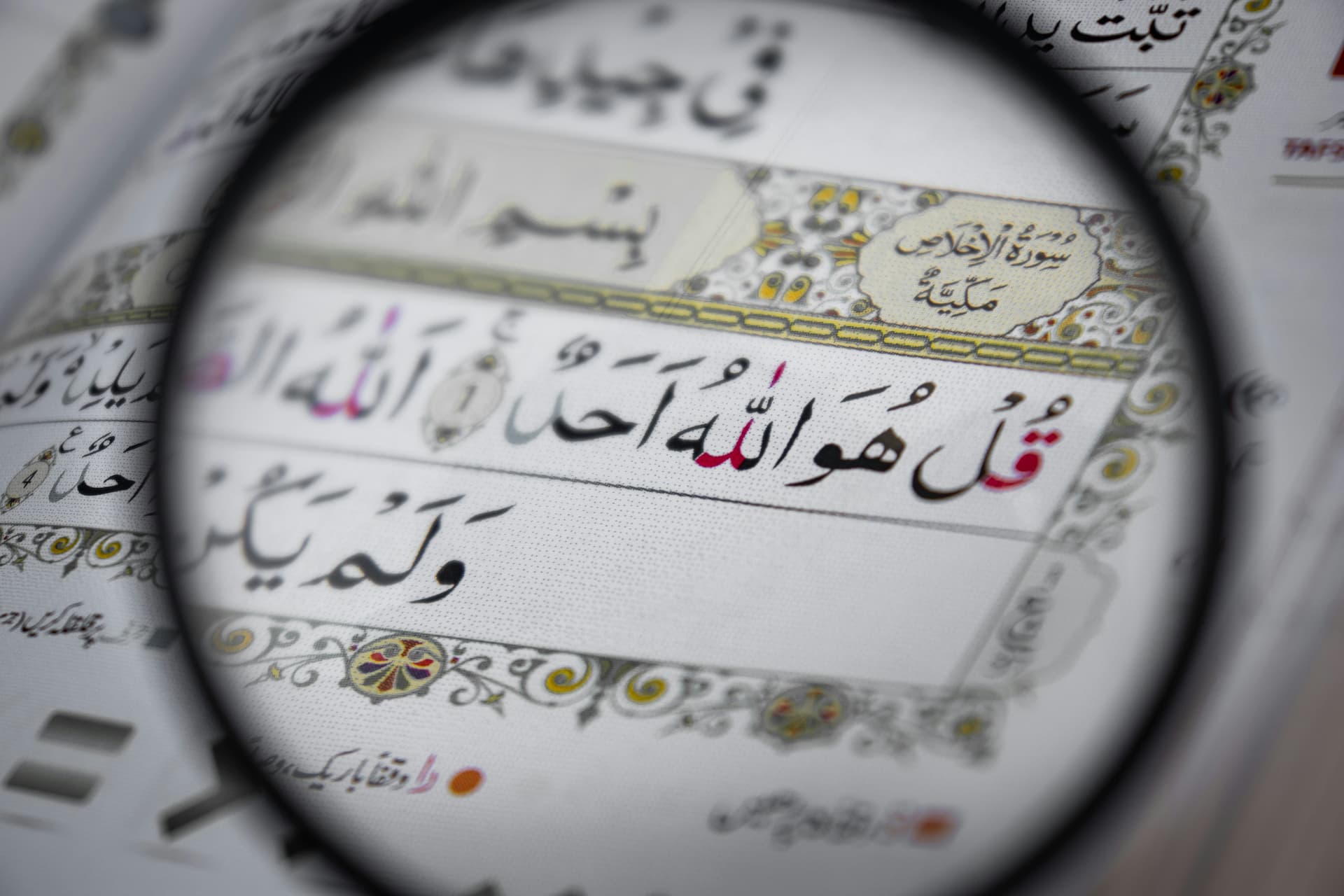
Successful Hifz requires more than remembering the written words. Students must also know where to pause, where to continue, and how to preserve the connection between phrases while reciting. This is why NoorPath’s Quran memorization training includes recognition of common Quranic signs alongside Tajweed, Makharij, and guided recitation.
Some common Waqf signs found in the Mushaf include:
- م — Waqf Lazim: Indicates a strongly required stopping point according to the Mushaf’s recitation notation. Continuing may disrupt the intended connection or meaning.
- لا — La Taqif: Indicates that the reader should not stop at this point because doing so can leave the meaning incomplete.
- ج — Waqf Jaiz: Indicates that both stopping and continuing are permissible.
- صلى — Al-Wasl Awla: Indicates that continuing the recitation is preferable, although stopping is allowed.
- قلى — Al-Waqf Awla: Indicates that stopping is preferable, although continuing is allowed.
- قف — Qif: An instruction or recommendation to stop at that point.
- ∴ ∴ — Waqf Al-Mu‘anaqah: Two paired sets of dots. The reciter may stop at either marked location but should not stop at both.
Learning these signs before fixing an Ayah in memory helps students memorize the passage with the correct pauses from the beginning. During live lessons, the tutor listens to each passage, identifies unsuitable stops, and helps the student connect the verses without obscuring their meaning.
This approach is especially important during longer Surahs, where an incorrect pause can make recitation sound incomplete even when every individual word has been memorized correctly.


What Is an Ijazah, and Why Does It Matter?
An Ijazah is a formal certification granted by a qualified teacher (Sheikh or Sheikha) confirming that a student has correctly recited the entire Quran, or a portion of it, from memory — with accurate Tajweed — directly to that teacher. What makes an Ijazah unique is the Sanad: an unbroken chain of transmission (Isnad) connecting the teacher, to their teacher, and so on, back through the generations to the Prophet Muhammad ﷺ himself.
This is why our program’s Ijazah is described as being “linked to the Prophet ﷺ” — it is not a diploma issued after a course, but a certification earned only after reciting the full Quran, from memory, to a Sanad-holding Sheikh, who personally verifies the recitation and formally authorizes the student to transmit it to others. Students researching the best online hifz program or comparing a noor hifz academy-style option against other providers should always ask two questions: (1) Does the teacher personally hold a verified Sanad, and (2) Is the Ijazah granted only after a full oral recitation to that teacher, not a written exam?
On the validity of Ijazah earned through live online sessions: the majority of contemporary scholars affirm that Talaqqi (direct teacher-student transmission) can be validly achieved through real-time video connection, since the essential conditions — the teacher hearing the student recite live and correcting errors in real time — are preserved. What is not considered valid Talaqqi is recitation submitted as a recording for later review, since it removes the immediate correction that defines traditional Quran transmission. This is a matter of scholarly consensus on the method, though individual scholars may differ on preferred platforms or verification procedures.
Memorize the Quran Online with Expert Tutors
Start your Hifz journey with expert, 1-on-1 online Quran memorization classes. Designed for brothers, sisters, and children.
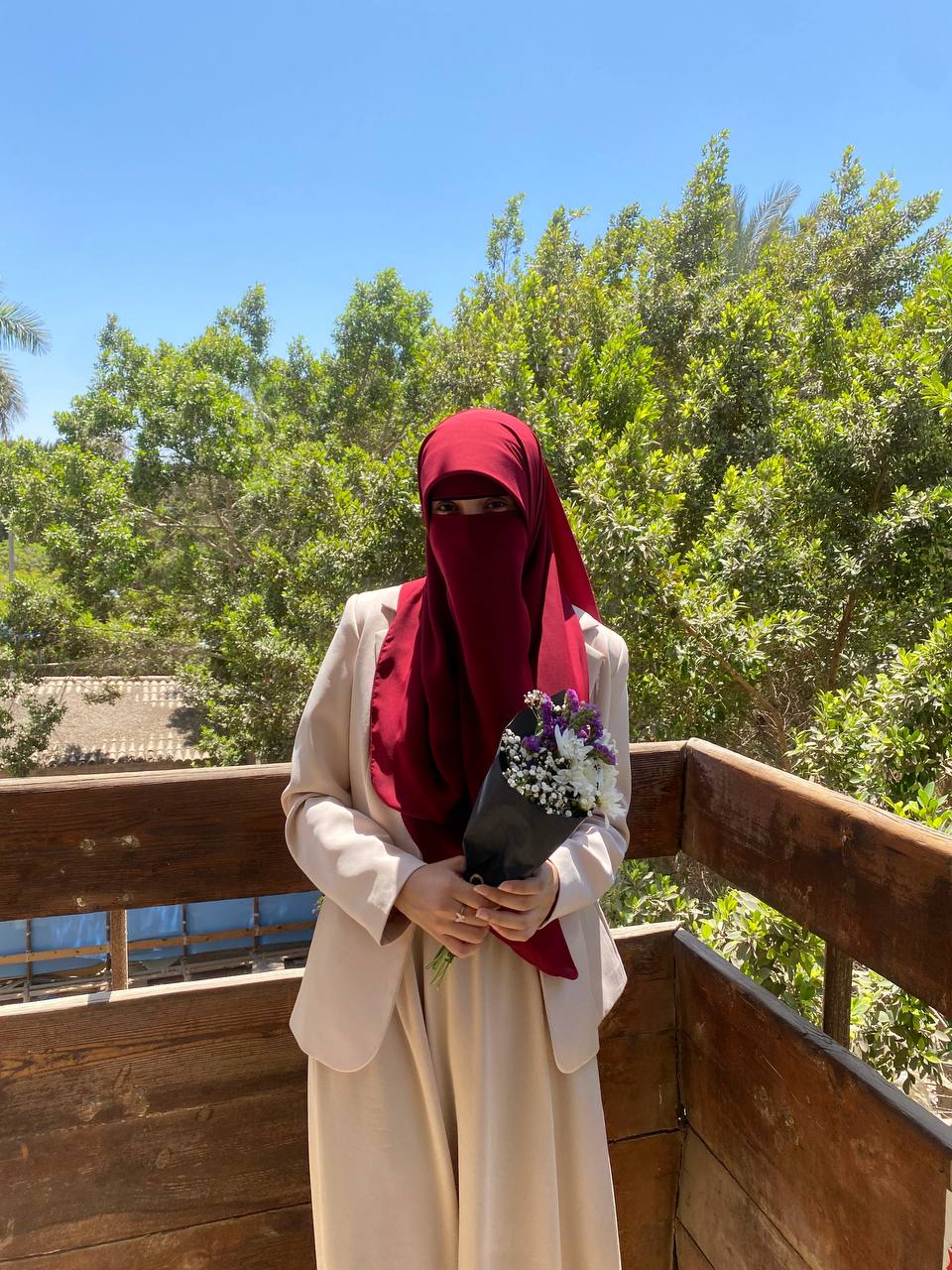
Fatima Abdul Rhman
5+ years
Qur’an Recitation (Tajweed)
Islamic Studies (Aqeedah, Seerah, General Islamic Knowledge
Fatima Abdul Rhman is a dedicated Qur’an and Islamic Studies teacher with over 5 years of teaching experience, working with both Arabic and read more…

Jalal Al-Ridwan
7+ years
Qur’an Recitation (Tajweed & Qira’at)
Qur’an Memorization (Hifz)
Islamic Studies (including Fiqh)
Jalal Al-Ridwan is a dedicated Qur’an and Islamic studies teacher from Egypt, with a strong academic foundation from Al-Azhar. He has been studying at read more…
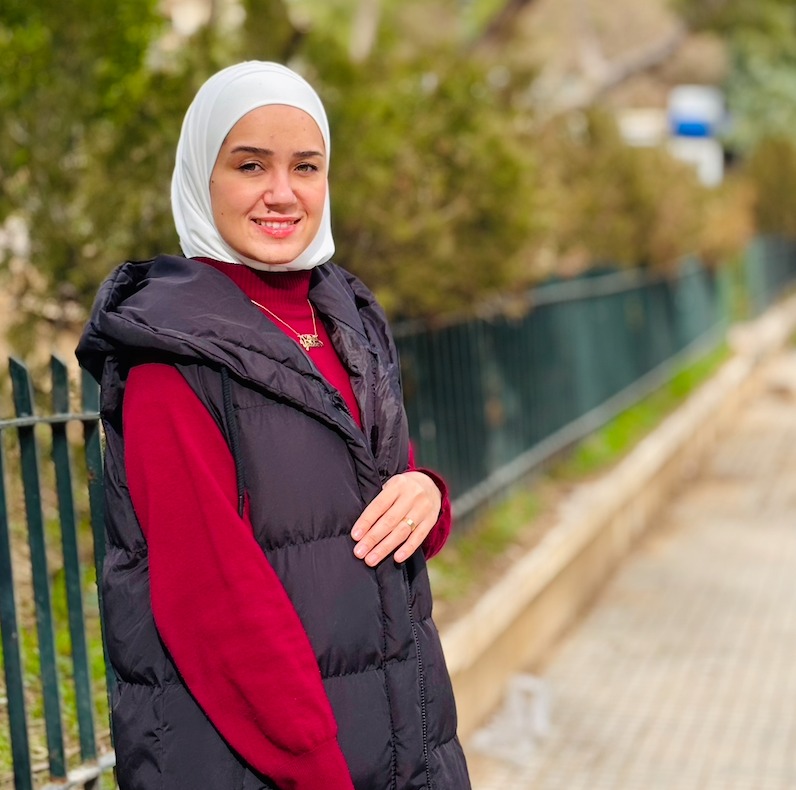
Aya Boghdady
3+ years
Islamic Studies (Aqeedah, Seerah, Hadith, General Islamic Knowledge)
Aya Boghdady is a passionate Islamic Studies instructor with over 3 years of teaching experience, dedicated to helping students understand their religion in a clear, practical, and meaningful way. read more…

Yusuf El Taher
5+ years
Qur’an Recitation (Tajweed)
Arabic Language
Islamic Studies
My name is Yusuf El Taher, and I am a dedicated educator at NoorPath Academy with over 5 years of experience teaching students from diverse read more..

Ola El Kabani
12+ years
Qur’an Recitation (Tajweed)
Qur’an Memorization (Hifz)
Ola El Kabani is a dedicated Qur’an teacher with over 12 years of teaching experience, with a strong focus on recitation, Tajweed, and memorization (Hifz). She is read more…

Ahmed Khatab
5+ years
Qur’an Recitation (Tajweed)
Islamic Studies
My name is Ahmed Khatab, and I am a committed Qur’an and Islamic Studies teacher at NoorPath Academy with over 5 years of teaching experience, read more…

Omnia Moahmed
4+ years
Qur’an Recitation (Tajweed)
Qur’an Memorization (Hifz)
Omnia Mohamed is a dedicated Qur’an and Tajweed teacher with over 4 years of teaching experience, working with both Arabic and non-Arabic speakers. She is passionate about helping students of all ages read more…
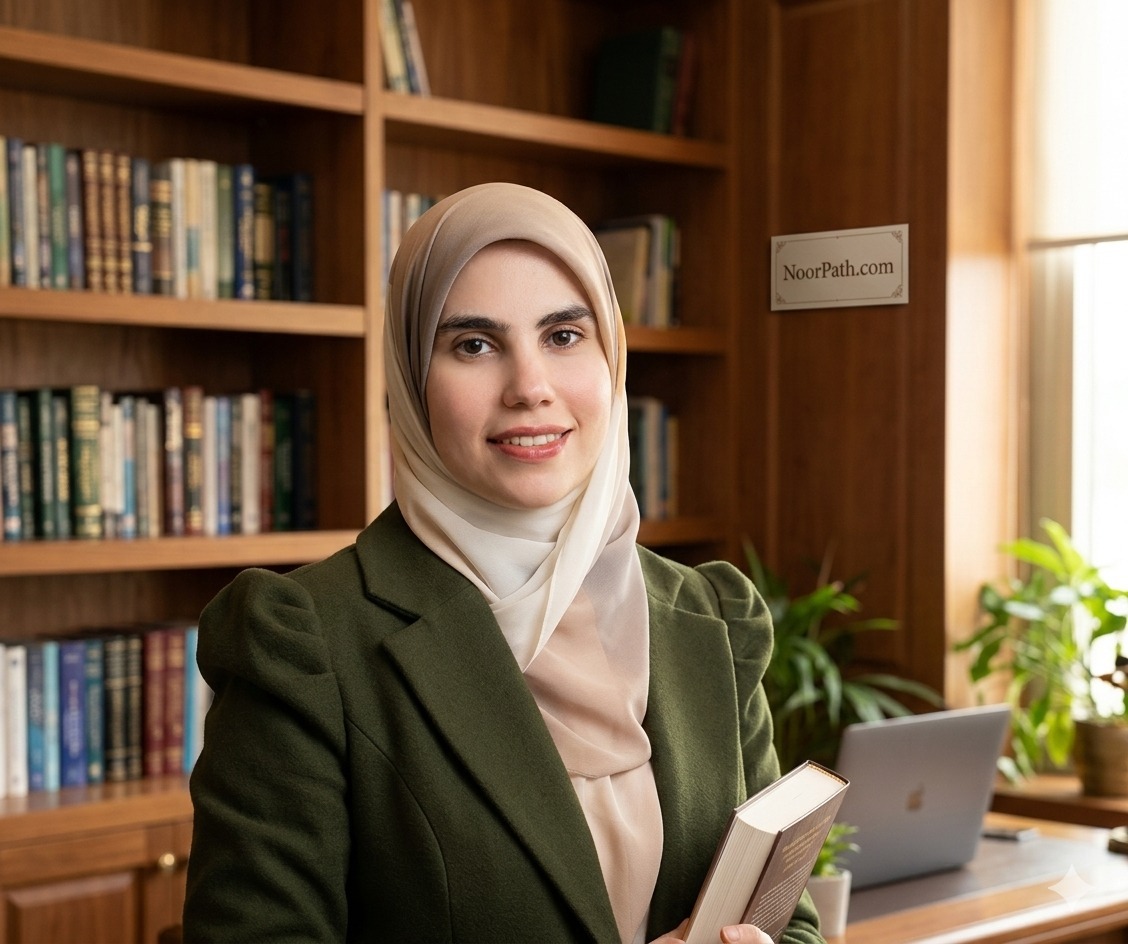
Norhan Ramy
4+ years
Quran Recitation (Tajweed)
Arabic Language
Islamic Studies
Norhan Ramy has over four years of experience teaching Quran, Arabic, and Islamic Studies. Throughout her teaching career, she has worked with students read more…
Why Choose NoorPath Academy for Your Hifz Quran Journey?
- Structured Quran memorization plans tailored to your busy schedule.
- Expert 1-on-1 attention from Al-Azhar tutors to perfect your Tajweed.
- Proven retention method ensures you never forget what you memorize.
- Flexible online timings designed for students in the UK, USA, and Europe.
- A clear pathway from beginner recitation to Ijazah certification.

Online Hifz Classes for Students in the USA
Students comparing the best online Quran classes in the USA need more than recorded lessons or a generic memorization schedule. A successful online Hifz program must provide live correction, clear English communication, flexible class times, and a revision plan that remains practical alongside school, university, work, and family responsibilities.
NoorPath’s online Quran memorization classes are designed to support students across US time zones through:
- Live, one-to-one Hifz sessions with individual tutor attention.
- Tutors who can explain Tajweed corrections and lesson instructions in fluent English.
- Flexible scheduling, including suitable evening and weekend options.
- Personalized memorization targets instead of imposing the same pace on every student.
- Structured Muraja’ah covering both recent lessons and older memorized portions.
- Programs for children, teenagers, working adults, brothers, and sisters.
- A progressive pathway from beginner recitation and Tajweed to full Hifz and advanced Ijazah assessment.
Because every lesson is private, the tutor can focus on the student’s exact pronunciation, repeated errors, memorization strength, and revision needs. This makes the program suitable for US-based families who want structured Quran education without depending on fixed local Madrasah hours.


Hifz Programs for Every Age: Kids, Teens & Adults
Whether you’re a parent looking for quran hifz classes online for your child, or an adult searching for a serious hifz program for adults that fits around work or university, the same core methodology applies — only the pacing and delivery differ:
- Children (ages 6–12): Shorter, more frequent sessions with gamified revision and simplified Tajweed rules, building the habit of daily recitation early.
- Teens: Balanced scheduling around school commitments, with an emphasis on consistency and connecting memorized Surahs to their meaning (Tafseer).
- Adults: Flexible, often evening or weekend sessions, with realistic revision plans that account for work, family, and existing life responsibilities — proving that starting Hifz later in life is entirely achievable with the right system.
Learn Quran for Adults: A Hifz Plan That Fits Real Life
Adults who want to learn Quran for adults or begin Hifz later in life sometimes assume they have missed the ideal age for memorization. In reality, adults often bring valuable strengths to the process, including personal motivation, stronger self-discipline, and a greater ability to understand the meaning and context of the verses they memorize.
At NoorPath, adult Hifz plans are built around consistency rather than unrealistic speed. Your tutor assesses your recitation level, previous memorization, weekly availability, and long-term goal before setting your daily target.
An adult Quran memorization plan can include:
- Early-morning, evening, or weekend classes that fit around employment, university, and family responsibilities.
- Manageable daily targets based on your available practice time rather than a fixed number of pages.
- A larger proportion of Muraja’ah when work or family commitments make the weekly schedule less predictable.
- Tajweed correction before new verses are committed to memory.
- Partial Hifz goals for students who want to memorize selected Surahs or specific Ajzaa before deciding whether to pursue the entire Quran.
- Regular progress reviews so the plan can be adjusted without losing previously memorized material.
If your Quran reading needs improvement, you do not have to postpone the entire journey. Your tutor can begin with Arabic reading, Noorani Qaida, Makharij, or supervised recitation before gradually introducing memorization.
Starting Hifz as an adult does not require rushing to compensate for beginning later. It requires a realistic system that you can maintain long enough to produce stable progress.

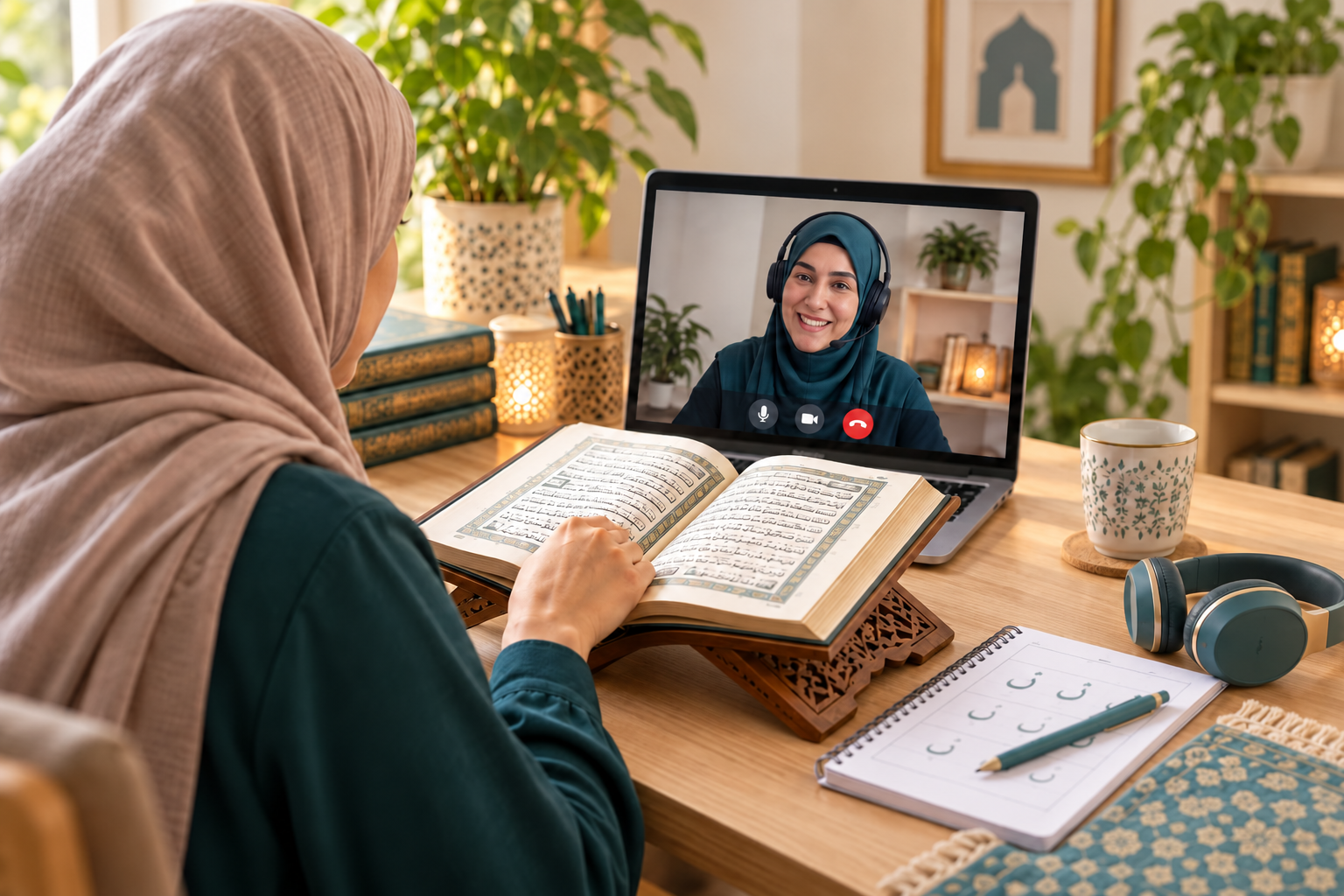
Not Ready for Full Hifz? Start with Quran Recitation
Whether you’re a parent looking for quran hifz classes online for your child, or an adult searching for a serious hifz program for adults that fits around work or university, the same core methodology applies — only the pacing and delivery differ:
- Children (ages 6–12): Shorter, more frequent sessions with gamified revision and simplified Tajweed rules, building the habit of daily recitation early.
- Teens: Balanced scheduling around school commitments, with an emphasis on consistency and connecting memorized Surahs to their meaning (Tafseer).
- Adults: Flexible, often evening or weekend sessions, with realistic revision plans that account for work, family, and existing life responsibilities — proving that starting Hifz later in life is entirely achievable with the right system.
Student Testimonial

My daughter finally started enjoying memorization instead of feeling pressured. The step-by-step pace and revision routine made a huge difference for us.
Amina Khan, UK

I work full-time, so I thought Hifz was unrealistic for me. This class gave me structure, accountability, and real progress every week.
Omar El-Sayed, Canada

The teacher was patient, and my son stayed motivated because each lesson felt organized and achievable. We can already see strong improvement.
Yusuf Rahman, USA

I used to make the same pronunciation mistakes again and again. After a few weeks here, my recitation became much clearer and more confident.
Fatima Noor, South Africa

The corrections were gentle but precise, which made learning easy to follow. I now understand the rules instead of just memorizing them.
Abdul Rehman, Pakistan

The Quran Tajweed course helped my kids recite with better focus and better pronunciation. The one-on-one attention really stands out.
Mariam Hassan (Mother), Germany
I finally feel like I am reciting with more awareness and control. The lessons are practical, clear, and very encouraging.
Zainab Ali, Ireland

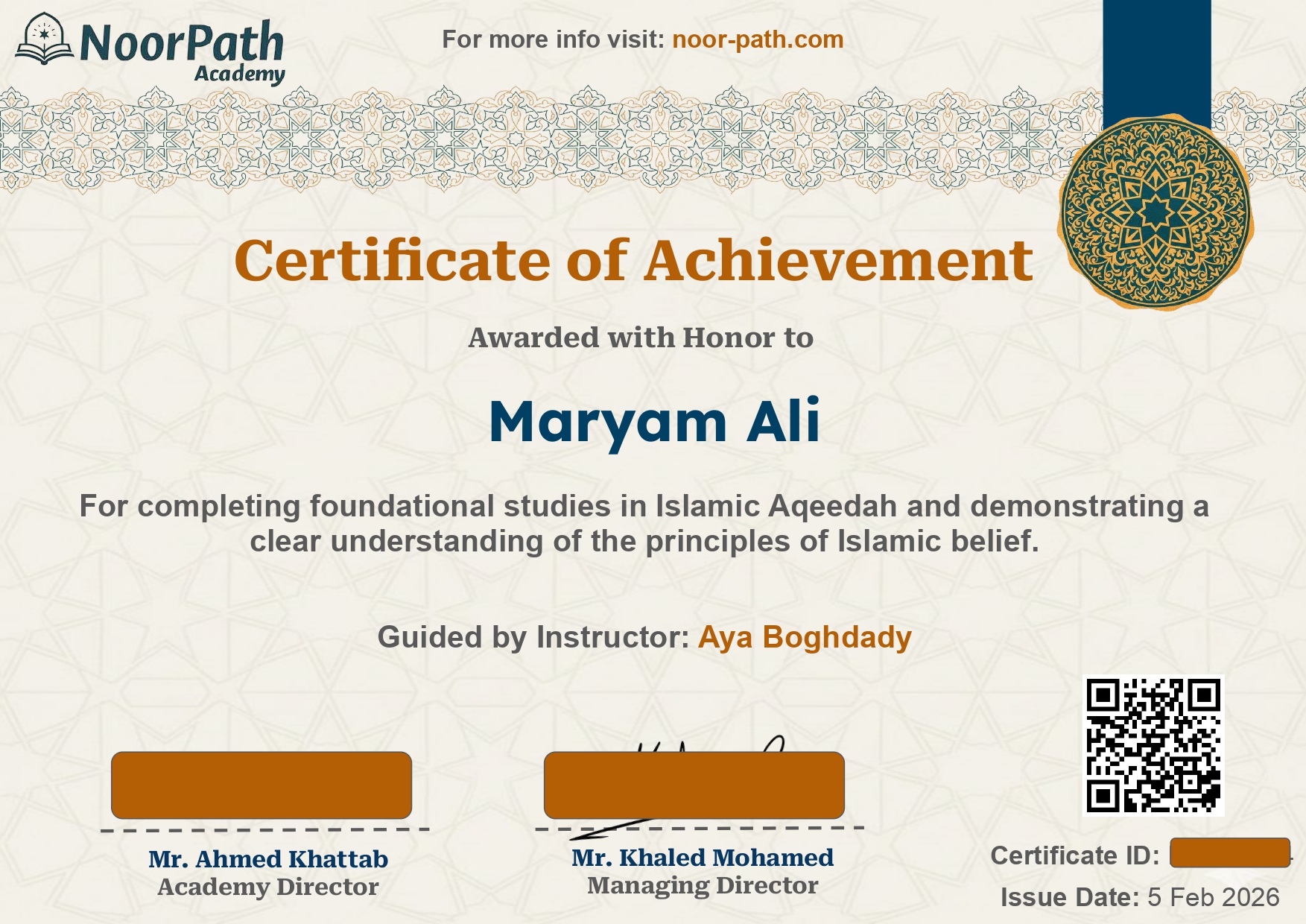
The Aqeedah course gave me clarity on beliefs I had heard all my life but never properly understood. The lessons were simple, structured, and meaningful.
Hamza Siddiq, USA

I liked how the teacher explained everything with patience and examples. It made the subject feel relevant to daily life, not just theory.
Maryam Saleh, Malaysia

My faith feels stronger because I now understand the foundations better. The course helped me connect knowledge with conviction.
Ibrahim Farooq, UK
It was easy to follow, even as a beginner. I came away with a much clearer understanding of the basics of belief in Islam.
Aisha Rahman, Canada

I finally understand the practical rulings behind everyday worship. The lessons were organized in a way that made real-life application easy.
Bilal Khan, Australia
The Fiqh course helped me answer questions I had for years about prayer, purity, and daily practice. It felt very useful and relevant.
Huda Karim, USA

I appreciated that the teacher explained the evidence and the wisdom behind the rulings. It made the subject much easier to trust and remember.
Faris Omar, South Africa
The pace was comfortable, and the explanations were clear enough for someone who is not a scholar. I feel much more confident now.
Noor Abdullah, UK

The Hadith course made me appreciate the Hadith much more deeply. I learned not just the wording, but the context and practical lessons too.
Salman Aziz, Pakistan
The teacher made a serious subject feel approachable. I now understand how Hadith connects directly to everyday Muslim life.
Hassan Ibrahim, Canada
My son became more interested in the Sunnah after joining this class. The explanations were clear, engaging, and age-appropriate.
Yasmin Omar (Mother), UAE
I liked how the lessons were broken down into manageable parts. It helped me stay consistent and actually remember what I learned.
Ahmad Saleem, Germany
I started as a complete beginner, and now I can read with far more confidence. The live correction really helped me improve fast.
Ahmed Zayed, USA
The class felt personal and practical. I especially liked how the teacher focused on speaking, reading, and understanding together.
Lina Hassan, UK

Arabic used to feel intimidating, but this course broke it down step by step. Now I actually enjoy learning it.
Faisal Omar, Canada
I can already see real progress in my pronunciation and reading. The lessons are patient, clear, and very well structured.
Noha Ali, Malaysia
This track gave me a full foundation in Islam instead of isolated topics. It feels balanced, organized, and easy to keep up with.
Abdul Rahman, Canada

I wanted a course that would help me and my children learn together, and this was exactly that. The lessons are broad but still very clear.
Fatima Saleh, USA

The combination of different subjects made the learning experience much richer. I liked that everything was taught in a connected way.
Yusuf Ali, Germany
Frequently Asked Questions
How long does it take to memorize the Quran online?
The time it takes to complete a full Quran memorization course depends on your dedication and schedule. With our structured online Hifz classes, a student memorizing 1 page per day can finish in about 2.5 to 3 years. For those in an intensive program memorizing 3 pages daily, it can take less than 10 months. We customize the pace for every student.
Can I get an Ijazah (Sanad) through these online Hifz classes?
Yes. Upon successfully completing the full Quran memorization and passing the rigorous review stages with perfect Tajweed, students can earn a verifiable Ijazah. This connects you to an unbroken chain of transmission (Sanad) tracing back to the Prophet Muhammad (PBUH).
Are there female Quran teachers available for sisters?
Absolutely. We provide specialized 1-on-1 Hifz classes for sisters, taught exclusively by certified female Arab Huffaz. This ensures a comfortable, private, and highly focused learning environment for women and young girls.
Do you offer a free online Quran memorization class to try?
Yes, we offer a free trial class for all new students. This allows you to meet your tutor, assess your current reading level, and experience our 4R Methodology (Read, Recite, Reflect, Review) before committing to a paid plan.
Is this Hifz program suitable for adults who work full-time?
Yes, our online Hifz program is highly flexible and designed for busy adults. Because classes are 1-on-1, you can schedule your sessions 24/7 to fit around your work or university commitments. We focus heavily on realistic goals and consistent revision so you don’t lose progress.
Do I need to be fluent in Arabic or Tajweed before starting?
While knowing how to read Arabic is required, you do not need to be an expert in Tajweed to begin. Our expert tutors will correct your pronunciation and teach you Tajweed rules natively as you progress through the Quran memorization course.
Is it possible to complete Hifz through an online hifz course?
Yes. As long as the program uses live, one-on-one sessions with a qualified tutor — rather than pre-recorded lessons — the essential element of Talaqqi (direct correction) is preserved, making online Hifz training religiously and pedagogically sound.
What is the difference between Hifz and Tajweed?
Tajweed refers to the rules of correct Quranic pronunciation and articulation (Makharij and Sifaat), while Hifz refers to memorization itself. Proper Hifz training always begins with Tajweed correction, since memorizing verses incorrectly creates habits that are difficult to unlearn later.
Is an online Ijazah recognized the same as one earned in person?
An Ijazah’s validity rests on the unbroken Sanad and verified live recitation to a qualified Sheikh — not on the physical location of the session. Most contemporary scholars accept Ijazahs earned through live, verified online recitation as valid, provided the teacher personally holds an authenticated chain of transmission.
What is Muraja'ah, and why is it emphasized so heavily?
Muraja’ah (revision) is the structured, repeated review of previously memorized portions of the Quran. Without it, memorized material fades from memory over time — this is why our “4R” methodology places dedicated review sessions alongside new memorization rather than treating revision as optional.
Can women teach Quran memorization to children and other women online?
Yes, and many programs — including those researched under names like madrasatelquran quran memorization course certified huffaz ijazah one-on-one weekly updates arabic english — specifically offer female Huffaz (certified memorizers) for female students and children, in line with the preference many families have for gender-matched instruction in religious education.
What technology do I need for online Quran memorization classes?
Should I start with Quran recitation or full Hifz?
Choose the recitation track if your immediate goal is to read the Quran fluently with correct Tajweed without following a memorization target. Choose the Hifz program if you want to memorize selected Surahs, one or more Ajzaa, or the full Quran. Beginners can start with recitation and transition into Hifz when their reading foundation is ready.
Can I memorize selected Surahs without committing to the full Quran?
Yes. NoorPath creates personalized plans for students who want to memorize Juz Amma, frequently recited Surahs, or other selected portions of the Quran. You can begin with a partial Hifz goal and later continue toward full memorization if your schedule and progress allow.
How much should an adult memorize each day?
There is no single daily target that suits every adult. Your tutor sets the amount according to your recitation level, available study time, retention strength, and existing commitments. A smaller target that you can memorize and review consistently is more effective than an ambitious target that causes earlier portions to weaken.
Our 100% Satisfaction Promise
If you are not happy after your first week of paid classes, we will refund your money with no questions asked.
Your Journey to Memorize the Quran Starts Here.
The Prophet (SAW) said: “The best of you are those who learn the Quran and teach it.”