
Tajweed rules are systematic guidelines that govern the proper pronunciation, articulation, and recitation of the Quran, ensuring it is recited exactly as it was revealed to Prophet Muhammad (ﷺ). While scholars differ on the exact count—some identifying 9, 12, or 17 main categories—the comprehensive framework encompasses 14 distinct rule types that work together to preserve the divine message’s linguistic integrity and spiritual beauty. Mastering these rules transforms ordinary recitation into a spiritually elevating experience that honors the Quran’s sacred origins.
What Are Tajweed Rules?
Tajweed (تجويد) literally means “to improve” or “to make better” in Arabic. As a science, it represents the systematic study of how to recite the Quran with precise pronunciation, proper articulation, and beautiful intonation. Research published in 2025 confirms that applying Tajweed rules enhances clarity, understanding, and spiritual connection while reciting the Quran, as it dictates how long to stretch certain vowels or when to merge or differentiate between specific sounds.
The importance of Tajweed cannot be overstated. A slight mispronunciation can completely alter meaning—the word “قلب” (qalb) means “heart,” but if the Qaaf is pronounced incorrectly as Kaaf, it becomes “كلب” (kalb), meaning “dog.” Similarly, in Surah Al-Kawthar, “وانحر” (wan-har) means “sacrifice,” but incorrect pronunciation of the Ha changes it to “scold.”
The 14 Essential Types of Tajweed Rules
1. Al-Isti’adhah and Al-Basmalah (Seeking Refuge and Beginning)
Al-Isti’adhah involves reciting “أَعُوذُ بِاللَّهِ مِنَ الشَّيْطَانِ الرَّجِيمِ” (A’udhu billahi min ash-shaytan ir-rajim) before beginning Quran recitation. This translates to “I seek refuge in Allah from the accursed devil.”
Al-Basmalah comprises “بِسْمِ اللَّهِ الرَّحْمَٰنِ الرَّحِيمِ” (Bismillah al-Rahman al-Rahim), meaning “In the name of Allah, the Most Gracious, the Most Merciful.”
Key Rules:
- Reciting Al-Isti’adhah once suffices for the entire Quran session, though it’s recommended at the beginning of each Surah
- Al-Basmalah is recited at the start of every Surah except Surah At-Tawbah (Chapter 9)
- There are six different ways to combine these two when starting recitation
Example: When beginning Surah Al-Fatiha, first say the Isti’adhah, then the Basmalah, followed by “الْحَمْدُ لِلَّهِ رَبِّ الْعَالَمِينَ” (Alhamdu lillahi rabbil ‘alamin).
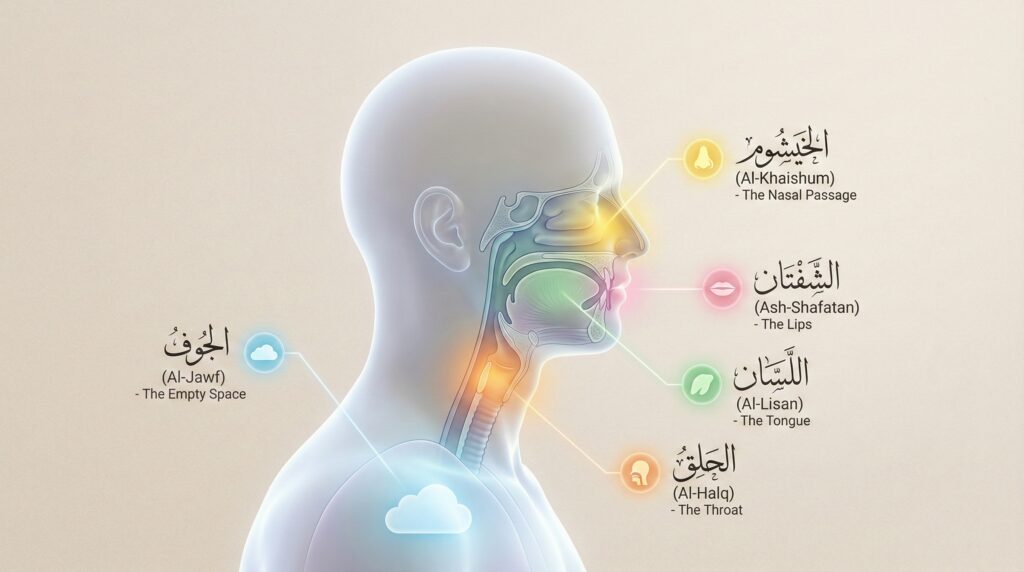
2. Makharij Al-Huroof (Articulation Points of Letters)
Makharij al-Huroof refers to the precise locations in the mouth, throat, lips, and nasal passages where each Arabic letter originates. Recent studies in Arabic phonetics confirm that scholars identify 17 distinct articulation points divided across five main regions.
The Five Main Regions:
- Al-Jauf (الجوف) – The empty space in the mouth and throat (1 point)
- Al-Halq (الحلق) – The throat (3 points)
- Al-Lisan (اللسان) – The tongue (10 points)
- Ash-Shafatayn (الشفتان) – The lips (2 points)
- Al-Khayshoom (الخيشوم) – The nasal cavity (1 point)
Throat Points:
- Lowest throat: Letters ء (Hamza) and ه (Ha)
- Middle throat: Letters ع (Ain) and غ (Ghayn)
- Upper throat: Letters ح (Ha) and خ (Kha)
Example: The letter ق (Qaaf) originates from the back of the tongue against the soft palate, while ك (Kaaf) comes from slightly forward. Confusing these changes “قال” (qaal – “he said”) to “كال” (kaal – “he measured”).
3. Sifaat Al-Huroof (Characteristics of Letters)
Each Arabic letter possesses inherent qualities that distinguish it from others. These characteristics are divided into two categories: those with opposites and those without.
Characteristics with Opposites (5 pairs):
| Characteristic | Opposite | Letters | Effect |
| Hams (Whispering) | Jahr (Voicing) | ف، ح، ث، ه، ش، خ، ص، س، ك، ت | Continuous breath flow |
| Shiddah (Strength) | Rakhawah (Softness) | أ، ج، د، ق، ط، ب، ت، ض، ظ، ك | Complete sound stoppage |
| Isti’laa (Elevation) | Istifaal (Lowering) | خ، ص، ض، ط، ظ، غ، ق | Tongue rises |
| Itbaaq (Closing) | Infitah (Opening) | ص، ض، ط، ظ | Tongue presses palate |
| Idhlaq (Fluency) | Ismaat (Difficulty) | ف، ر، م، ن، ل، ب | Easy pronunciation |
Characteristics without Opposites (7 unique traits):
- Qalqalah (Bouncing)
- Safeer (Whistling)
- Inhiraaf (Deflection)
- Tafasshi (Spreading)
- Istitalah (Lengthening)
- Takreer (Repetition)
- Ghunnah (Nasalization)
Example: The letter ص (Saad) has Itbaaq (closing), making it heavy and emphatic, while س (Seen) has Infitah (opening), making it light and clear.
4. Noon Saakinah and Tanween: Izhar (Clear Pronunciation)
Izhar (إظهار) means “to make clear.” This rule applies when Noon Saakinah (نْ) or Tanween (ًٌٍ) is followed by any of six throat letters.
The six Izhar letters: ء، ه، ع، ح، غ، خ
Example from Quran:
- “مِنْ أَحَدٍ” (min ahad) – Surah Al-Ikhlas (112:4)
- “أَحَدٌ اللَّهُ” (ahadun Allah) – Surah Al-Ikhlas (112:1)
The Noon or Tanween is pronounced clearly and distinctly without any merging or concealment.
5. Noon Saakinah and Tanween: Idgham (Merging)
Idgham (إدغام) means “to merge.” The Noon Saakinah or Tanween merges into the following letter when followed by specific consonants.
Idgham letters (remembered by يَرْمَلُونَ): ي، ر، م، ل، و، ن
Two types:
Idgham with Ghunnah (nasal sound) – Letters: ي، و، م، ن
- Example: “مَنْ يَّقُولُ” (man yaqoolu) becomes “mayyaqoolu”
- Example: “أَمَنَةً نُّعَاسًا” (amanatan nu’aasan)
Idgham without Ghunnah – Letters: ر، ل
- Example: “مِنْ رَّبِّهِمْ” (mir rabbihim) – the Noon merges completely
- Example: “مِنْ لَّبَنٍ” (mil labanin)
6. Noon Saakinah and Tanween: Iqlab (Conversion)
Iqlab (إقلاب) means “to convert” or “substitute.” When Noon Saakinah or Tanween is followed by the letter ب (Ba), it converts to a Meem-like sound with Ghunnah for two counts.
The Iqlab letter: ب only
Examples:
- “سَمِيعٌۢ بَصِيرٌۢ” (samee’um baseer) – The Tanween converts to Meem sound
- “مِنۢ بَعْدِ” (mim ba’d) – Pronounced with nasal Meem sound
- “أَنۢبَتَتْ” (ambatet)
How to apply: Close your lips as if saying Meem, but produce the sound through the nose with nasalization.
7. Noon Saakinah and Tanween: Ikhfaa (Concealment)
Ikhfaa (إخفاء) means “to hide” or “conceal.” This is the most common rule, applying when Noon Saakinah or Tanween is followed by 15 specific letters.
The 15 Ikhfaa letters: ت، ث، ج، د، ذ، ز، س، ش، ص، ض، ط، ظ، ف، ق، ك
Contemporary research on Quranic recitation patterns shows that Ikhfaa occurs more frequently than any other Noon Saakinah rule in the Quran.
Examples:
- “مَنْ تُؤْمِنُوا” (an tu’minoo) – from Surah Al-Baqarah
- “مِنْ شَرِّ” (min sharr) – from Surah Al-Falaq
- “أَنْ صَدُّوكُمْ” (an saddookum)
How to apply: The Noon sound is hidden between clear pronunciation (Izhar) and complete merging (Idgham), with light nasalization held for two counts.
8. Meem Saakinah Rules (Three Rules)
Meem Saakinah (مْ) is the letter Meem with sukoon. It follows three distinct rules:
Idgham Shafawi (Lip Merging)
When Meem Saakinah is followed by another Meem, they merge with Ghunnah.
- Example: “لَهُم مَّا” (lahum ma)
- Example: “أَمْ مَنْ” (am man)
Ikhfaa Shafawi (Lip Concealment)
When Meem Saakinah is followed by ب (Ba), the Meem is concealed with nasalization.
- Example: “تَرْمِيهِم بِحِجَارَةٍ” (tarmeehim bihi
jaratin)
- Example: “وَهُم بِالْآخِرَةِ” (wahum bil-akhirati)
Izhar Shafawi (Lip Clarity)
When Meem Saakinah is followed by any of the remaining 26 letters, it’s pronounced clearly.
- Example: “لَكُمْ فِيهَا” (lakum feeha)
- Example: “عَلَيْكُمْ سَلَامٌ” (alaykum salaam)
9. Noon and Meem Mushaddad (Doubled Letters)
When Noon (ن) or Meem (م) carries a Shaddah (ّ) mark, indicating doubling, they must be pronounced with full Ghunnah (nasalization) for two complete counts.
Examples:
- “إِنَّ” (inna) – The doubled Noon requires strong Ghunnah
- “ثُمَّ” (thumma) – The doubled Meem requires nasalization
- “مُنَّافِقُونَ” (munafiqoon) – from Surah Al-Baqarah (2:8)
This represents the strongest and longest duration of Ghunnah in Tajweed rules.
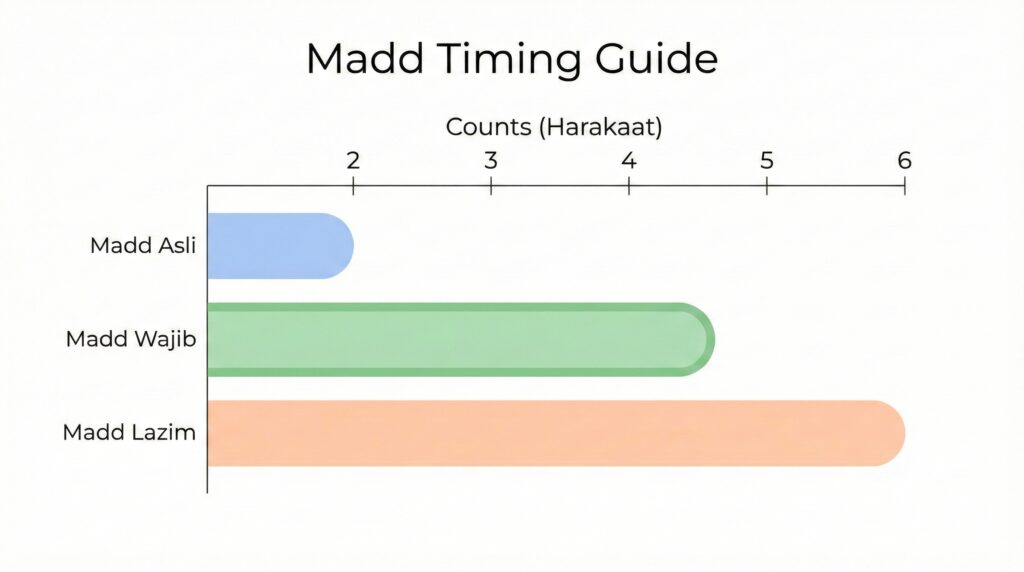
10. Al-Madd (Prolongation/Elongation)
Madd refers to the extension of vowel sounds. Recent research published in October 2025 emphasizes that Madd rules are among the most critical for maintaining the melodious flow of Quranic recitation.
Two Main Categories:
Madd Asli (Natural Prolongation)
The basic elongation lasting 2 counts when a madd letter (أ، و، ي) follows its corresponding vowel.
Example: In “قَالَ” (qaala), the Alif is held for 2 counts.
Madd Far’i (Secondary Prolongation)
This includes several subtypes with varying lengths:
Madd Wajib Muttasil (Connected Mandatory): 4-5 counts
- Occurs when Hamza follows a Madd letter in the same word
- Example: “جَاءَ” (jaa’a), “سُوءَ” (soo’a)
Madd Jaiz Munfasil (Disconnected Permissible): 2-5 counts
- Occurs when Hamza begins the next word
- Example: “إِنَّا أَعْطَيْنَاكَ” (inna a’tayna)
Madd Lazim (Compulsory Prolongation): 6 counts
- Occurs when permanent sukoon follows a Madd letter
- Example: “الضَّالِّينَ” (ad-daalleen)
Madd Arid Lissukoon (Temporary Prolongation): 2-6 counts
- Occurs when stopping at a word
- Example: “الرَّحِيمِ” (ar-raheem) when stopping
11. Qalqalah (Bouncing/Echo Sound)
Qalqalah (قلقلة) means “disturbance” or “vibration.” Research published in 2024 on Tajweed pedagogy reveals that this rule adds a beautiful harmony and depth to recitation by creating an echoing sound.
The five Qalqalah letters (remembered by قُطْبُ جَدٍّ): ق، ط، ب، ج، د
Three Levels of Intensity:
Qalqalah Kubra (Strong): Occurs when stopping on a Qalqalah letter
- Example: “تَبَّتْ” (tabbat) – Surah Al-Masad (111:1)
- Example: “الْفَلَقِ” (al-falaq) – Surah Al-Falaq (113:1)
Qalqalah Wusta (Moderate): Occurs mid-word with shaddah
- Example: “يُحَجُّ” (yuḥajju)
Qalqalah Sughra (Weak): Occurs mid-word without stopping
- Example: “أَقْبَلَ” (aqbala)
How to apply: Create a slight bouncing or echoing sound by quickly stopping and releasing the letter without adding a vowel.
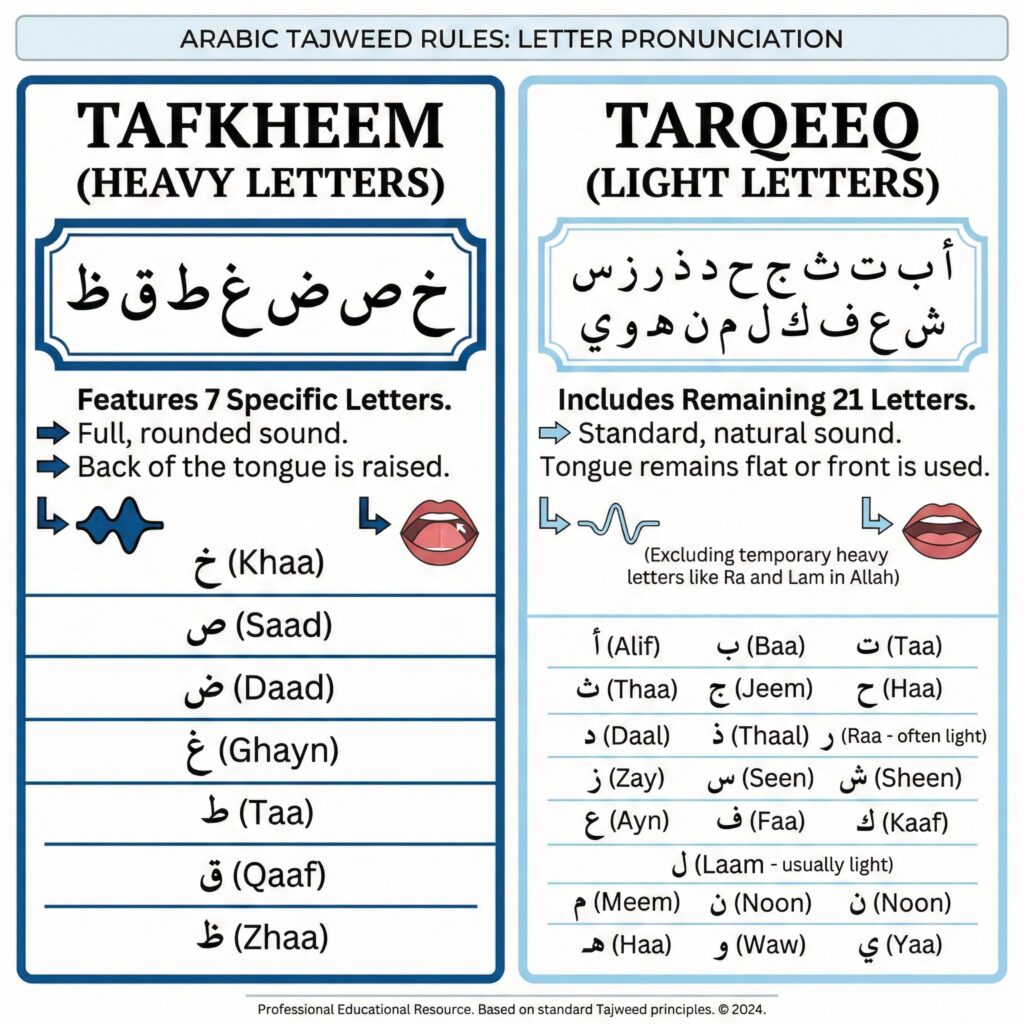
12. Tafkheem and Tarqeeq (Heavy and Light Pronunciation)
These rules govern whether letters are pronounced with emphasis (heavy) or normally (light).
Tafkheem (التفخيم) – Heavy Letters
Seven letters are always pronounced with fullness and emphasis, remembered by: خُصَّ ضَغْطٍ قِظْ
The heavy letters: خ، ص، ض، ط، ظ، غ، ق
Examples:
- “خَلَقَ” (khalaqa) – Heavy Kha
- “الصَّلَاةَ” (as-salaata) – Heavy Saad
- “قُلْ” (qul) – Heavy Qaaf
Tarqeeq (الترقيق) – Light Letters
The remaining 21 letters are pronounced lightly without emphasis.
Examples:
- “سَلَامٌ” (salaam) – Light Seen
- “زَكَاةٍ” (zakaat) – Light Zay
Special Case – The Letter ر (Raa):
- Heavy when followed by Fatha or Dammah: “رَبِّ” (rabbi)
- Light when followed by Kasra: “رِزْقًا” (rizqan)
13. Laam Saakinah Rules
The letter Laam with sukoon (لْ) has special rules, particularly in Allah’s name and the definite article ال (Al).
Laam in “الله” (Allah):
- Heavy (Tafkheem) when preceded by Fatha or Dammah
- Example: “قَالَ اللَّهُ” (qaalAllah)
- Example: “رَسُولُ اللَّهِ” (rasoolullah)
- Light (Tarqeeq) when preceded by Kasra
- Example: “بِسْمِ اللَّهِ” (bismillah)
Laam Al-Ta’reef (The Definite Article “ال”):
Laam Shamsiyyah (Sun Letters): The Laam is silent and merges with the following letter (14 letters)
- Example: “الشَّمْسُ” (ash-shamsu) – pronounced “Ash-shamsu”
- Example: “الرَّحْمَٰنِ” (ar-rahmaan) – pronounced “Ar-rahmaan”
Laam Qamariyyah (Moon Letters): The Laam is pronounced clearly (14 letters)
- Example: “الْقَمَرُ” (al-qamaru)
- Example: “الْحَمْدُ” (al-hamdu)
14. Waqf and Ibtida’ (Stopping and Starting)
Waqf (الوقف) refers to rules governing how and where to stop during recitation. Ibtida’ (الابتداء) concerns how to resume after stopping.
Types of Waqf:
Waqf Lazim (مْ) – Mandatory Stop: Must stop to preserve meaning
- Example: “وَمَا يَعْلَمُ تَأْوِيلَهُۥٓ إِلَّا ٱللَّهُۗ” (Quran 3:7) – must stop after “Allah”
Waqf Ja’iz (ج) – Permissible Stop: May stop or continue
- Better to stop for clarity
Waqf Mamnu’ (لا) – Prohibited Stop: Do not stop as it breaks meaning
- Stopping would separate interconnected phrases
Waqf Mujawwaz (ص or قلى) – Preferably Continue: Better to continue but stopping is allowed
Rules When Stopping:
- Final vowels become sukoon
- Feminine Ta (ة) is pronounced as Ha (ه)
- Example: “رَحْمَةً” becomes “rahmah” when stopping
Rules When Starting:
- Never start mid-phrase or mid-sentence
- Must begin from a point that preserves complete meaning
- Example: After stopping at “ٱلرَّحْمَٰنِ ٱلرَّحِيمِ”, start with “مَٰلِكِ يَوْمِ ٱلدِّينِ”
Learning Timeline and Practice Tips
According to 2025 curriculum guidelines from established Tajweed institutions, most learners achieve basic Tajweed competency following this progression:
Beginner Level (0-3 months):
- Master Makharij (articulation points)
- Learn basic Noon and Meem rules
- Understand natural Madd
Intermediate Level (3-6 months):
- Master all four Noon Saakinah rules
- Perfect Qalqalah application
- Study Tafkheem and Tarqeeq
Advanced Level (6-12 months):
- Master all Madd variations
- Perfect Waqf and Ibtida’
- Develop beautiful recitation rhythm
Daily Practice Recommendations:
- Practice 10-15 minutes daily with specific rule focus
- Listen to skilled reciters (Mahmoud Khalil Al-Husary, Mishary Alafasy)
- Record yourself and compare with professional recitation
- Seek feedback from qualified teachers
Common Mistakes to Avoid in Learning Tajweed Rules
- Ignoring Makharij: Pronouncing letters from incorrect articulation points
- Skipping Ghunnah: Omitting nasal sounds in Noon/Meem Mushaddad
- Incorrect Madd lengths: Holding elongations too short or too long
- Misplacing stops: Breaking at inappropriate places that alter meaning
- Confusing similar letters: Mixing Saad (ص) with Seen (س), or Qaaf (ق) with Kaaf (ك)
Why Tajweed Matters?
The Prophet Muhammad (ﷺ) said: “One who recites the Quran beautifully, smoothly, and precisely will be in the company of noble angels.” (Sahih Al-Bukhari)
Learning Tajweed serves multiple purposes:
- Preserves divine revelation: Ensures the Quran is recited exactly as revealed
- Prevents meaning distortion: Maintains linguistic accuracy
- Enhances spiritual connection: Deepens relationship with Allah’s words
- Fulfills religious obligation: Most scholars consider proper Tajweed an individual obligation (Fard ‘Ayn)
Conclusion
The 14 types of Tajweed rules form an interconnected system designed to preserve the Quran’s divine articulation. From the foundational Makharij and Sifaat to the nuanced applications of Madd and Waqf, each rule contributes to the beauty and precision of Quranic recitation. While the journey to mastery requires dedication and consistent practice, the spiritual rewards and deep connection with Allah’s words make every effort worthwhile.
Whether you’re a beginner starting with basic articulation points or an advanced student perfecting complex prolongation rules, remember that consistency and proper guidance from qualified teachers accelerate progress significantly. Start with the fundamentals, practice daily, listen to skilled reciters, and gradually build toward complete mastery of all 14 Tajweed rule categories.