
Embarking on the journey to read the Holy Quran is one of the most profound and rewarding endeavors a Muslim can undertake. It is a path of spiritual enlightenment, a direct conversation with Allah (SWT), and a source of guidance for all aspects of life. However, for many, especially beginners, the path can seem daunting. The beauty of the Quran is not just in its message but also in the very sound of its recitation. This is where Tajweed comes in. The desire to learn Tajweed online for beginners has grown immensely as people seek authentic, accessible, and effective ways to perfect their recitation. This guide is designed to illuminate that path, showing you how platforms like NoorPath Academy provide a structured, supportive environment to help you connect with the Quran in the way it was meant to be recited, right from the comfort of your home.
What is Tajweed?
Before diving into the methods and benefits of learning, it’s crucial to understand the essence of Tajweed. Linguistically, the Arabic word “Tajweed” (تجويد) means ‘to make good,’ ‘to improve,’ or ‘to make proficient.’ In the context of the Quran, it is the science and art of reciting the Quranic verses correctly. It is a set of rules that dictates how each letter of the Arabic alphabet should be pronounced, depending on its position and the letters surrounding it. It governs the articulation points (Makharij), the attributes of the letters (Sifat), and the various rules that affect the letters when they are recited in sequence.
Tajweed is not a modern invention; its principles are rooted in the way the Angel Jibril (Gabriel) revealed the Quran to Prophet Muhammad (ﷺ), and how the Prophet, in turn, taught it to his companions. The goal is to recite the Quran in the exact manner it was revealed, thereby preserving the divine text from any form of distortion, whether in pronunciation or meaning. A slight change in the way a letter is pronounced can, in some cases, drastically alter the meaning of a word, which is why precision is paramount. Therefore, Tajweed is not merely about beautifying the voice; it is a fundamental duty to give each letter its due right and characteristic, ensuring the integrity of the message of Allah.
Think of it as the grammar of Quranic recitation. Just as grammatical rules in any language ensure clarity and correct meaning in written and spoken communication, Tajweed rules ensure the Quran is recited with the utmost accuracy and reverence. It is the key that unlocks the divine melody and rhythm inherent in the Quranic text, allowing the reciter and the listener to experience its full spiritual and emotional impact.

Importance of learning Tajweed for beginners
For a beginner, starting the journey of Quranic recitation with Tajweed is like building a house on a solid foundation. While it might seem like an extra layer of complexity, integrating Tajweed from day one is far more effective than trying to correct ingrained pronunciation errors later. The importance of this foundational knowledge cannot be overstated.
Firstly, learning Tajweed is an act of worship in itself. It demonstrates a deep respect for the words of Allah (SWT). When we strive to pronounce each letter correctly, we are showing our commitment to preserving the sanctity of the revelation. This effort is beloved by Allah and brings immense spiritual rewards. The Prophet Muhammad (ﷺ) said, “The one who is proficient in the recitation of the Qur’an will be with the honorable and obedient scribes (angels) and he who recites the Qur’an and finds it difficult to recite, doing his best to recite it in the best way possible, will have a double reward.” (Bukhari and Muslim). This hadith is a beautiful encouragement for beginners, as it shows that the struggle and effort to learn are highly valued.
Secondly, it builds confidence. Many beginners feel shy or hesitant to recite the Quran aloud, fearing they will make mistakes. A structured approach to learning Tajweed, such as that offered in online tajweed classes, provides the learner with the tools and knowledge to recite with certainty. As you master the basics, from the Arabic alphabet to the fundamental rules, your confidence grows, and you become more comfortable and eager to engage with the Quran. This confidence is a crucial element in making recitation a regular, joyful part of your daily life.
Finally, starting with Tajweed ensures you develop correct habits from the outset. Correcting long-standing mistakes in pronunciation is a challenging and often frustrating process. By learning the proper articulation points and letter attributes from the beginning, you are setting yourself up for a smoother, more progressive learning curve. This is why programs designed for beginners, like the Qur’an Track at NoorPath Academy, start with the absolute basics—the alphabet (alif, baa, taa)—and systematically build upon that foundation with phonetics and proper Tajweed rules.
Why is Tajweed essential for Quran recitation?
The necessity of Tajweed in Quranic recitation stems from a core principle: the preservation of meaning. The Arabic language is incredibly precise. A subtle shift in pronunciation, the elongation of a vowel, or the incorrect merging of letters can lead to a completely different meaning. This is not just a matter of phonetic aesthetics; it is a matter of textual integrity. Reciting the Quran is a conversation with the Creator, and it is our responsibility to ensure we are articulating His words as they were intended.
This is where we must understand the Distinction Between Recitation and Tajweed. Simple recitation might involve just reading the words off the page, similar to reading a newspaper. However, recitation with Tajweed is a meticulous, rule-based discipline. For example, the letter ‘Ha’ (ح) is a soft, breathy sound from the middle of the throat, while ‘Kha’ (خ) is a heavier, rasping sound from the top of the throat. Confusing them can change a word like ‘Al-Hamd’ (Praise) into something entirely different. Similarly, the emphatic letters like ‘Saad’ (ص), ‘Daad’ (ض), ‘Taa’ (ط), and ‘Dhaa’ (ظ) have distinct, heavy sounds that differentiate them from their lighter counterparts (‘Seen’ (س), ‘Daal’ (د), ‘Taa’ (ت), and ‘Dhaal’ (ذ)). Reciting ‘Sirat’ (path) with a ‘Seen’ instead of a ‘Saad’ is a common mistake that Tajweed corrects.
Furthermore, Tajweed governs the rhythm, flow, and melody of the recitation. Rules like ‘Madd’ (elongation) dictate exactly how long certain vowels should be held, creating a mesmerizing and meditative cadence that is unique to the Quran. The rules of ‘Ghunna’ (nasalization) on the letters ‘Noon’ (ن) and ‘Meem’ (م) add a beautiful, resonant quality to the sound. These are not arbitrary musical additions; they are integral parts of the revealed recitation. When you learn quran recitation with tajweed, you are learning to reproduce this divine symphony. This is why a one-on-one setting with a recitation Quran online with certified teacher is so valuable, as they can provide immediate, personalized feedback on these subtle but critical nuances.
Benefits of Learn Tajweed Online For Beginners
In today’s digital world, the opportunity to learn Tajweed online for beginners has removed many traditional barriers to acquiring this sacred knowledge. The benefits are numerous, combining the authenticity of classical teaching with the convenience of modern technology. Platforms like NoorPath Academy have harnessed this model to create an effective and enriching learning environment.
Spiritual growth and connection with the Quran
One of the most profound benefits of tajweed is the deep spiritual connection it fosters. When you recite the Quran with proper Tajweed, you are no longer just a passive reader of words; you become an active participant in a divine tradition. The focus required to apply the rules—to articulate each letter from its correct point, to give it its proper attributes, to apply the correct elongations and stops—transforms recitation into a mindful, meditative act. This focused attention quiets the mind and opens the heart to the message of the Quran.
The beautiful sound produced by correct Tajweed is not just for the listener; it has a powerful effect on the reciter as well. It allows you to feel the majesty, the warning, the mercy, and the hope within the verses. You begin to appreciate the miraculous nature of the Quran’s structure and linguistic beauty. This heightened appreciation leads to a stronger emotional and spiritual bond with the text, making your prayers more meaningful and your personal recitation a source of immense peace and comfort. This is a key reason why so many people seek to learn quran with tajweed online—to bring this spiritual depth into their daily lives.
Improved pronunciation and understanding
On a practical level, the most immediate benefit of learning Tajweed is the dramatic improvement in pronunciation. For non-Arab speakers, many sounds in the Arabic language are entirely new and can be challenging to produce. A structured Tajweed course breaks down these challenges systematically. At NoorPath Academy, for instance, the curriculum is designed for complete beginners, starting with the very building blocks of the language. Patient, experienced teachers guide you through the phonetics, demonstrating how to use your mouth, tongue, and throat to produce each sound correctly.
This precision in pronunciation has a direct impact on memorization and understanding. When the words are pronounced correctly, they are easier for the brain to recognize and retain. This is particularly helpful for those who wish to embark on the journey of Hifz (memorization), including those looking into how to memorize Quran in old age, where establishing clear phonetic patterns is crucial. Furthermore, as you become more attuned to the sounds and rhythms of the language through Tajweed, you begin to recognize patterns and root words, which can be a stepping stone towards a deeper understanding of the Arabic language and the Quran’s meaning itself. This is the essence of what it means to learn online quran with tajweed: it’s a holistic process that enhances both the form and the substance of your connection to the scripture.
Common Challenges Beginners Face and How to Overcome Them
The path to mastering Tajweed is a journey, and like any journey, it has its challenges. Acknowledging these hurdles is the first step to overcoming them. Fortunately, with the right guidance and resources, every challenge can be surmounted.
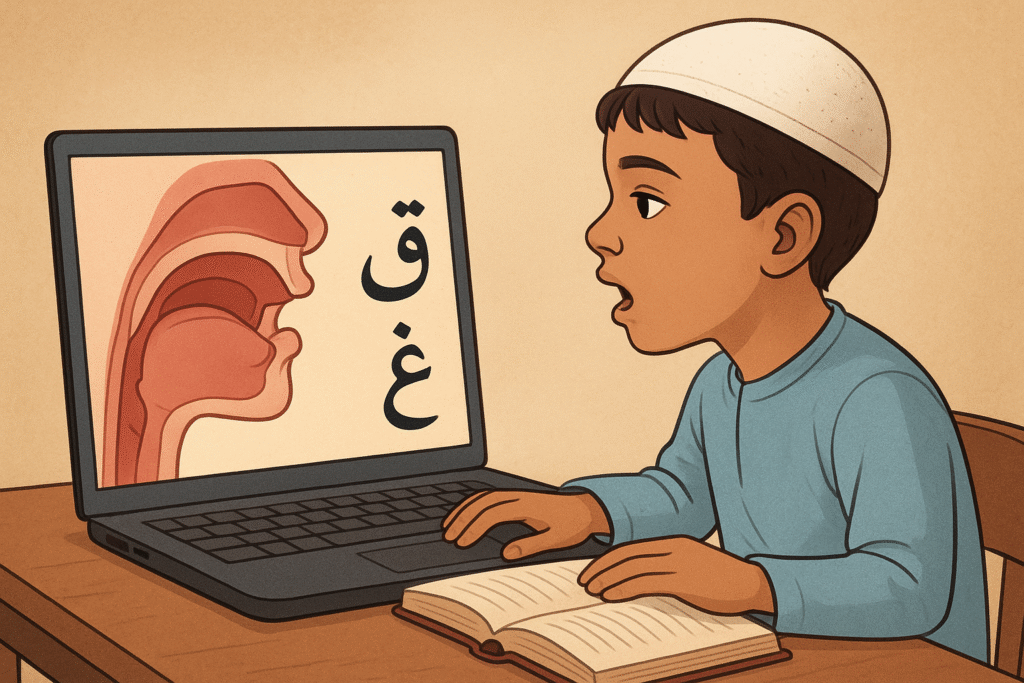
- Difficulty with New Sounds: The Arabic alphabet contains several letters with no direct equivalent in English, such as ‘Ayn (ع), Ghayn (غ), Hā’ (ح), Qāf (ق), and Dād (ض). Beginners often struggle to differentiate and produce these sounds.
Solution: The key is one-on-one guidance. A qualified teacher can demonstrate the exact articulation point, provide live feedback, and offer targeted exercises. This is a core advantage of the live, one-on-one classes offered by NoorPath Academy, where a teacher can patiently correct you in real-time until you master the sound. Recording yourself and comparing it to a master reciter is also an excellent practice. - Feeling Overwhelmed by Rules: The sheer number of Tajweed rules—Izhar, Idgham, Iqlab, Ikhfa, the different types of Madd, etc.—can seem overwhelming at first.
Solution: A structured, step-by-step curriculum is essential. A good course will not throw all the rules at you at once. It will introduce concepts progressively, ensuring you master one before moving to the next. NoorPath’s tracks are designed to be gentle and structured, preventing students from feeling overwhelmed and building their knowledge brick by brick. - Lack of Motivation and Consistency: Life gets busy, and it can be hard to stay motivated and practice regularly, especially when learning alone.
Solution: A supportive environment and a clear schedule are crucial. Having a dedicated class time with a teacher creates accountability. Furthermore, being part of a welcoming student community, as mentioned by NoorPath, can provide encouragement and a sense of shared purpose. Setting up a personal recitation Quran with daily practice schedule, even if it’s just for 15 minutes, helps build a consistent habit. - Finding a Qualified Teacher: Perhaps the biggest challenge is finding an authentic, qualified teacher who is also patient and experienced with beginners.
Solution: This is where online academies excel. They vet and hire qualified teachers from around the world, often native Arabic speakers who hold an Ijazah (a license to teach). When you decide to learn Tajweed online for beginners, you gain access to a pool of expert educators that might not be available in your local community.
Tajweed rules for beginners
To truly understand how to learn tajweed of quran, one must get acquainted with its core rules. While a comprehensive study takes time, beginners can start with a few fundamental areas. A good online course will guide you through these in detail, but here is a brief overview of what you can expect to learn.
1. Makhārij al-Hurūf (The Articulation Points of the Letters)
This is the absolute foundation of Tajweed. It is the study of where each of the 28 Arabic letters originates in the mouth and throat. There are five main areas of articulation: the empty space in the mouth and throat (Al-Jawf), the throat (Al-Halq), the tongue (Al-Lisān), the two lips (Ash-Shafatān), and the nasal cavity (Al-Khayshūm). Learning the precise point for each letter is the first step to correct pronunciation.
2. Sifāt al-Hurūf (The Attributes of the Letters)
Once you know where a letter comes from, you need to know how it is pronounced. This is governed by its attributes. Each letter has a set of characteristics, such as being heavy/full-mouthed (Tafkhīm) or light/empty-mouthed (Tarqīq), whispered (Hams) or audible (Jahr), and so on. These attributes give each letter its unique sound and are essential for a beautiful and accurate recitation.
3. The Rules of Noon Sākinah and Tanween
This is one of the most frequently encountered set of rules in the Quran. It deals with how to pronounce a Noon with a Sukoon (a silent Noon) or a Tanween (the ‘an’, ‘in’, ‘un’ endings) when it is followed by another letter. There are four possible rules:
- Al-Iz’hār (The Clarification): The Noon sound is pronounced clearly without any nasalization (ghunnah). This happens when the Noon Sākinah or Tanween is followed by one of the six throat letters (ء, ه, ع, ح, غ, خ).
- Al-Idghām (The Merging): This is the merging of the Noon sound into the following letter. So, what is idgham in tajweed? It means to combine two things. In this context, the Noon Sākinah or Tanween is merged into one of the letters of the word يرملون (Yarmalūn). Idghām can be with ghunnah (nasalization) or without.
- Al-Iqlāb (The Conversion): This rule applies when the Noon Sākinah or Tanween is followed by the letter Bā’ (ب). The Noon sound is converted into a light Meem (م) sound with a ghunnah.
- Al-Ikhfā’ (The Hiding): This is the most common of the four rules. It means to hide the Noon sound, producing a light nasal sound (ghunnah) while preparing to pronounce the next letter. This occurs when the Noon Sākinah or Tanween is followed by any of the remaining 15 letters of the alphabet.
4. The Rules of Madd (Elongation)
Madd means to elongate the sound of the three vowel letters: Alif (ا), Wāw (و), and Yā’ (ي). There are many types of Madd, but the fundamental concept is that some vowels are held for a longer duration than others. The length is measured in ‘harakāt’ (beats). Learning these rules is crucial for the correct rhythm and flow of the recitation and is one of the key Tips and Tricks for Beautiful Quran Recitation.
Mastering these basic rules provides a strong framework for any student. The journey to learn quran with tajweed for beginners becomes a systematic and achievable goal when broken down into these manageable components.
How to Choose the Right Online Tajweed Course?
With a growing number of options available, choosing the right course to learn Tajweed online for beginners can be a decision that shapes your entire learning experience. It’s important to look for a program that not only teaches the rules but also provides a supportive and effective learning structure. Here are key factors to consider:
- Qualified and Certified Teachers: The teacher is the most important element. Look for courses where teachers are not just fluent in Arabic but are certified in Tajweed, preferably holding an Ijazah. An experienced teacher knows the common pitfalls for beginners and can provide patient, targeted guidance. NoorPath Academy emphasizes its “patient and experienced teachers” who are qualified to guide students from the very beginning.
- Structured Curriculum for Beginners: A good course should have a clear, logical progression. It should start with the fundamentals, like the Arabic alphabet and pronunciation, before moving on to complex rules. Ask if the academy has a specific track for beginners. NoorPath’s “Qur’an Track” is a perfect example, designed specifically for those with no prior knowledge.
- One-on-One Classes: While group classes can be beneficial, one-on-one sessions are unparalleled for learning pronunciation-heavy subjects like Tajweed. This format allows for personalized attention, immediate feedback, and a pace that is tailored to your individual learning speed. NoorPath Academy’s model of conducting all classes live and one-on-one is a significant advantage for serious learners.
- Flexibility and Resources: An online course should offer flexibility in scheduling to fit your lifestyle. Additionally, look for valuable resources like recorded sessions. The ability to review your classes, as offered by NoorPath, is an invaluable tool for revision and reinforcing what you’ve learned.
- Free Trial or Evaluation: A reputable institution will be confident in its teaching quality and should offer a way for you to experience it before committing. While some may search for completely free courses, the quality can be inconsistent. A better approach is to look for a free evaluation session. NoorPath offers a “free evaluation session” where an advisor assesses your level and recommends the best path for you, ensuring you start in the right place. This addresses the interest in tajweed classes online free by providing a no-cost, high-value entry point.
By evaluating a course based on these criteria, you can ensure you are investing your time and effort in a program that will genuinely help you achieve your goal of learning quran with tajweed online beautifully and correctly.
In Conclusion
The journey to recite the Quran with Tajweed is a noble and deeply fulfilling pursuit. It is a path that connects us to the divine revelation in its purest form, enhances our worship, and brings tranquility to our hearts. In the past, this journey was often limited by geography and access to qualified teachers. Today, the opportunity to learn Tajweed online for beginners has made this sacred knowledge accessible to everyone, everywhere.
From understanding the profound importance of Tajweed to mastering its intricate rules, the path is one of dedication and patience. The key to success lies in finding a structured, supportive, and authentic learning environment. Platforms like NoorPath Academy are specifically designed to provide this, with a curriculum that caters to absolute beginners, one-on-one classes with experienced teachers, and the flexibility that modern life demands. The goal is not just to learn rules but to build a lifelong, confident, and beautiful relationship with the Holy Quran. If you are ready to take the first step, don’t hesitate. Your journey to perfect your recitation and deepen your connection with the words of Allah is just a click away.
FAQs
How long does it take to learn Tajweed for beginners?
The time it takes to learn Tajweed varies greatly from person to person. It depends on several factors, including your prior experience with Arabic, the amount of time you dedicate to practice, and the quality of your instruction. Generally, a beginner can grasp the fundamental rules and significantly improve their pronunciation within a few months of consistent study . However, mastering Tajweed and achieving a high level of proficiency is a lifelong journey. The key is not speed, but consistency. With a structured course and a dedicated teacher, you will see noticeable progress week by week.
Can I learn Tajweed without knowing Arabic?
Yes, absolutely! This is a common concern for many non-Arab Muslims, and the answer is a resounding yes. Reputable online academies like NoorPath Academy are designed with complete beginners in mind. As stated in their approach, their Qur’an Track starts from the very basics, beginning with the Arabic alphabet . From there, you are guided step-by-step into phonetics, pronunciation, and the rules of Tajweed. An effective program does not require any prior Arabic knowledge; it builds that knowledge as part of the curriculum, ensuring you have a solid foundation to stand on.
How can I practice Tajweed daily at home?
To practice Tajweed daily at home, establish a consistent routine of daily recitation, start with short surahs to build confidence, focus on correct letter pronunciation by listening to expert reciters and emulating them, record yourself to identify mistakes, utilize online resources like apps and courses for structured learning and personalized feedback, and gradually expand your practice to longer verses, always aiming for accuracy and a deep connection with the Quran.
