
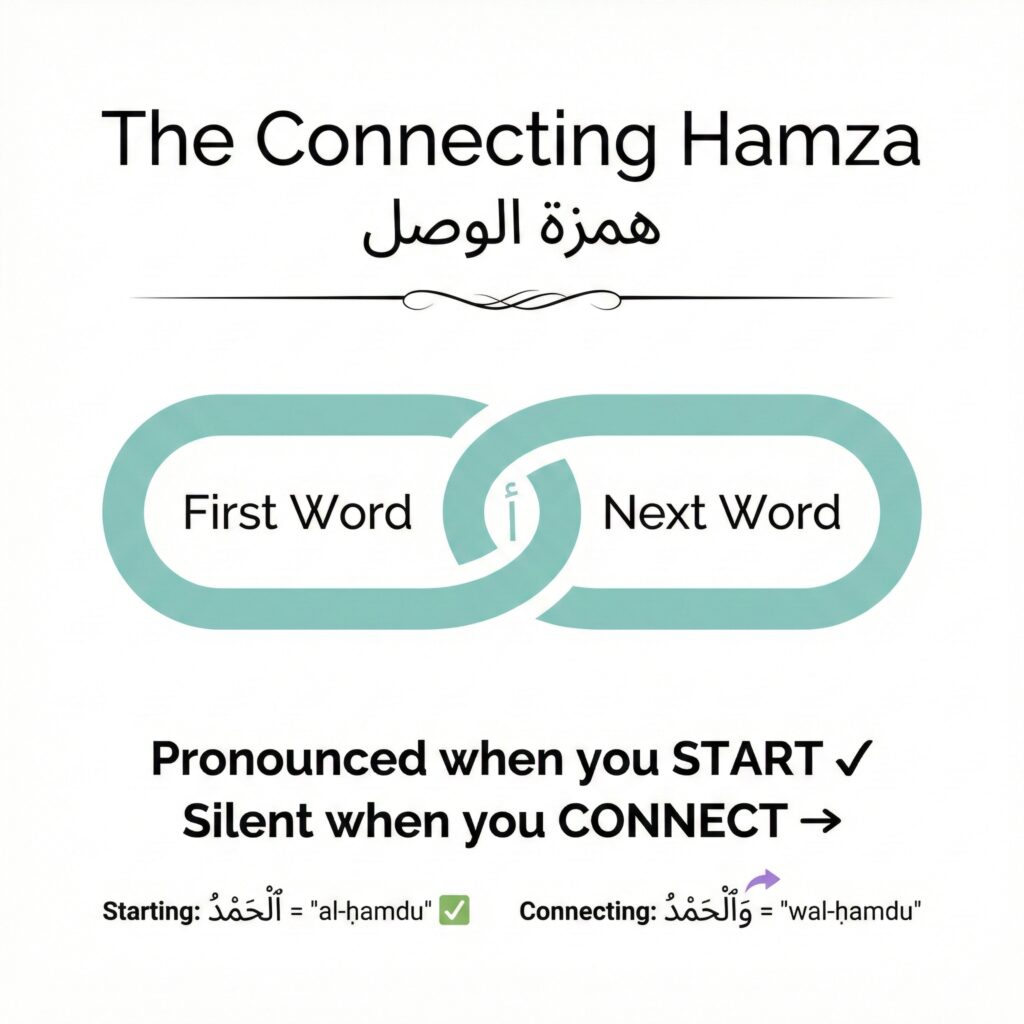
Hamzatul Wasl is a special connecting hamza that appears at the beginning of certain Arabic words, is pronounced only when starting a new utterance, and drops silently in continuous speech to keep recitation smooth and flowing. This fundamental Tajweed rule affects how words connect in fluent Quran recitation and is essential for anyone learning proper Arabic pronunciation.
What Is Hamzatul Wasl?
Its specialized sound occurs at the beginning of specific words and acts like a bridge, linking them smoothly without disrupting the flow of speech. The term “hamzatul wasl” translates literally to “the connecting hamza” in Arabic.
The core principle behind hamzatul wasl stems from a fundamental rule in Arabic phonetics. Arabic does not permit words to begin with a consonant that has sukoon (no vowel sound).
When Arabic speakers encountered words beginning with silent consonants, they needed a solution. Quran Grace explains that hamzatul wasl rules were created specifically to prevent starting words with saakin letters, transforming potential pronunciation difficulties into smooth, natural speech.
How Hamzatul Wasl Appears in Writing?
In the Quran, hamzatul wasl is written as an alif with a distinctive marking. Written as: ٱ (alif with a small saad-like symbol above it). Looks like: In printed Mushafs, you’ll see a tiny curved mark resembling the letter saad (صـ) positioned above the alif. (In the Quran, this appears above the text to help reciters identify connecting hamzas immediately.)
Riwaq Al Quran notes that while the alif may have a hamza symbol above or below it or nothing at all, hamzatul wasl distinctively carries this small saad marking. This calligraphic difference helps reciters distinguish between a true alif, a regular hamza, and a connecting hamza at a glance.
In everyday Arabic texts outside the Quran, hamzatul wasl often appears as a plain alif without special marking, which can make it challenging for learners to identify. However, knowing the grammatical patterns where it occurs helps you recognize it reliably.
When to Pronounce Hamza Wasl and When to Drop?
The pronunciation of hamzatul wasl follows a straightforward principle that depends entirely on context.
Pronounce hamzatul wasl when: The word containing it starts a sentence, verse, or utterance. You’re beginning recitation from that specific word after a pause. You’re reading the word in isolation.
Drop hamzatul wasl when: The word is preceded by another word with a vowel sound. You’re reading continuously without pause. The previous word connects directly to the following consonant.
Consider the phrase from Surah Al-Fatiha: ٱلْحَمْدُ لِلَّهِ (al-hamdu lillah). When you begin recitation with this phrase, you clearly pronounce the hamza in ٱلْحَمْدُ, saying “al-hamdu.” However, in the complete verse وَقُلِ ٱلْحَمْدُ لِلَّهِ (wa qulil-hamdu lillah), the hamzatul wasl drops. The vowel from “quli” flows directly into the “h” sound of “hamdu,” creating seamless connection.
Where does Hamzatul Wasl appear in Arabic Words?
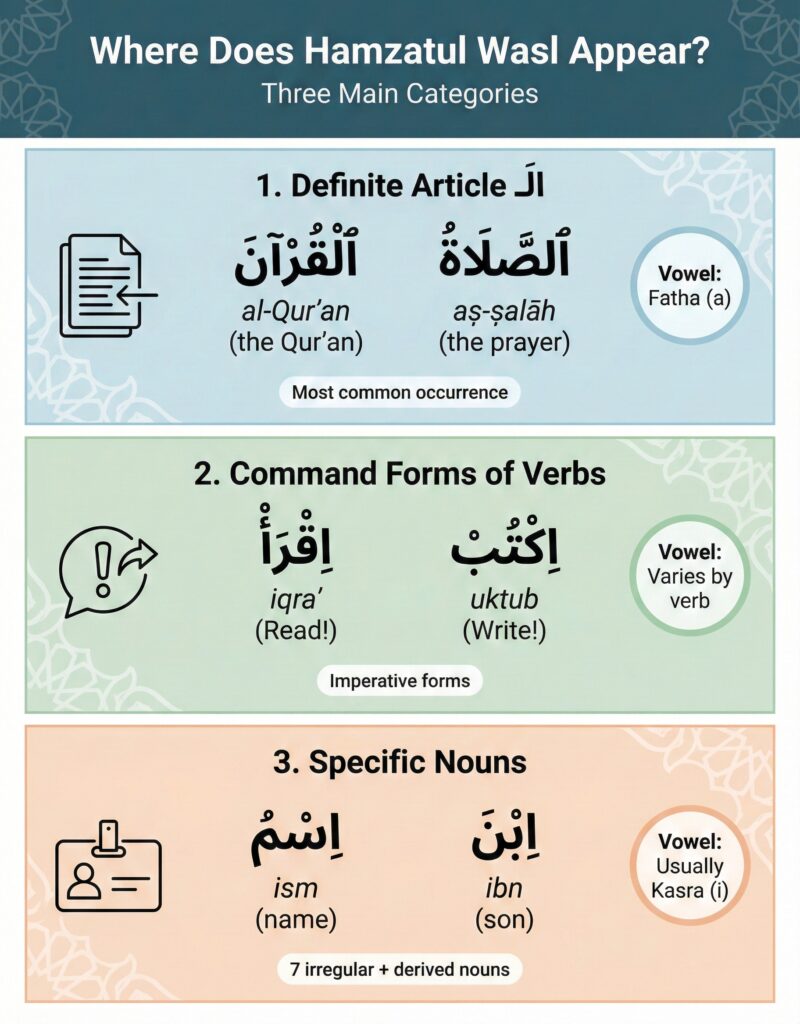
Understanding the specific locations where hamzatul wasl occurs helps you identify it quickly during reading and recitation. Tajweed Me explains that hamzatul wasl occurs in three main categories: nouns, verbs, and particles.
In the Definite Article “Al” (ٱلـ)
The most common occurrence of hamzatul wasl is in the Arabic definite article “al.” Every time you see ٱلـ at the beginning of a word, that initial alif is hamzatul wasl.
Examples from the Quran include: ٱلرَّحْمٰنُ (ar-Rahman, the Most Merciful), ٱلرَّحِيمُ (ar-Rahim, the Most Compassionate), ٱلصَّلَاة (as-salah, the prayer), ٱلْقُرْآن (al-Quran, the Quran).
When these words appear at the start of recitation, the hamza is pronounced with a fatha vowel sound. When preceded by connecting words like وَ (wa, meaning “and”) or فَ (fa, meaning “so”), the hamza drops and the previous vowel connects directly to the following consonant.
In Command Forms of Verbs
Command verbs in Arabic frequently begin with hamzatul wasl. This applies to imperative forms derived from three-letter, five-letter, and six-letter root verbs.
For three-letter root verbs: ٱكْتُبْ (uktub, write!), ٱقْرَأْ (iqra, read!), ٱذْهَبْ (idhhab, go!).
For five-letter root verbs: ٱسْتَغْفِرُوا (istaghfiru, seek forgiveness!), ٱنْطَلِقْ (intalaqa, go forth!).
For six-letter root verbs: ٱسْتَكْبِرْ (istakbir, be arrogant).
About Tajweed explains that when the past tense or command form of a verb has sukoon for the first letter, a hamzatul wasl is needed to start the verb. The hamzatul wasl never appears at the beginning of present tense verbs.
In Specific Nouns
Certain nouns in Arabic naturally begin with hamzatul wasl. These include both regular (qiyasi) and irregular (sama’i) nouns.
Irregular nouns with hamzatul wasl: ٱبْن (ibn, son), ٱبْنَة (ibnah, daughter), ٱثْنَانِ (ithnan, two, masculine), ٱثْنَتَانِ (ithnatain, two, feminine), ٱسْم (ism, name), ٱمْرَأَة (imra’ah, woman), ٱمْرُؤ (imru’, man).
Regular nouns derived from five or six-letter verbs: When verbs with five or six root letters are converted to nouns (masdar forms), those nouns begin with hamzatul wasl. Examples include ٱنْطِلَاق (intilaq, departure) from the verb ٱنْطَلَقَ (intalaqa, he departed), and ٱسْتِكْبَار (istikbar, arrogance) from ٱسْتَكْبَرَ (istakbara, he was arrogant).
Determining the Correct Vowel Sound for Hamzatul Wasl
When you pronounce hamzatul wasl at the beginning of speech, you must use the correct vowel sound. The vowel depends on the type of word and follows specific rules.
For the Definite Article (ٱلـ)
The definite article always takes fatha (the “a” sound). When starting with ٱلْقُرْآن, you say “al-Quran” with a clear “a” vowel on the hamza.
Hamzatul Wasl For Nouns
Most nouns with hamzatul wasl use kasra (the “i” sound) when pronounced at the beginning of speech. When starting with ٱسْم, you say “ism” with an “i” vowel. When starting with ٱبْن, you say “ibn” with an “i” vowel.
Notable exceptions exist for specific words like ٱثْنَانِ and ٱمْرَأَة, which also use kasra.
Hamzatul Wasl For Verbs
The vowel sound for verbs follows a more complex rule based on the third letter of the past tense form. Itqan Academy details the verb vowel rule: look at the third letter in the past tense form.
If the third letter has dammah (u-sound), begin the verb with dammah. Example: ٱدْخُلُوا becomes “udhkhulu” with “u” vowel. If the third letter has kasra (i-sound), begin with kasra. Example: ٱسْتَغْفِرُوا becomes “istaghfiru” with “i” vowel. If the third letter has fatha (a-sound), begin with kasra. This is the default for most verbs.
This rule ensures that every verb with hamzatul wasl receives appropriate pronunciation when starting recitation.
the Difference between Hamzatul Wasl vs Hamzatul Qat’
One of the most common challenges for Quran learners is distinguishing between hamzatul wasl and hamzatul qat’. These two types of hamza follow completely different rules and mixing them leads to mispronunciation.
What is Hamzatul Qat’?
Hamzatul qat’ (همزة القطع) literally means “the cutting hamza.” Kalimah Center explains that hamzatul qat’ is the hamza that is always pronounced and written, whether at the beginning of speech or in its connection. This hamza “cuts” or “interrupts” the flow, creating a distinct glottal stop.
Written as: أ or إ or ؤ or ئ (hamza with various seats). Looks like: A small symbol resembling the head of the letter ‘ayn (ع) that appears above or below the alif, or sits on waaw or yaa. (In the Quran, this appears as a visible hamza symbol rather than the small saad marking.)
Key differences include: Position in word: Hamzatul qat’ can appear at the beginning, middle, or end of words. Hamzatul wasl only appears at the beginning. Pronunciation: Hamzatul qat’ is always pronounced regardless of position. Hamzatul wasl is pronounced only at the beginning of utterances. Visual marking: Hamzatul qat’ shows a visible hamza symbol (ء). Hamzatul wasl shows a small saad symbol (صـ) in the Quran. With vowel markings: Hamzatul qat’ can have fatha, kasra, or dammah marked above or below it. Hamzatul wasl has no vowel marking written over it.
Quick Test to Identify Hamzatul Wasl
Quran House provides a practical test: add a conjunction like waw (و) in front of the word that begins with hamza. If the hamza disappears in pronunciation, it’s hamzatul wasl (connecting). If it remains clear in pronunciation, it’s hamzatul qat’ (cutting). The hamza must be proven when writing the word.
Example: ٱلْكِتَاب (al-kitab, the book). Add وَ before it: وَٱلْكِتَاب. In pronunciation, this becomes “wal-kitab” (not “wa-al-kitab”). The hamza disappeared, confirming it’s hamzatul wasl.
Example: أَكَلَ (akala, he ate). Add وَ before it: وَأَكَلَ. In pronunciation, this remains “wa-akala.” The hamza is still pronounced, confirming it’s hamzatul qat’.
Special Tajweed Cases: Hamzatul Wasl with Tanween and Other Letters
Advanced recitation involves understanding how hamzatul wasl interacts with other Tajweed rules, particularly when preceded by tanween (nunation) or specific letters.
When Preceded by Tanween?
Quran House explains that when hamzatul wasl is preceded by tanween, the nun of tanween must be pronounced with kasra to eliminate consecutive consonants. This creates smooth connection between the tanween and the following word.
Example: رَجُلٌ ٱسْمُهُ (a man whose name). Written form shows: رَجُلٌ ٱسْمُهُ. Pronounced as: “rajulinis-muhu” (the tanween becomes “in” with kasra, and hamzatul wasl drops).
The first consonant is the pronounced nun of tanween, and the second consonant is the letter following hamzatul wasl. Since hamzatul wasl is not pronounced during connected speech, the kasra on the tanween connects directly to the subsequent letter.
When Preceded by Connecting Particles?
When hamzatul wasl comes after particles like وَ (wa, and) or فَ (fa, so), the hamza is silent and the particle’s vowel connects directly to the following consonant.
Examples: وَٱسْتَعِينُوا (wa-ista’inu, and seek help) becomes “wastai’nu” in pronunciation. فَٱدْخُلِي (fa-dkhuli, so enter) becomes “fadkhuli” in pronunciation.
When Preceded by Words Ending in Sukoon?
Tajweed Me notes that when hamzatul wasl is preceded by sukoon, special circumstances apply. If the word مِنْ (min, from) precedes hamzatul wasl, the silent noon is voweled with fatha. This happens automatically in the Quranic script.
For words ending in long vowels (madd letters), a different rule called “prevention of two sakins meeting” applies. In this case, both the hamzatul wasl and the long vowel are dropped to avoid consecutive silent sounds.
Practical Learning Strategies for Mastering Hamzatul Wasl
Developing proficiency with hamzatul wasl requires systematic practice and the right resources. Here are proven strategies that help learners master this essential rule.
Start with Pattern Recognition
Begin by memorizing the common patterns where hamzatul wasl appears. Focus first on the definite article ٱلـ since it’s the most frequent occurrence. Practice identifying it in verses you’re already familiar with from daily prayers.
Next, learn the seven irregular nouns (ٱبْن، ٱبْنَة، ٱثْنَانِ، ٱثْنَتَانِ، ٱسْم، ٱمْرَأَة، ٱمْرُؤ) by heart. These appear regularly in both Quranic and everyday Arabic, making them essential vocabulary.
Practice with Marked Mushafs
Use a color-coded Tajweed Mushaf that clearly shows the small saad symbol (صـ) above hamzatul wasl letters. Shaykhi Academy recommends utilizing Quranic fonts that display this visual cue to reinforce the concept of the silent hamza.
When reading, consciously note each hamzatul wasl you encounter. Practice reading the same verse twice: once starting from the word with hamzatul wasl (pronouncing it), and once reading continuously from the previous word (dropping it).
Listen to Expert Reciters
Auditory learning is crucial for Tajweed. Listen repeatedly to renowned Quran reciters like Sheikh Abdul Basit, Sheikh Mishary Rashid, or Sheikh Muhammad Siddiq Al-Minshawi. Pay specific attention to how they handle hamzatul wasl at verse beginnings versus in continuous recitation.
Many online platforms now offer verse-by-verse recitation with highlighting, allowing you to follow along visually while hearing proper pronunciation.
Work with a Qualified Teacher
While self-study helps build foundational knowledge, working with an experienced Tajweed teacher is invaluable. A teacher can correct subtle pronunciation errors you might not notice yourself, particularly regarding vowel sounds on hamzatul wasl and the smoothness of connections.
Consider online Tajweed courses that offer one-on-one sessions with qualified instructors. Many platforms now connect students worldwide with teachers from Al-Azhar or other reputable Islamic institutions.
Use Minimal Pairs for Practice
Shaykhi Academy suggests practicing with minimal pairs, which are words that differ only by the presence or absence of pronounced hamzatul wasl. This sharpens your ability to hear and produce the distinction.
Example pair: ٱقْرَأْ (iqra, read, with hamzatul wasl at the beginning) versus أَقْرَأُ (aqra’u, I read, with hamzatul qat’ that’s always pronounced).
The subtle pronunciation difference changes meaning entirely, making this practice essential for accuracy.
Regular Reading Aloud
Dedicate time each day to reading Arabic texts aloud, paying specific attention to hamzatul wasl. Start with familiar Surahs from your daily prayers, then expand to other portions of the Quran. The more you practice, the more natural the rules become.
Common Mistakes and How to Avoid Them
Even advanced learners sometimes struggle with hamzatul wasl. Being aware of common errors helps you avoid them.
Mistake 1: Pronouncing Hamzatul Wasl in the Middle of Speech
The most frequent error is pronouncing hamzatul wasl when it should be dropped. This happens when learners treat it like hamzatul qat’, reading every alif with full pronunciation regardless of context.
Solution: Before reading any verse, identify all instances of hamzatul wasl. Mark them mentally or physically in your practice Mushaf. When reading continuously, consciously drop these hamzas and let the previous vowel flow directly into the next consonant.
Mistake 2: Dropping Hamzatul Qat’ by Mistake
The reverse error, dropping hamzatul qat’ when it should be pronounced, often occurs when learners see an alif at the beginning of a word and assume it’s hamzatul wasl.
Solution: Learn to quickly identify the visual difference. If you see a hamza symbol (ء) above or below the alif, or if the alif has a vowel marking (fatha, kasra, dammah), it’s hamzatul qat’ and must be pronounced. If you see the small saad marking (صـ) or if it’s the definite article ٱلـ, it’s hamzatul wasl.
Mistake 3: Using the Wrong Vowel Sound
When starting recitation with hamzatul wasl, using an incorrect vowel sound (saying “al-kitab” instead of “ul-ktub” for a command verb, for example) changes the pronunciation and can affect comprehension.
Solution: Memorize the vowel rules: fatha for definite articles, kasra for most nouns, and the third-letter rule for verbs. When uncertain, consult a reliable Tajweed reference or teacher.
Mistake 4: Not Applying the Tanween Rule
When tanween precedes hamzatul wasl, forgetting to change the tanween to kasra creates awkward pronunciation and violates Tajweed rules.
Solution: Whenever you see tanween followed by hamzatul wasl, automatically convert that tanween to an “in” sound with kasra. Practice this pattern repeatedly until it becomes second nature.
Why Hamzatul Wasl Is Essential for Beautiful Recitation?
Mastering hamzatul wasl transforms your Quran recitation from choppy and disconnected to smooth and melodious. The rule exists specifically to maintain the natural flow and rhythm that makes Arabic such a phonetically beautiful language.
When hamzatul wasl is applied correctly, words blend seamlessly into phrases, phrases flow into verses, and verses connect into passages. This creates the distinctive sound that characterizes expert Quranic recitation, a sound that captures hearts and touches souls.
Beyond aesthetics, correct application of hamzatul wasl demonstrates respect for the Quran’s linguistic precision. Every rule in Tajweed serves to preserve the exact pronunciation taught by the Prophet Muhammad (peace be upon him) and transmitted through generations of careful reciters.
For non-native Arabic speakers, hamzatul wasl can initially seem complex. However, with consistent practice and proper guidance, it becomes intuitive. The investment in learning this rule pays dividends throughout your Quranic studies, improving your recitation quality, comprehension, and connection with the sacred text.
Whether you’re just beginning your Tajweed journey or refining advanced skills, hamzatul wasl deserves focused attention. Master this connecting hamza, and you’ll notice immediate improvement in the fluency and beauty of your recitation.