
Learning Quran symbols is essential for proper recitation and understanding. These specialized marks, developed by Islamic scholars over centuries, guide readers in pronunciation, pausing, and maintaining the correct meaning of verses. This comprehensive guide covers the 15 most important symbols every beginner should recognize.
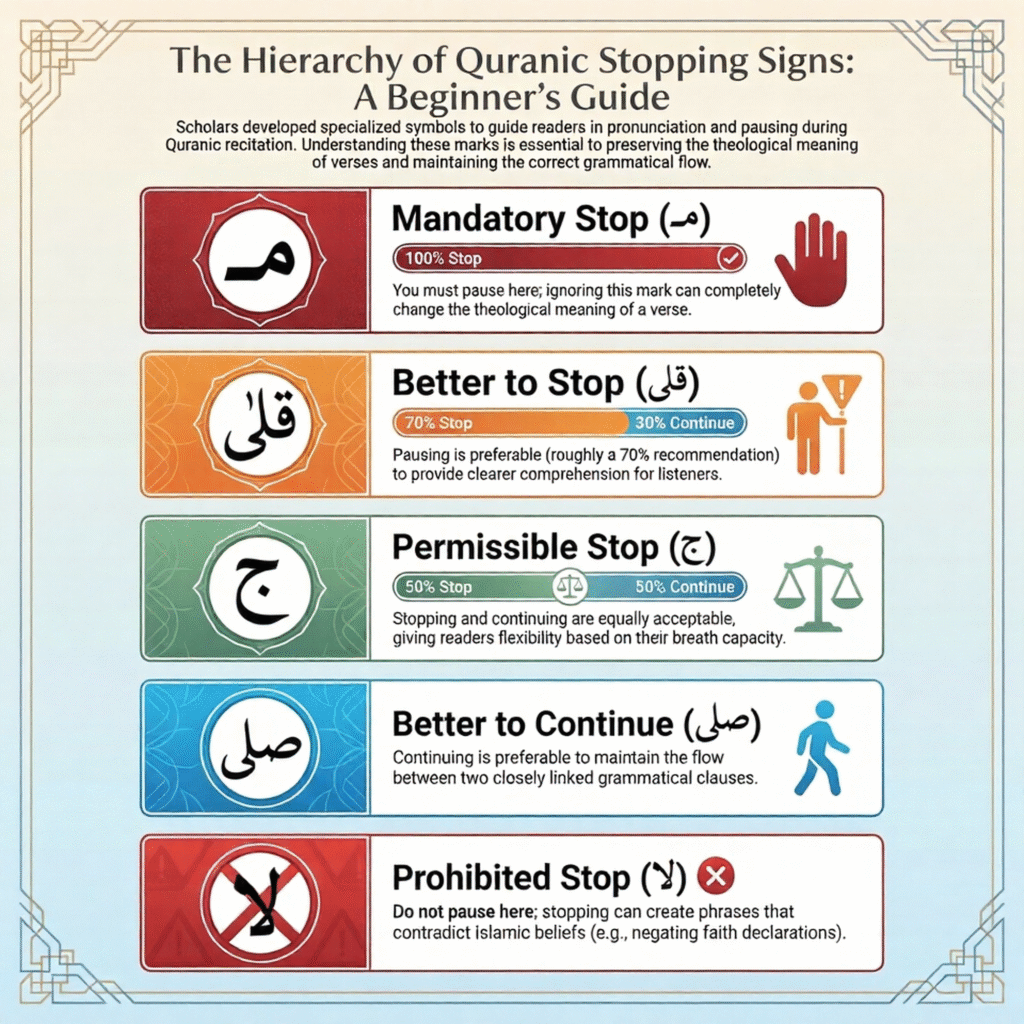
1. Mandatory Stop (مـ)
The Mandatory Stop sign, written as a small horizontal “meem” (مـ), is one of the most critical symbols in the Quran. When you encounter this mark, you must pause your recitation.
Ignoring a Mandatory Stop can completely change the theological meaning of a verse. For example, stopping at the wrong place might separate a condition from its result, creating confusion about Islamic teachings.
When you see this symbol:
- Complete the word where it appears
- Take a full breath
- Resume recitation from the beginning of the next sentence or phrase
Islamic universities emphasize that this symbol protects the integrity of Quranic meaning. Unlike optional stopping points, the Mandatory Stop ensures readers never accidentally distort the message.
2. Prohibited Stop (لا)
The Prohibited Stop appears as the Arabic letters “lam” and “alif” (لا), literally meaning “no” or “don’t.” This symbol warns readers not to pause at this location.
Many new learners mistakenly treat this as a stopping sign because it looks decorative. However, stopping at a Prohibited Stop can create phrases that contradict Islamic beliefs.
The classic example involves the phrase “There is no god” (La ilaha). If you stop here without continuing to “except Allah” (illa Allah), you have negated the entire declaration of faith.
If you absolutely must breathe at a Prohibited Stop due to physical necessity:
- Keep the pause as brief as possible
- Restart from at least two words before the stopping point
- This ensures listeners hear the complete thought
3. Permissible Stop (ج)
The letter “jeem” (ج) indicates that stopping or continuing are equally acceptable choices. This symbol gives readers flexibility based on their breath capacity and comfort.
Permissible Stops typically appear where a sentence ends but the following sentence continues the same theme. Both options maintain the correct meaning.
Research from leading Islamic institutions shows that these marks were carefully placed by scholars who studied the grammatical and thematic flow of each verse.
If you choose to stop at a Permissible mark, consider repeating the last word when you resume. This helps listeners maintain context, especially in group settings or when teaching children.
4. Better to Stop (قلى)
The symbol “qila” (قلى) suggests that pausing is preferable, though continuing is also permissible. This creates a hierarchy of choices for the reader.
Think of this as a 70-30 recommendation. While you won’t make an error by continuing, stopping usually provides clearer comprehension for listeners.
| Symbol | Arabic | Meaning | Action Priority |
| Mandatory Stop | مـ | Must stop | 100% stop |
| Better to Stop | قلى | Prefer to stop | 70% stop, 30% continue |
| Permissible Stop | ج | Equal choice | 50% stop, 50% continue |
This graduated system allows readers to develop natural rhythm while respecting the structure of Quranic Arabic.
5. Better to Continue (صلى)
Written as “sala” (صلى), this symbol indicates that continuing without pause is preferable, though stopping is allowed.
Why Continue?
These marks usually appear where two clauses are closely linked grammatically. Continuing maintains the flow and helps listeners grasp the relationship between ideas.
Different Quran editions may show slight variations of this symbol. The Madinah Mushaf uses “صلى” while some Indo-Pak editions use alternative markers. The meaning remains identical across all authentic prints.
6. Saktah (س)
The letter “seen” (س) indicates a special type of pause called Saktah. This is one of the most misunderstood symbols among beginners.
A Saktah is a pause in your voice without taking a breath. You stop the sound but keep your breath held, then immediately continue.
Normal stop: sound stops + breath taken + resume Saktah: sound stops + no breath + resume
Saktah marks appear only in specific locations throughout the Quran, often for rhythmic or phonetic clarity. Scholars note that proper Saktah execution is considered a mark of advanced Tajweed knowledge.
7. Madd (Elongation) (~)
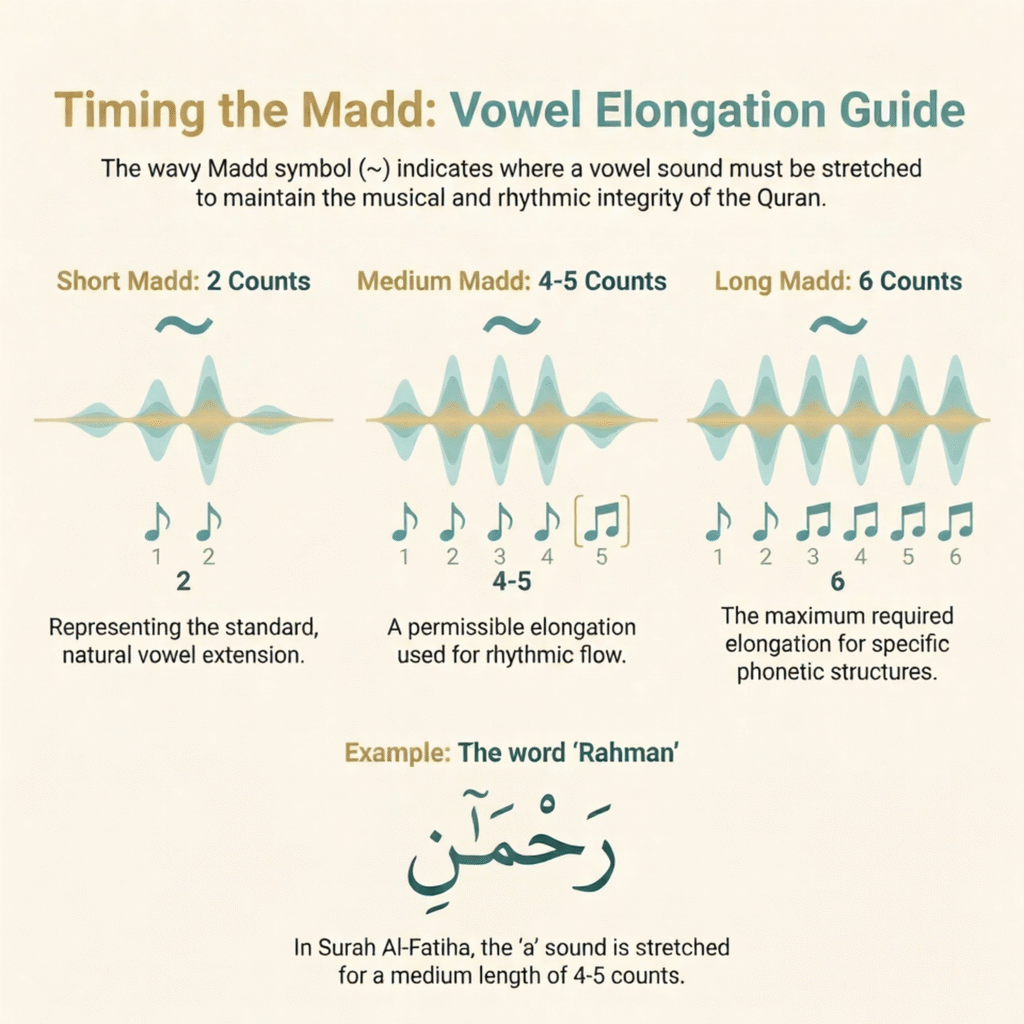
The wavy line (~) above or near a letter signals that the vowel sound should be stretched. This symbol directly affects the musical quality of Quranic recitation.
Not all wavy lines are equal. Madd lengths vary:
- Short Madd: 2 counts (normal vowel extension)
- Medium Madd: 4-5 counts (permissible elongation)
- Long Madd: 6 counts (required elongation)
The word “Rahman” in Surah Al-Fatiha contains a Madd. Instead of saying “Rah-man” quickly, you extend it to “Raaaaah-man” for approximately 4-5 counts.
Academic research on Tajweed science shows that proper Madd application distinguishes fluent readers from beginners. Many Quran learning programs, including structured courses at Noor-path, emphasize Madd practice in early lessons.
8. Shaddah (ّ)
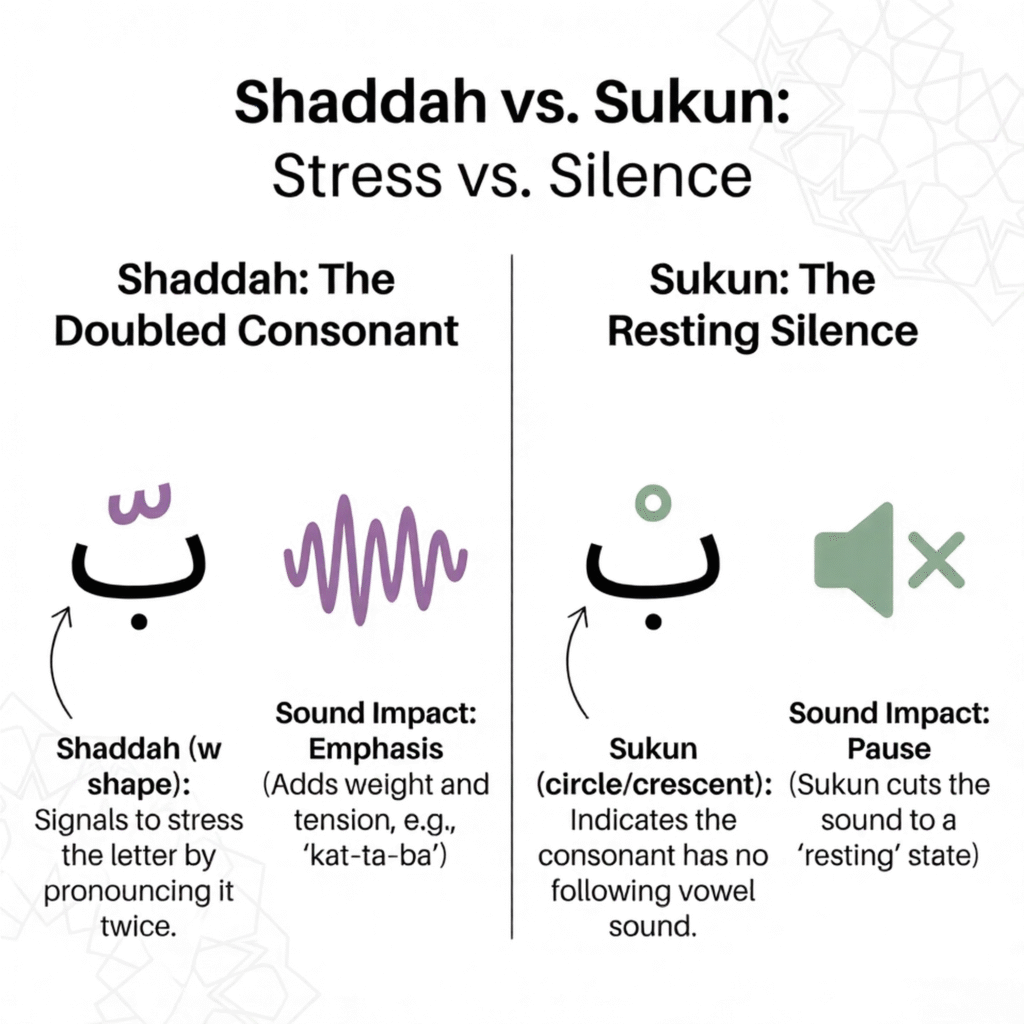
The Shaddah looks like a small “w” or “3” shape positioned above a letter. It indicates that the consonant should be doubled or stressed.
When you see Shaddah over a letter, pronounce it twice without breaking:
- Without Shaddah: “ka-ta-ba” (he wrote)
- With Shaddah: “kat-ta-ba” (he made write)
The Shaddah is often combined with vowel marks:
- Shaddah + Fathah: stressed consonant with “a” sound
- Shaddah + Kasrah: stressed consonant with “i” sound
- Shaddah + Dhammah: stressed consonant with “u” sound
9. Sukun (ْ)
The Sukun appears as a small circle or crescent above a letter, indicating that the consonant has no vowel sound following it. The letter is “silent” or “resting.”
Different Styles Across Editions
| Mushaf Type | Sukun Shape |
| Madinah (Uthmani) | Small crescent |
| Indo-Pak | Small circle |
| Educational texts | Open circle |
All variations carry the same meaning and pronunciation rule.
Beginners sometimes confuse Sukun with the number zero. Remember that Sukun affects pronunciation, not numerical value. It tells you to stop the vowel sound on that letter.
10. Ayah Markers
These decorative circles or ornaments contain numbers and appear at the end of each verse. They serve both aesthetic and practical purposes.
Each marker shows:
- The verse number
- The division point between verses
- Where to pause naturally during memorization
Different regions have distinct artistic styles for Ayah markers. Some Mushafs feature elaborate floral designs, while others use simple numbered circles. The function remains universal across all authentic editions.
11. Sajdah Sign (۩)
This dome-shaped symbol (۩) indicates a verse where prostration is recommended or required during recitation.
When you reach a Sajdah verse:
- Complete the verse
- Say “Allahu Akbar” (God is Greatest)
- Perform a single prostration
- Rise and continue recitation
Islamic jurisprudence identifies 14 to 15 Sajdah points in the Quran (the variation depends on different schools of thought). Most appear in longer Surahs that discuss the magnificence of creation or divine signs.
According to traditional scholarship, you should be in a state of Wudu (ablution) when performing the Sajdah, though there is some flexibility in certain circumstances.
The Hanafi school generally counts 14 recitation prostrations, while the Shafi’i, Maliki, and Hanbali schools count 15 — a difference tied to how an additional Sajdah in Surah Sad is classified.
12. Juz and Hizb Markers
These symbols divide the Quran into manageable reading portions for daily recitation.
The Quran contains:
- 30 Juz (major divisions)
- 60 Hizb (each Juz has 2 Hizb)
- 240 Rub’ al-Hizb (each Hizb has 4 quarters)
Juz markers typically appear in the margins with ornamental designs and the number written in Arabic or numerals. The Rub’ al-Hizb uses a star-like symbol (۞).
Many Muslims aim to complete the Quran during Ramadan by reading one Juz daily. These markers make it easy to track progress and plan reading schedules.
Many readers search for this mark as “the asterisk in the Quran” — that’s this same Rub al-Hizb star. In some regional Mushaf styles, the identical marker appears as an eight-petaled floral rosette instead of a sharp-pointed star; both forms carry the same meaning, and neither should be confused with the dome-shaped Sajdah sign (۩), which serves a completely different function.
13. Mu’anaqah (∴ ∴)
Two sets of three dots (∴ ∴) create a unique stopping rule. You may stop at either the first set OR the second set, but never both.
This symbol appears when two phrases are closely related alternatives or examples. Stopping at both would create unnecessary repetition or break the natural flow.
Choose based on:
- Your breath capacity
- Whether you want to emphasize the first or second phrase
- The needs of your listeners
This is considered an advanced Tajweed concept, so beginners should consult qualified teachers when first encountering these marks.
14. Short Vowel Marks (Harakaat)
Three fundamental marks control the vowel sounds in Arabic:
Fathah (َ): A small diagonal line above the letter, producing an “a” sound Kasrah (ِ): A small diagonal line below the letter, producing an “i” sound
Dhammah (ُ): A small “و” shape above the letter, producing an “u” sound
The original Quranic text contained only consonants. Early scholars added these marks to preserve correct pronunciation for non-Arab Muslims and future generations.
Abu al-Aswad al-Du’ali introduced the first vowel system using colored dots during the Umayyad period. Later, Al-Khalil ibn Ahmad developed the modern symbols still used today.
15. Tanween (Double Vowels)
Tanween appears as doubled versions of the short vowel marks, adding an “n” sound to the end of a word.
The Three Types:
- Tanween Fathah (ً): produces “an” sound
- Tanween Kasrah (ٍ): produces “in” sound
- Tanween Dhammah (ٌ): produces “un” sound
In Uthmani script, the alignment of Tanween marks provides additional information:
- Parallel marks: Clear pronunciation (Izhar)
- Offset marks: Nasal sound required (Ghunnah)
This subtle feature helps advanced readers apply Tajweed rules without memorizing every exception.
Common Mistakes Beginners Make with Quran Symbol
- Treating the Prohibited Stop (لا) as decorative — its angular shape can look ornamental to new readers, leading them to pause where they shouldn’t.
- Confusing Saktah with a normal stop — Saktah requires holding the breath, not releasing it; releasing the breath here is one of the most common beginner errors.
- Ignoring Madd length distinctions — treating all wavy elongation marks as equal, when short, medium, and long Madd carry different counts and, in some cases, different rulings.
- Skipping symbol legends — nearly every printed Mushaf includes a glossary of its quran symbols meaning in the back pages; beginners often never check it, missing regional variations in how marks are drawn.
- Assuming all Mushaf editions use identical symbols — Indo-Pak and Madinah prints sometimes use different letters for the same stop type (e.g., ص vs ز for a preferred stop), which can confuse readers switching between editions.
What Quran Symbols Are?
When you open any printed Mushaf today, you’ll immediately notice small marks and symbols scattered throughout the Arabic text. These aren’t decorative elements. They’re precision tools developed over centuries to safeguard the Quran’s pronunciation and meaning.
the original Quranic revelation contained no diacritical marks, dots, or Tajweed symbols. Early Muslims who were native Arabic speakers could read the text without assistance. However, as Islam spread beyond Arabia and non-Arab populations embraced the faith, scholars recognized an urgent need for pronunciation guides. Islamic sources indicate that vowel symbols and diacritical marks were systematically introduced during the time of Caliph Abdul Malik ibn Marwan around 65 AH (approximately 685 CE) to preserve accurate recitation.
These symbols serve multiple critical functions:
- Pronunciation guidance: Show how to articulate each letter correctly
- Pause indicators: Mark where stopping is mandatory, recommended, or prohibited
- Meaning preservation: Prevent recitation errors that could alter verse meanings
- Structural markers: Identify verse endings, chapter divisions, and memorization sections
- Worship cues: Signal when prostration (sujud) is recommended
Understanding these marks transforms recitation from merely reading words to delivering the Quran exactly as it was revealed, with proper rhythm, melody, and semantic clarity.
What Is a Mushaf? Understanding the Physical Quran
Before exploring individual quranic marks, it helps to understand the object they appear in. A physical quran — properly called a Mushaf (مصحف) — is a bound, written copy of the Quranic text. The word “Mushaf” simply means “a collection of written sheets,” and it’s the term Muslims use to distinguish the physical book from “the Quran” as the recited, memorized divine revelation itself.
Every printed Mushaf today contains the same core text but may differ slightly in how it displays tajweed symbols in quran, page layout, and font style, depending on the region and printing house. The Madinah Mushaf (printed in Saudi Arabia) is the most widely distributed worldwide and uses the Uthmani script, the standardized writing system most quran signs in this guide are based on.
Taking Your Next Steps
Understanding Quran symbols transforms your recitation from simple reading to meaningful worship. These 15 symbols represent centuries of scholarly work to preserve the exact pronunciation and meaning of divine revelation.
Start with the stopping signs (symbols 1-6) as they prevent theological errors. Then progress to phonetic marks (symbols 7-9) to improve your pronunciation. Finally, learn structural symbols (symbols 10-12) for organizing your reading practice.
Many beginners find that color-coded Mushafs (Tajweed Qurans) accelerate learning by using different colors for different rules. Almost every printed Mushaf includes a symbol glossary in the back pages, which serves as a quick reference guide.
For structured learning with qualified teachers who can correct your pronunciation in real-time, consider exploring comprehensive Tajweed courses. Noor-path offers beginner-friendly programs that systematically cover each symbol with practical application exercises.
Remember that the companions of the Prophet Muhammad (peace be upon him) learned Quran recitation through oral transmission. While symbols are valuable tools, nothing replaces learning from a knowledgeable teacher who can hear your recitation and provide immediate feedback.
The journey of Quran learning is a lifelong blessing. Each symbol you master brings you closer to reciting as it was revealed, preserving a tradition that spans over 1,400 years.