NoorPath Academy Blog
Key Concepts of Fiqh in Islamic Jurisprudence
As Muslim parents raising our children in the West, we often find ourselves asking big questions. We teach our kids to pray, to fast, to be kind.
November 19, 2025
NoorPath Academy Blog
Key Concepts of Fiqh in Islamic Jurisprudence
As Muslim parents raising our children in the West, we often find ourselves asking big questions. We teach our kids to pray, to fast, to be kind.
November 19, 2025
As Muslim parents raising our children in the West, we often find ourselves asking big questions. We teach our kids to pray, to fast, to be kind. But then come the follow-ups: “Why do we pray this way?” “Is this cartoon okay to watch?” “My friend has a birthday party at a place that serves non-halal food, can I still go?” These aren’t just kids’ questions; they’re our questions, too. We’re all trying to live a life that’s pleasing to Allah (SWT) in a world full of complexities. This is where understanding the key concepts of fiqh becomes not just an academic exercise, but a practical tool for everyday life. It’s the roadmap that helps us navigate our daily choices with confidence and clarity. It’s about transforming our entire life, from our morning routine to our financial decisions, into a conscious act of worship.

What Is Fiqh In Islam?
Let’s be honest, the word “Fiqh” can sound a bit intimidating. It brings to mind thick, dusty books and long, scholarly debates. But the truth is, Fiqh is one of the most practical and accessible parts of our deen.
In the simplest terms, Fiqh is the human understanding and application of the divine law, the Shari’ah. Think of it this way: The Shari’ah, based on the Qur’an and the Sunnah, is the divine “What” and “Why.” It gives us the foundational principles and commands from Allah. Fiqh is the “How.” It’s the detailed methodology derived by qualified scholars to apply those divine principles to our real, messy, beautiful lives.
Imagine you’re building a house. The Shari’ah is the blueprint from the master architect—it tells you the purpose of the house, the essential pillars that must be in place, and the non-negotiable rules for its foundation. Fiqh is the detailed construction manual written by expert builders. It tells you how to mix the concrete, how to lay the bricks for the prayer room, how to wire the electricity safely, and how to ensure the plumbing works according to the blueprint’s standards. You need both to build a strong, functional, and beautiful home.
So, Fiqh isn’t a new set of rules. It’s the deep, scholarly effort to understand and extract the practical rulings from the primary sources of Islam. It covers everything from the grand acts of worship to the tiniest details of social etiquette. It’s the discipline that answers the question, “As a Muslim, how should I handle this situation?” Understanding the key concepts of fiqh empowers us to answer that question for ourselves and our children.
Importance of Fiqh in Everyday Muslim Life
Now, you might be wondering, “Okay, I get the definition, but why is it so important? Can’t I just be a good person and love Allah?” That’s a beautiful sentiment, and it’s the foundation of everything. But love is also an action. When we love someone, we want to know what makes them happy, what they appreciate, and how we can best show that love. Fiqh is the language of that love for Allah (SWT).
Here’s the thing: Fiqh brings intention and mindfulness to our daily existence. Without it, our actions can become hollow rituals. With it, every mundane act can be elevated to an act of worship.
- Clarity in Worship: Fiqh gives us the precise details of our Ibadat (worship). How to make wudu correctly, what breaks our fast, how to calculate Zakat. This clarity ensures our acts of worship are performed as prescribed, giving us peace of mind that we’re doing them correctly. It removes the “am I doing this right?” anxiety.
- Ethical Framework for Life: Life is more than just prayer and fasting. How do we conduct business? What are our rights and responsibilities in a marriage? How do we handle contracts, loans, and neighborly disputes? Fiqh provides a comprehensive ethical framework for all these interactions, ensuring fairness, justice, and compassion.
- Building a Muslim Identity: For our children growing up in the West, a strong Muslim identity is crucial. When they understand the “how” and “why” behind their practices, it’s no longer just “something my parents make me do.” It becomes their own, a conscious choice rooted in wisdom. Teaching them the key concepts of fiqh helps them build a resilient and confident Islamic identity.
- Adapting to Modern Challenges: What does Islam say about social media, cryptocurrency, or genetic engineering? These issues didn’t exist 1400 years ago. Fiqh, through principles like Ijtihad (scholarly reasoning), provides the methodology to address contemporary issues in a way that is faithful to the sources of Islam. It shows that our deen is timeless and relevant for every generation.
In our experience at NoorPath Academy , we’ve seen how learning Fiqh transforms families. It sparks incredible dinner-table conversations and empowers parents to answer their children’s questions with confidence. It moves the conversation from “you have to” to “we get to, and here’s the beautiful reason why.”
Core Sources of Fiqh
To truly appreciate Fiqh, we need to understand where it comes from. It’s not based on the whims or opinions of scholars; it’s a rigorous discipline grounded in primary sources. Think of these sources as a hierarchy of authority, each one building upon the other. For anyone wondering how to study usul al fiqh (the principles of jurisprudence), understanding these sources is the absolute first step.
The Qur’an as the Primary Source
The Qur’an is the ultimate sourcebook. It is the literal word of Allah (SWT), and therefore, it is the highest and most authoritative source for all Islamic rulings. Everything starts here. The Qur’an provides the foundational principles, the clear-cut commands, and the overall moral direction for a Muslim’s life.
Some rulings in the Qur’an are incredibly explicit and detailed. For example, the laws of inheritance (Surah An-Nisa) are laid out with mathematical precision. The punishments for certain major crimes are clearly stated. The command to establish prayer (Salah) and pay Zakat is mentioned repeatedly.
However, the Qur’an often provides broad principles rather than minute details. It tells us to pray, but it doesn’t describe the exact number of rak’ahs for each prayer. It commands us to engage in trade by mutual consent but doesn’t detail every type of modern business contract. This is by divine wisdom. It provides the unshakable foundation while leaving room for the other sources to provide detail and context. This is why our Quran online courses focus not just on recitation, but on understanding the context and meaning behind the verses, which is the first step to understanding Fiqh.
The Sunnah and Hadith
If the Qur’an is the blueprint, the Sunnah is the master builder’s demonstration. The Sunnah refers to the way of life of the Prophet Muhammad (peace be upon him)—his actions, his words, and his tacit approvals. We learn about the Sunnah through the Hadith, which are the records of his traditions.
The Sunnah has a critical role:
- It explains and details the Qur’an: As we mentioned, the Qur’an commands us to pray. It was the Prophet (PBUH) who showed us how. He said, “Pray as you have seen me praying.” His entire life was a practical demonstration of the Qur’an in action.
- It provides rulings on matters not mentioned in the Qur’an: The Sunnah can specify rulings on topics that the Qur’an doesn’t explicitly cover. For example, the prohibition of wearing silk for men comes from the Hadith.
- It reinforces the principles of the Qur’an: The Prophet’s (PBUH) emphasis on kindness to neighbors, honesty in trade, and caring for orphans reinforces and brings to life the general principles mentioned in the Qur’an.
Studying the Hadith is therefore essential for understanding Fiqh. It provides the context and practical application for the divine word. At NoorPath Academy , our hadith online course is designed to help students appreciate this vital connection between the Qur’an and the Sunnah.
Ijma’ (Consensus) and Qiyas (Analogy)
What happens when a new issue arises that isn’t explicitly mentioned in the Qur’an or the Sunnah? This is where the secondary sources, derived from the primary ones, come into play.
Ijma’ (Consensus): Ijma’ is the unanimous agreement of qualified Islamic scholars on a specific legal ruling in a particular era. The authority for this comes from the Prophet’s (PBUH) saying that his Ummah (community) would never collectively agree on an error. When the highest-ranking scholars of a generation all agree on a point of Fiqh, it becomes a binding ruling. For example, the compilation of the Qur’an into a single book (mushaf) was a matter of Ijma’ among the Companions. It wasn’t explicitly commanded in that form, but they all agreed it was necessary to preserve the revelation.
Qiyas (Analogical Reasoning): This is one of the most fascinating tools of Fiqh. Qiyas is the process of deriving a ruling for a new issue by comparing it to an existing issue with a clear ruling, based on a shared underlying reason or cause (‘illah).
Scholars use this same logic. The Qur’an forbids drinking wine because it is an intoxicant that clouds the mind. By Qiyas, scholars have extended this prohibition to all other substances that have the same effect, like narcotics or hard drugs, even though they aren’t mentioned by name in the text. This is how Fiqh remains a living, breathing discipline capable of addressing new challenges. Understanding these sources is fundamental to grasping the key concepts of fiqh.

Key Concepts of Fiqh
Beyond the sources, Fiqh operates on a set of powerful principles and concepts that allow it to be both stable and flexible. These are the tools in the scholar’s toolbox. For us as parents and laypeople, understanding these concepts helps us appreciate the wisdom and compassion embedded in Islamic law. These are the true key concepts of fiqh that unlock a deeper understanding of our deen.
Halal and Haram
This is the most famous Fiqh concept, but it’s often misunderstood as only applying to food. Halal (permissible) and Haram (forbidden) are categories that apply to every single aspect of life.
- Halal/Haram in Food: This is the most obvious. We avoid pork and improperly slaughtered meat. But it also extends to the source of the food. Was the money used to buy it earned through halal means?
- Halal/Haram in Finance: This involves avoiding Riba (interest), gambling (Maysir), and transactions with excessive uncertainty (Gharar). It means earning a living through honest work and ethical investments.
- Halal/Haram in Speech: Lying, backbiting (Gheebah), and slander are Haram. Honest, kind, and beneficial speech is encouraged.
- Halal/Haram in Entertainment: This is a big one for our kids. Is the content of a video game, movie, or book aligned with Islamic values? Does it promote violence, indecency, or disbelief?
The beautiful principle in Fiqh is that everything is considered Halal by default, unless there is clear evidence from the Qur’an or Sunnah to prove it is Haram. This makes life expansive and open, not restrictive. The prohibitions are there to protect us—our faith, our life, our intellect, our family, and our property.
Ijtihad and Taqlid
These two concepts are like two sides of the same coin, and they’re essential for how Fiqh functions in society.
Ijtihad (Scholarly Striving): This is the intense intellectual effort exerted by a highly qualified scholar (a Mujtahid) to derive a ruling on a new or complex matter directly from the primary sources. It’s not something anyone can do. It requires mastery of the Arabic language, the Qur’an and its sciences, Hadith and its sciences, the principles of jurisprudence (Usul al-Fiqh), and more. Ijtihad is the engine of Fiqh that keeps it relevant, addressing issues like IVF, organ donation, and digital finance.
Taqlid (Following a Ruling): Now, let’s be honest. We’re busy parents, not Mujtahids. We don’t have the time or the training to perform Ijtihad. So, what do we do? We practice Taqlid, which means following the qualified opinion of a scholar or a school of thought (Madhhab). This is not “blind following.” It’s a practical necessity, just like when we have a medical issue, we go to a doctor and follow their expert advice. We don’t try to perform surgery on ourselves by reading a medical textbook. Taqlid is about trusting the experts in their field. It’s a mercy from Allah that we don’t all have to become master scholars to practice our religion correctly. This is one of the most practical key concepts of fiqh for the average Muslim.
Maslahah (Public Interest)
Maslahah is a profound concept that shows the deep wisdom and purpose-driven nature of Islamic law. It refers to securing a benefit or preventing a harm, all within the framework of the objectives of Shari’ah (Maqasid al-Shari’ah). These objectives are the preservation of:
- Faith (Deen)
- Life (Nafs)
- Intellect (‘Aql)
- Lineage (Nasl)
- Property (Mal)
Any ruling in Fiqh ultimately serves to protect and promote these five essentials. Maslahah allows scholars to make rulings that serve the public good, even if not explicitly mentioned in the texts. For example, traffic laws. There are no verses about red lights or speed limits. But these laws prevent chaos and save lives. Since they serve the objective of protecting life (Hifdh al-Nafs), they are considered Islamically valid and necessary based on the principle of Maslahah. This concept is a cornerstone among the key concepts of fiqh.
Istihsan (Juristic Preference)
Istihsan is a tool primarily used in the Hanafi school of Fiqh, but its spirit is found across the board. It means to depart from a ruling derived through strict analogy (Qiyas) in favor of a different ruling that is considered better, more suitable, or more just for a specific situation. It’s about choosing the more compassionate or practical solution when a rigid application of a rule would lead to an unfair or difficult outcome.
Think of it as applying the spirit of the law over the letter of the law. For example, if a contract has a very minor, insignificant ambiguity that technically invalidates it by strict Qiyas, a scholar might use Istihsan to uphold the contract, recognizing that voiding it would cause more harm than good and that the ambiguity doesn’t affect the core purpose of the agreement. It’s a mechanism for fairness and equity, showing that Fiqh is not a rigid, unthinking system.
‘Urf (Custom)
This is a hugely important concept for us living in the West. ‘Urf refers to the customs and common practices of a particular society. Fiqh recognizes and gives weight to local customs as long as they do not explicitly contradict a clear text of the Qur’an or Sunnah.
What does this mean for us? It means Islam is not culturally monolithic. The way people dress modestly can differ between Pakistan, Senegal, and Canada—and that’s okay. The specific foods eaten to break the fast, the way a wedding celebration is conducted (within halal limits), or the common language of business contracts can all be shaped by local ‘Urf.
This principle allows Islam to be at home in any culture and any time. It allows us to integrate into our Western societies, adopting the good from our local customs while holding firm to our Islamic principles. It’s a beautiful testament to the universality of our faith and a vital concept for our children to understand. This is one of the key concepts of fiqh that helps build bridges.
Applications of Fiqh in Daily Life
Alright, we’ve covered the theory. But how does all this translate into our busy lives, juggling school runs, work deadlines, and soccer practice? The beauty of Fiqh is in its application. It’s not meant to stay in books; it’s meant to be lived. Many parents ask us, “how to learn fiqh online?” because they want this practical knowledge. At NoorPath Academy , our goal is to make these applications clear and accessible.
Worship (Ibadat)
This is the most direct application of Fiqh. Our Ibadat are the pillars of our faith, and Fiqh provides the structure for those pillars.
- Salah (Prayer): Fiqh tells us the timings for each prayer, the steps for making wudu, the number of rak’ahs, the physical movements, and what to recite. It also covers special situations: How do you pray when you’re traveling? What if you’re sick and can’t stand? Our fiqh lessons often start here, as prayer is the cornerstone of our daily practice. For children, learning the Fiqh of Salah can be made engaging. At NoorPath Academy , we use interactive methods to teach kids the steps, making it a positive and understood experience rather than a chore. This is also where a strong foundation from an Online Quran memorization course becomes so valuable, as they can recite with confidence in their prayers.
- Zakat (Charity): Fiqh details who is obligated to pay Zakat, how to calculate the amount (2.5% of surplus wealth held for a year), what kind of assets are included, and who is eligible to receive it. It turns a simple act of giving into a structured system of social welfare.
- Sawm (Fasting): What time does the fast begin and end? What actions invalidate the fast? Who is exempt (e.g., the sick, travelers)? Fiqh provides clear answers, allowing us to observe the month of Ramadan with confidence and focus on the spiritual benefits.
- Hajj (Pilgrimage): The entire ritual of Hajj is a detailed application of Fiqh, from the state of Ihram to the Tawaf around the Kaaba and the standing at Arafat.
Transactions and Business Ethics (Muamalat)
This is where Fiqh moves out of the prayer room and into the marketplace, the office, and our bank accounts. The goal of Muamalat is to ensure justice, fairness, and the elimination of exploitation.
Imagine you’re starting a small online business. Fiqh guides you:
- Honesty in Dealings: You must be transparent about your product. No false advertising or hiding defects. The Prophet (PBUH) said, “The seller and the buyer have the right to keep or return goods as long as they have not parted. And if they spoke the truth and described the defects, then they would be blessed in their transaction.”
- Valid Contracts: Your terms of service must be clear. The price, product description, and delivery terms should be unambiguous to avoid future disputes.
- Avoiding Riba (Interest): You cannot take out a conventional business loan that involves paying interest. Instead, you would look for Islamic financing options like profit-sharing (Mudarabah) or partnerships (Musharakah).
These principles apply whether you’re a CEO or just selling crafts on Etsy. It’s about bringing your faith into your work and earning a livelihood that is blessed by Allah (SWT). This is a crucial part of any comprehensive online fiqh courses.
Family and Social Relations
Fiqh provides a beautiful and comprehensive framework for building a strong family and a compassionate society. This is often where we, as parents, feel the most need for guidance.
- Marriage (Nikah): Fiqh outlines the conditions for a valid marriage contract, the rights and responsibilities of the husband and wife, and the importance of mutual love and respect. It frames marriage not just as a social contract, but as a sacred bond and half of one’s deen.
- Parenting: While Fiqh doesn’t give a step-by-step parenting manual, it provides guiding principles. The responsibility to provide for children (nafaqah), to educate them in their deen, and to treat them with kindness and justice are all derived from Fiqh. It emphasizes that raising righteous children is one of the greatest investments a person can make. This is a core focus of our parent-friendly approach at NoorPath Academy .
- Inheritance: The Qur’an lays out specific shares of inheritance. Fiqh scholars have detailed these laws to ensure a just and clear distribution of property after a person’s passing, preventing family disputes.
- Neighborly Relations: Fiqh emphasizes the rights of neighbors so strongly that the Prophet (PBUH) said he thought they would be given a share in inheritance. This includes not harming them, sharing food, and checking in on them—a vital lesson for building community, especially in diverse Western neighborhoods.
By understanding these applications, we see that the key concepts of fiqh are not abstract theories. They are living, breathing principles that guide us toward a life of purpose, justice, and devotion.
In Conclusion
We’ve journeyed through the world of Fiqh, from its profound sources in the Qur’an and Sunnah to its practical, everyday applications. We hope you see it now not as a book of rigid rules, but as a compassionate and wise guide for living a life aligned with our faith. It’s the answer to “how” we live as Muslims in a way that is pleasing to Allah (SWT). Understanding the key concepts of fiqh is empowering. It gives us the confidence to navigate modern life, the tools to build strong Muslim families, and the ability to transform every action into an act of worship.
We know that juggling work, school, and Islamic education can feel overwhelming. You might be thinking, “This is all great, but where do I even start?” The truth is, you don’t have to become a scholar overnight. The journey of a thousand miles begins with a single step. Start with the basics that affect your daily life—the Fiqh of prayer, of fasting, of how you earn and spend.
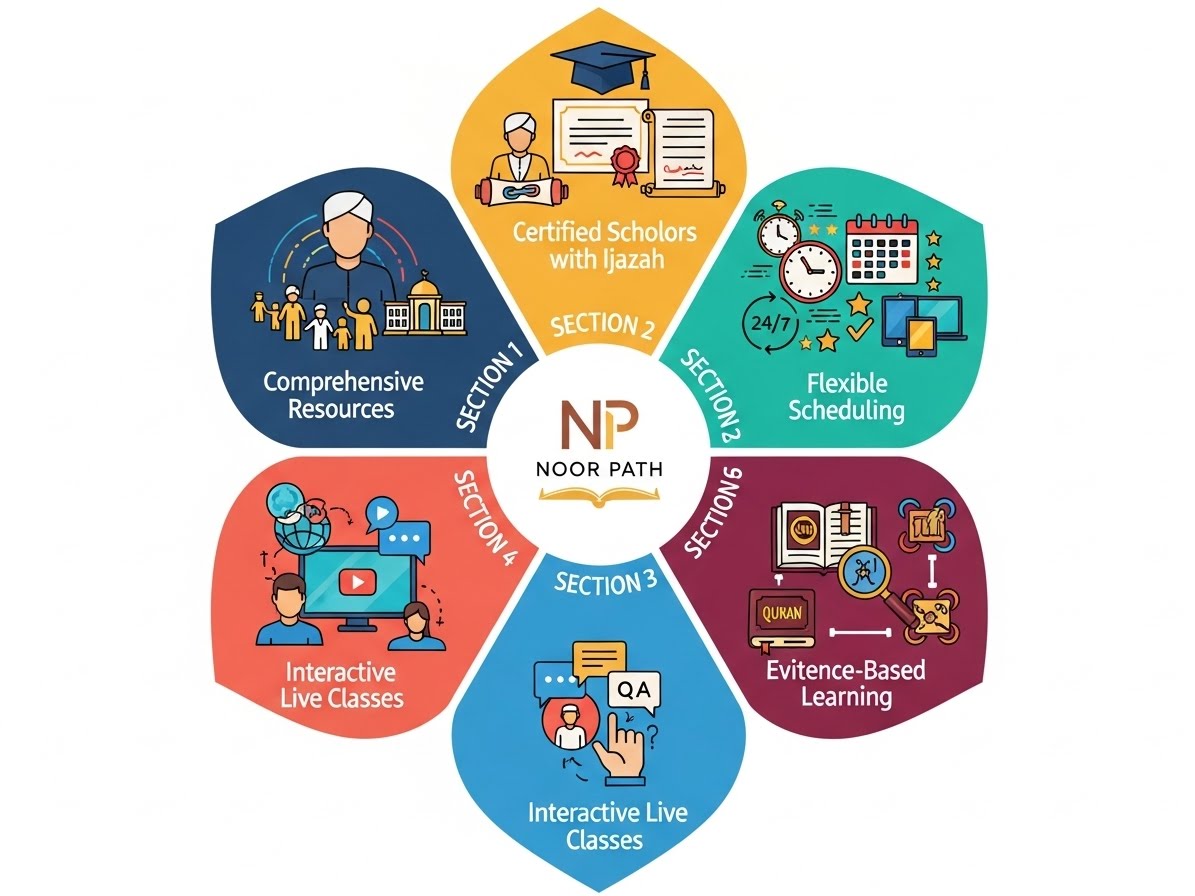
This is precisely why we created NoorPath Academy . We wanted to provide a warm, accessible, and authentic space for families like yours to learn. Our Fiqh classes are designed for busy Western lifestyles, with flexible timings and engaging teachers who understand your reality. Whether you’re looking for a comprehensive islamic fiqh course online for yourself or fun, interactive fiqh lessons for your children, we are here to support you. Our approach is built on making these timeless teachings relevant and inspiring for today’s world.
FAQs
What is the concept of fiqh?
The concept of Fiqh is the human understanding and application of Shari’ah . While Shari’ah is the divine, unchanging law found in the Qur’an and Sunnah, Fiqh is the body of rulings derived from these sources by qualified scholars. In simple terms, if Shari’ah is the what , Fiqh is the how . It’s the practical, detailed manual for living a Muslim life, covering everything from worship to social and business ethics.
What are the 5 major principles of fiqh?
The five major principles of fiqh, often referred to as qawa’id al-fiqhiyyah or legal maxims, are: Acts are judged by intentions, Certainty is not overruled by doubt, Hardship begets facility, Harm must be eliminated, and Custom is the basis of judgment. These principles serve as guiding rules for deriving legal rulings from primary sources like the Quran and Sunnah.
What are the 5 pillars of fiqh?
The five pillars of fiqh are more commonly known as the five pillars of Islam: shahada declaration of faith, salat prayer, zakat charity, sawm fasting during Ramadan, and hajj pilgrimage to Mecca These pillars represent the foundational practices and core beliefs in the Islamic faith.
What are the basics of fiqh?
The basics of fiqh are its fundamental branches, which cover Islamic law and provide guidance for a Muslim’s life, including acts of worship (ibādāt), financial transactions (mu`āmalāt), family matters (munkahāt), and criminal law (jināyāt). Fiqh is the understanding of Islamic law derived from the Quran and the Sunnah (teachings and practices of the Prophet Muhammad) to guide Muslims in their daily lives, ensuring their practices align with Islamic teachings.
Start Today
Ready to speak Arabic that brings you closer to Allah? Join NoorPath Academy’s Quranic Arabic courses, start today and feel the difference in your faith journey.