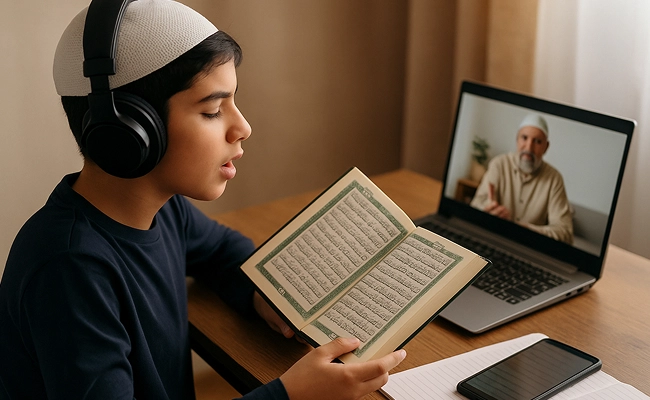
The benefits of reading Quran reach far beyond fulfilling a religious duty. Science and centuries of Islamic scholarship agree: regular engagement with the Quran strengthens memory, calms anxiety, deepens purpose, and transforms character. Whether you are a busy parent in the UK, a student in Canada, or a professional in the USA looking to reconnect with your faith, this guide covers everything you need to know.
A scoping review published in Health Science Reports analyzed 15 studies and found that Quran recitation and listening consistently reduced anxiety, stress, and depression. A systematic review of 28 clinical trials confirmed the same pattern. And a randomized controlled trial among university students found that listening to specific Quranic passages measurably reduced academic anxiety while a control group’s anxiety increased. Here is a quick snapshot of what the evidence shows:
| Area of Benefit | What Research Found |
| Anxiety and stress | Significant reduction across 15+ reviewed studies |
| Depression symptoms | Notable improvement in several clinical trials |
| Academic anxiety | Reduced exam stress scores in RCT vs. control group |
| Memory and recall | Hifz training linked to stronger hippocampal function |
| Emotional well-being | Higher contentment and calm after regular recitation |
This is not a replacement for professional mental health care. It is a powerful, accessible, and faith-aligned companion to a healthy life. Now, here are the 14 benefits in full.
1. Strengthens Memory and Recall
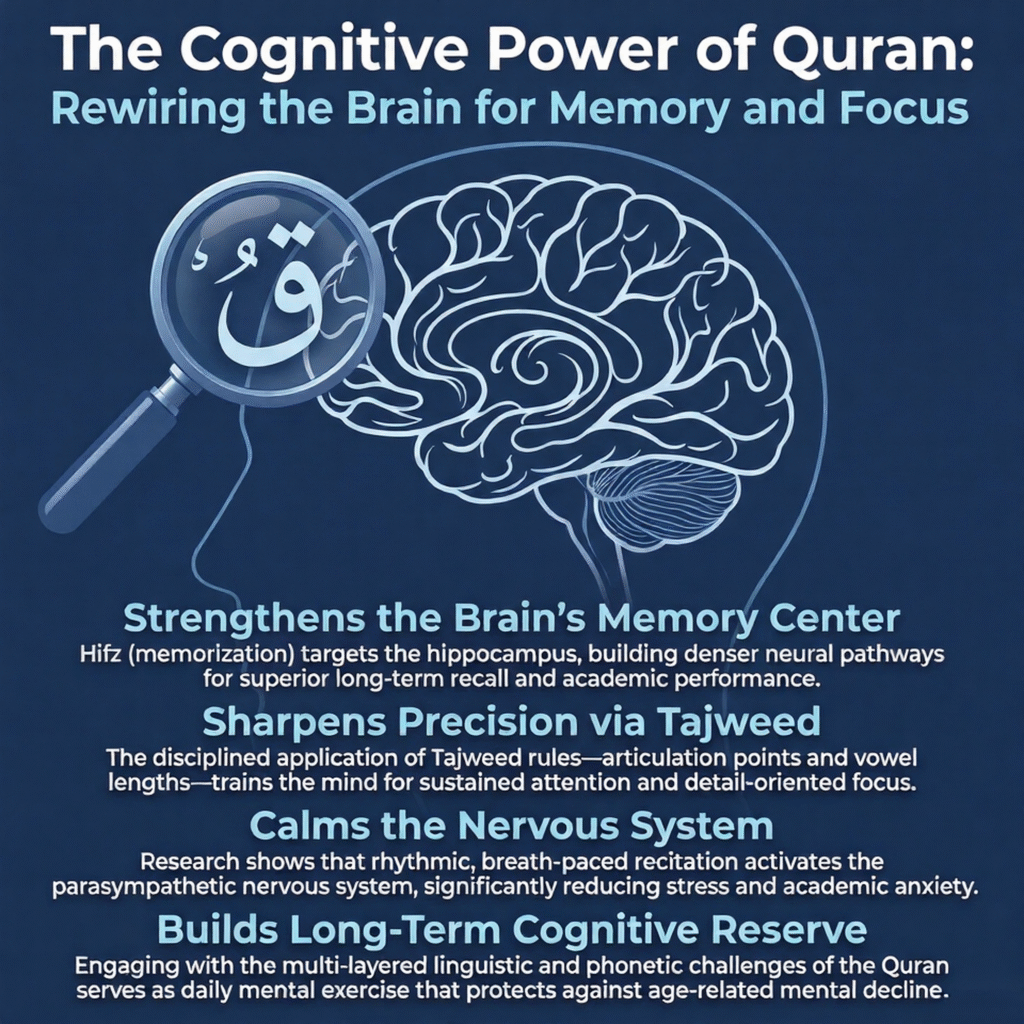
Regular Quran reading, and especially memorization (hifz), is one of the most demanding and rewarding exercises the human brain can undertake. Memorizing verses requires intense, repeated engagement with language, rhythm, and meaning, all at the same time. Research in Islamic education contexts has shown that this process strengthens the hippocampus, the region of the brain most responsible for forming and retrieving long-term memories.
Students who practise hifz regularly demonstrate stronger recall not just in Quran, but in academic subjects too. The brain builds denser neural pathways through this kind of systematic, layered repetition. Each review session deepens the trace that a verse leaves in long-term memory, making retrieval faster and more reliable over time.
Even if you are not memorizing full surahs, reading a page of Quran daily with focused attention trains the same memory systems. The key is consistency: small, regular sessions outperform occasional long ones when it comes to memory consolidation.
Did You Know? The Prophet Muhammad (peace be upon him) said that a person who reads the Quran and memorizes it will be with the noble and righteous scribes in the Hereafter. The pursuit of hifz is, in this sense, both a cognitive and a spiritual investment that pays dividends in this life and the next.
If you are ready to begin memorizing with structured guidance, NoorPath Academy’s Quran Hifz Memorization Course is designed for learners at every level, from those who want to memorize short surahs to those working toward the full Quran.
2. Sharpens Focus and Attention Span
Tajweed, the science of correct Quran recitation, demands your complete and undivided attention. Every letter has a precise articulation point. Every vowel has a measured length. Every rule of merging, stopping, or prolonging requires conscious, deliberate application. This is not passive reading. It is active, disciplined attention training.
In a world saturated with notifications and constant distraction, sitting with the Quran and applying Tajweed rules is one of the few activities that fully absorbs the modern mind. Research into cognitive training consistently shows that sustained, rule-based mental tasks improve general attention span over time, and the carry-over effect extends to other areas of life including work, study, and prayer.
For Muslims who struggle to concentrate during salah or find their mind wandering throughout the day, a daily Quran reading habit built on proper Tajweed can be one of the most practical and spiritually grounded solutions available.
Tutor’s Tip: If your mind wanders during recitation, slow down rather than speeding up. Reciting more slowly with deliberate attention to each letter forces the mind to stay present and makes the session far more effective for both focus and reward.
If you want to learn Tajweed properly with a certified native Arabic teacher, NoorPath Academy’s Quran Tajweed and Recitation Course is structured specifically for beginners and intermediate learners in the West.
3. Builds Mental Resilience and Supports Healthy Ageing
Sustained cognitive engagement is one of the strongest protective factors researchers associate with healthy brain ageing. People who regularly challenge their minds with complex language tasks, including reading, memorizing, and reflecting on text, tend to maintain sharper mental function longer into life.
Daily Quran reading delivers exactly this kind of challenge in a way that most other reading cannot. It involves engaging with classical Arabic, a language most Western Muslims are learning rather than native to, while applying phonetic rules and simultaneously extracting meaning. This multi-layered cognitive demand keeps the mind active and responsive at every age.
The benefit compounds over years. Muslims who maintain a consistent Quran practice throughout their adult lives are essentially doing daily mental exercise that strengthens the same cognitive reserves that protect against age-related decline. When you combine this with the spiritual calm and structured routine that Quran reading creates, you get a holistic habit that serves your mind, heart, and faith simultaneously.
Understanding the Arabic you are reciting deepens this benefit even further. When the meaning of a verse is clear to you, the cognitive engagement doubles: you are processing language, applying phonetic rules, and drawing on semantic understanding at the same time. NoorPath Academy’s Arabic Language Course is designed to help non-Arabic speakers build exactly this kind of meaningful connection with the Quran’s original language.
4. Enhances Academic and Professional Performance
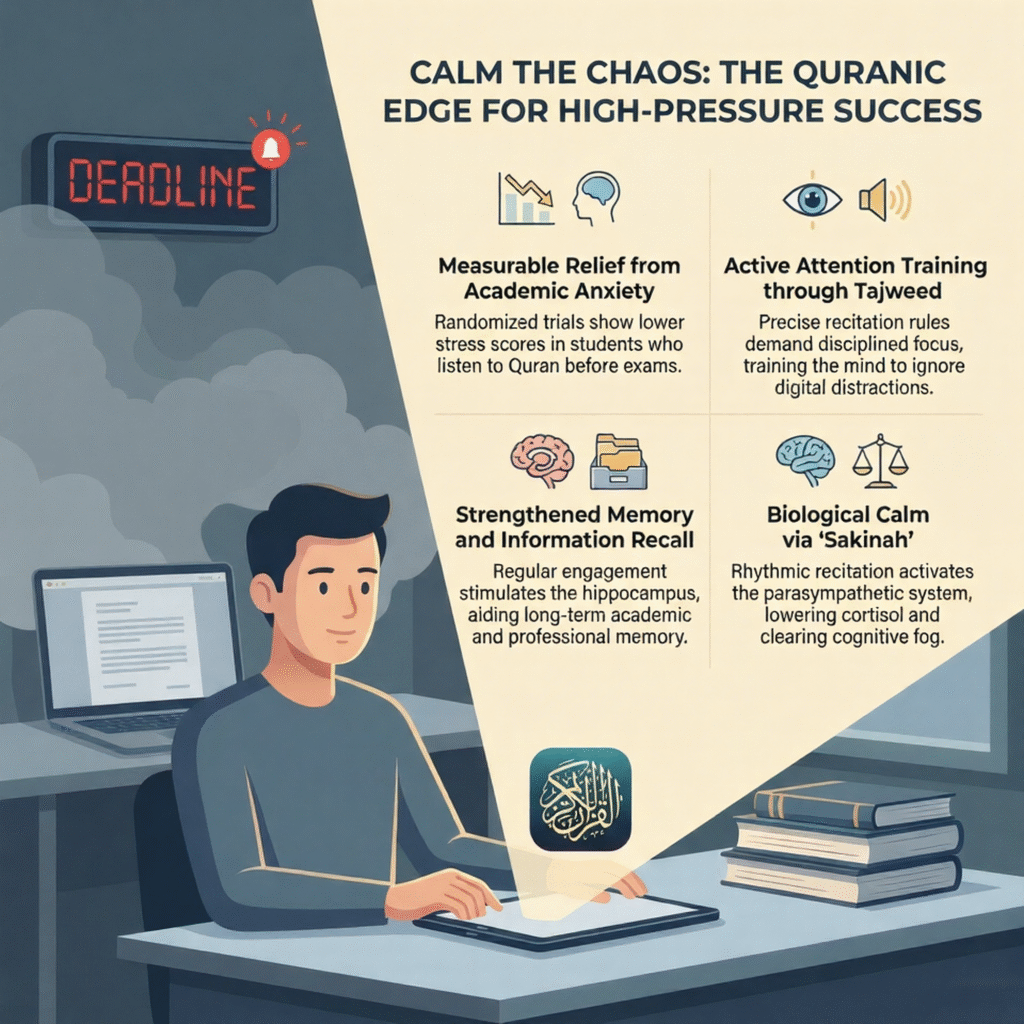
A randomized controlled trial among first-year university students found that listening to specific Quranic passages before stressful academic tasks reduced their anxiety scores measurably, while students who did not listen saw their anxiety increase over the same period. Lower anxiety before exams and presentations directly improves cognitive performance: clearer thinking, more reliable memory retrieval, and more composed delivery under pressure.
The mechanism is straightforward. Anxiety narrows your cognitive bandwidth. When your nervous system is in a state of alarm, it diverts mental resources away from higher-order thinking and toward threat detection. Quran recitation and listening interrupt this cycle by activating the body’s relaxation response, freeing up the mental capacity you need to perform at your best.
For Muslim students and professionals in the USA, UK, Canada, and Australia navigating high-pressure environments, a five to ten minute recitation or listening session before a test, presentation, or interview is a simple, evidence-backed habit that costs nothing and requires no special equipment.
Tutor’s Tip: Before a big exam or high-stakes meeting, recite Surah Al-Inshirah (Surah 94) with its meaning. Its message, that with every hardship Allah has placed ease, is a direct reminder that re-frames pressure as temporary and replaces panic with perspective.
5. Reduces Anxiety in Daily Life
This is perhaps the most clinically supported of all the benefits of reading Quran. The scoping review in Health Science Reports drew on 15 separate studies and found that Quran recitation and listening consistently reduced anxiety across a wide range of settings, from hospital patients recovering from illness to university students facing exams to healthy adults managing the ordinary pressures of daily life.
The physiological pathway is well understood. The rhythmic, breath-paced recitation of Arabic naturally extends the exhalation phase of breathing. Extended exhalation directly activates the parasympathetic nervous system, the body’s built-in calm-down system that lowers heart rate, relaxes muscle tension, and signals safety to the brain. When you layer the spiritual weight and meaning of what you are reciting onto this physiological response, the effect deepens in a way that ordinary breathing exercises cannot replicate.
You do not need a long session to feel the difference. Even five to ten minutes of focused Quran listening or recitation has shown measurable impact in study settings. The key is showing up consistently, not waiting until anxiety peaks before turning to the Quran.
6. Lowers Stress and Physical Tension
Stress is not only a mental experience. It lives in the body as tight shoulders, a racing heart, shallow breathing, disrupted sleep, and persistent headaches. These are not separate problems from your mental state. They are its physical signature. Quran recitation addresses both the root cause and the physical symptoms at the same time.
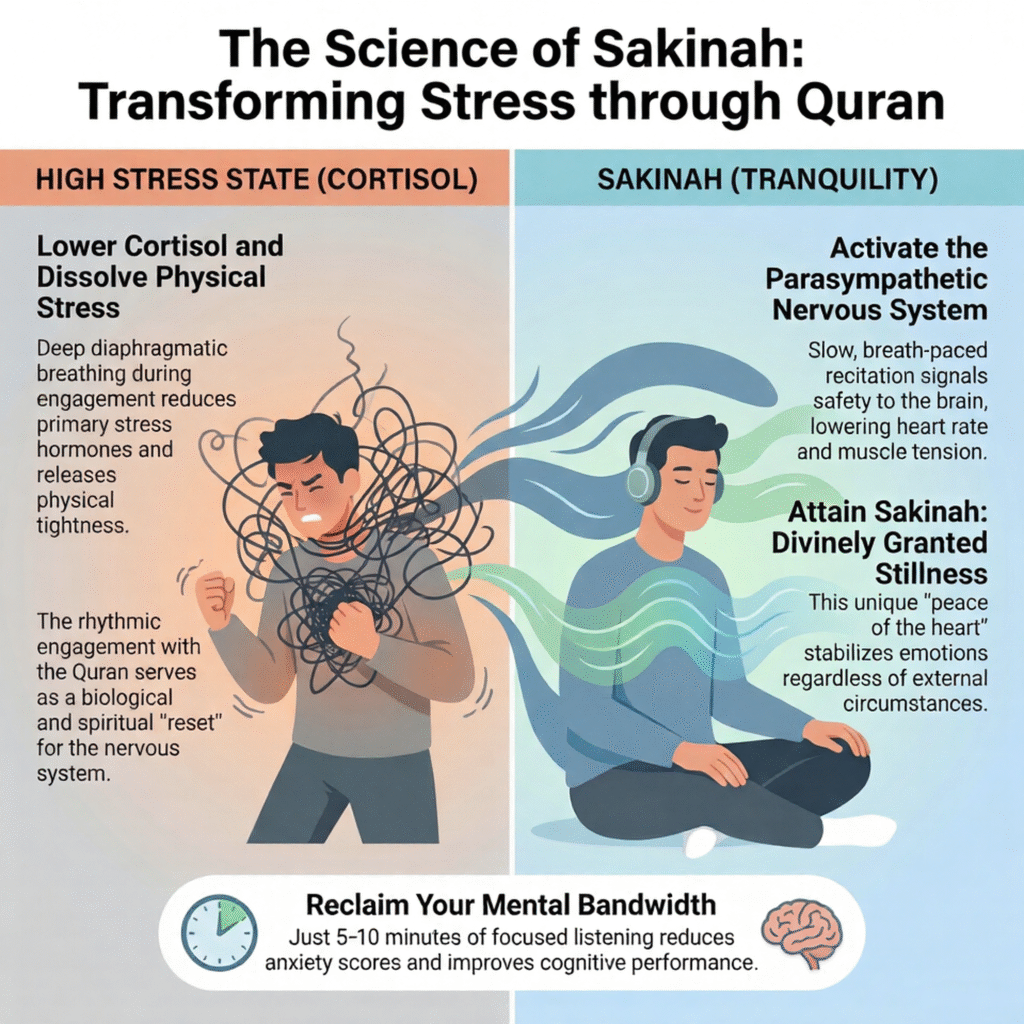
The slow, melodic rhythm of proper Quran recitation encourages diaphragmatic breathing, the deep belly breathing that directly reduces cortisol, the primary stress hormone, in the bloodstream. Lower cortisol means lower physical tension, better sleep quality, and a calmer baseline from which to face the day.
Muslim scholars throughout history described the act of recitation as bringing rahmah (mercy) down into the space around the reciter and driving away distress. Modern physiology now offers a working explanation for the mechanism behind what these scholars observed across generations of practice. The systematic review of 28 trials published in the Iran Journal of Nursing and Midwifery Research found that this stress-reducing effect held across both clinical and non-clinical settings, meaning it works for the unwell and the healthy alike.
7. Supports Relief From Low Mood
Several studies included in the Health Science Reports scoping review specifically measured depressive symptoms alongside anxiety, and found meaningful improvements among participants who regularly listened to or recited Quran. The effect was observed across clinical and non-clinical populations, suggesting it is not limited to people with diagnosed conditions.
Low mood in the modern West is often rooted in disconnection: from community, from purpose, from the transcendent. The Quran addresses all three at once. It reconnects you to Allah, orients you toward a purpose larger than your current circumstances, and reminds you that your suffering is known, witnessed, and temporary. This is not a surface-level comfort. It is a reorientation of perspective that clinical researchers are increasingly recognizing as a genuine therapeutic mechanism.
To be clear: Quran reading is not a substitute for professional mental health treatment. If you or someone you love is struggling with persistent low mood, please seek professional support. What the Quran offers is a meaningful, evidence-supported complement to professional care, not a replacement for it.
8. Brings Sakinah (Tranquility) and Emotional Stability
Sakinah is a Quranic concept that refers to a divinely granted stillness of the heart, a peace that does not depend on external circumstances being perfect. Allah mentions it specifically in the Quran as something He sends down to the hearts of the believers (Surah Al-Fath, 48:4). It is not just the absence of anxiety. It is an active, living calm.
Regular readers of the Quran consistently describe this quality in their experience. Research on emotional well-being following Quran engagement supports what they report: participants show higher contentment scores, lower emotional reactivity, and a stronger sense of being guided and held. The Quran does not promise to remove life’s difficulties. It changes your relationship to them.
For Muslims in the West managing the unique pressures of maintaining faith identity in a secular environment, raising children with Islamic values, and navigating workplaces and social spaces that do not reflect their beliefs, this emotional stability is not a luxury. It is a necessity.
Did You Know? Imam Ibn al-Qayyim wrote that the Quran is the medicine of hearts and that its healing effect increases in proportion to the depth of reflection and sincerity of the reader. The more you invest in understanding what you recite, the more it gives back.
9. Deepens Connection With Allah and Strengthens Iman
The Quran is the direct speech of Allah. Every time you open it, you are not reading about your Creator. You are receiving communication from Him. No other act of worship carries this particular quality, and no other text on earth holds this status.
Regular recitation softens the heart in ways that are difficult to describe but immediately recognizable to those who experience it. It builds khushu, the quality of humble presence and attentiveness, in salah. It deepens trust in Allah’s plan during difficult seasons of life. It steadily replaces the background noise of doubt and distraction with a settled awareness of who you are and Whose you are.
For Muslims living as minorities in Western societies, often surrounded by materialism, secularism, and subtle pressure to downplay their faith, daily Quran reading is one of the most powerful anchors available. It is the practice that holds everything else in place.
10. Provides Guidance for Daily Decisions and Life Purpose
The Quran addresses the deepest questions of human existence: Who am I? What am I here for? How should I treat the people in my life? What do I do when circumstances break me? These are not abstract theological questions. They are the questions that drive anxiety, indecision, and a pervasive sense of being lost that many people in the modern West carry quietly.
When you read with tadabbur, which means deep, unhurried reflection on meaning, the Quran begins to speak directly to your actual situation. Verses that seemed distant or formal during a quick recitation suddenly become precise, personal answers to questions you have been carrying for months. Scholars describe this as one of the miracles of the Quran: its capacity to speak to each reader’s specific condition across every generation and culture.
This kind of clarity has a measurable effect on daily life. It reduces overthinking. It gives you a framework for making decisions that feel aligned rather than arbitrary. It replaces the existential fog that so many people in the West describe with a sense of direction that comes from something far larger than personal preference.
11. Builds Discipline, Patience, and Positive Habits
A daily Quran reading practice is what habit researchers call a keystone habit, meaning a single practice that organizes and quietly elevates other areas of life around it. The discipline of returning to the Quran every day, even for ten minutes, trains the willpower muscle in a way that transfers to other commitments: waking for Fajr, managing screen time, being more present with family, following through on goals.
It also builds patience in the most practical sense. The Quran does not reveal all of its meaning immediately. Understanding deepens over years of return and reflection. Learning to sit with a verse, to come back to it, to let it work on you slowly, is a form of patience training that reshapes how you approach everything that requires sustained effort.
The knock-on effects compound over time: better sleep rhythms for those who read after Isha or before Fajr, lower reactive stress because the day is grounded in something meaningful before it begins, and a stronger sense of self-respect that comes from knowing you kept your commitment to Allah and to your own growth.
Tutor’s Tip: Link your Quran reading to an existing daily habit, such as right after Fajr prayer or before opening your phone in the morning. When you attach a new habit to something already established in your routine, it sticks far more reliably than trying to find a brand new time slot.
12. Strengthens Family and Community Bonds
Quran reading is rarely only a private act. When parents recite to their children at bedtime, when spouses sit together after Isha, when siblings work on memorizing the same surah: the Quran builds a shared language of faith and love within the family that no other activity quite replicates.
For Muslim families in the UK, USA, Canada, and Australia, this is especially significant. Raising children with a strong Islamic identity in a largely secular environment is one of the most real challenges Muslim parents face. A shared Quran routine at home creates a consistent rhythm of togetherness rooted in something eternal. Children who grow up hearing and reading the Quran regularly carry a spiritual foundation that shapes their character, their resilience, and their sense of identity long into adulthood.
Beyond the family, joining a local or online Quran circle connects you to a community of learners who share your values and your journey. This kind of community is a recognized protective factor for mental health and belonging, particularly for Muslim minorities in Western countries.
NoorPath Academy’s Quran Tajweed and Recitation Course and Quran Hifz Memorization Course are both available for children and adults, with flexible family enrollment discounts so the whole household can learn and grow together.
13. Helps Academic and Professional Muslims Manage Daily Pressure
The randomized controlled trial on student anxiety has direct applications well beyond the university classroom. Job deadlines, performance reviews, difficult conversations with managers, parenting pressures, financial uncertainty: all of these activate the same physiological stress response. What differs from Benefit 5 is the context and the habit strategy required to address it.
Managing the chronic, low-grade pressure of a professional or student life in the West requires a daily maintenance practice, not just an emergency tool. A five-minute Quran listening session during your morning commute, a few verses before lunch, or a short recitation before bed creates a nervous system rhythm that prevents stress from compounding across the week. The research on academic anxiety consistently shows that structured, repeated exposure to Quran recitation produces better outcomes than single sessions in a crisis moment.
For Muslim professionals and students who feel the tension between the demands of a Western career or academic environment and their spiritual life, this benefit reframes the Quran not as a retreat from the pressures of daily life but as the tool that makes you more capable of meeting them.
14. Multiplied Rewards and Intercession in the Hereafter
The Prophet Muhammad (peace be upon him) taught that every single letter of the Quran earns ten rewards, and that the alif, lam, meem at the opening of Surah Al-Baqarah counts as three separate letters, not one. He also described the Quran as something that will intercede for its companion on the Day of Judgement, rising to advocate for the one who gave it time, attention, and reverence in this life.
For a Muslim, this transforms every page into an investment in eternity. The benefits of reading Quran do not end at the boundaries of this life. Every sitting with the Book, however short, however imperfect your recitation, is a deposit into an account that never devalues and never expires. This is the benefit that makes all the others feel small by comparison.
How Much Quran Should You Read Daily for Memory and Peace?
There is no single required amount. Consistency matters far more than volume. The studies showing mental health benefits often involved relatively short, structured sessions, meaning you do not need an hour to feel the difference. You need intention, presence, and regularity.
Here are practical starting points based on where you are right now:
| Your Situation | Suggested Daily Goal |
| Complete beginner or returning after a gap | 5 minutes of listening plus reciting 3 short surahs |
| Intermediate reader | One page with focused Tajweed attention |
| Working toward memorization | One quarter (rub’) of a juz per day |
| Busy parent or professional | One hizb (half a juz) spread across two short sessions |
Start at the level that feels sustainable, not aspirational. A page a day done every day for a year is worth far more than a juz attempted occasionally.
Is Listening to Quran as Beneficial as Reading It?
Both are genuinely beneficial, and the research supports this clearly. The systematic review of 28 trials found significant reductions in anxiety and stress from listening alone. Participants were not reciting or reading. They were simply listening with attention, and the effect was measurable. This is important news for Muslims who are still building their Arabic reading ability.
Spiritually, scholars agree that listening to Quran with reverence and presence carries its own reward and its own healing. Reading with understanding, using a translation alongside the Arabic, adds a deeper layer of tadabbur that enriches both the spiritual and cognitive benefits. The most balanced approach for most Western Muslims is to combine both: read when you can sit with it fully, and listen during commutes, household tasks, or before sleep.
Did You Know? Many Muslims in the West report that listening to a calm recitation of Surah Al-Mulk or Surah Al-Baqarah before sleep significantly improves their sleep quality and the feeling of waking up settled. This practice is grounded in prophetic guidance and is consistent with what research tells us about calm auditory input and sleep quality.
Your Free Lesson Is One Step Away
You have just read about 14 real, evidence-backed and spiritually grounded benefits of reading Quran. The next step is to make them part of your actual daily life, not just something you know about.
NoorPath Academy connects you with Al-Azhar certified, native Arabic tutors in personalized 1-on-1 online sessions designed for beginners, parents, and reverts across the West. There is no required entry level, no pressure, and no credit card needed to begin.
Book Your Free Evaluation Session at NoorPath Academy and let a qualified teacher guide you to the Quran with the clarity, correctness, and confidence you deserve.
“The best of you are those who learn the Quran and teach it.” (Prophet Muhammad, peace be upon him)
Frequently Asked Questions
How does reading the Quran improve memory and concentration?
Regular Quran recitation and memorization engage the hippocampus, the brain’s primary memory centre, through intensive repetition and linguistic pattern recognition. This strengthens neural pathways used for long-term memory and sustained focus, with benefits that carry over into academic and professional performance.
Can Quran recitation reduce anxiety and depression?
Yes, according to multiple peer-reviewed studies. A scoping review of 15 studies found consistent reductions in anxiety, stress, and depressive symptoms from Quran recitation and listening. It works best as a complementary practice alongside professional care when needed, not as a standalone treatment for clinical conditions.
Is listening to Quran enough if I struggle to read Arabic?
Absolutely. A systematic review of 28 trials found significant mental health benefits from listening alone. Learning to read fluently is a worthwhile long-term goal, but your spiritual and emotional journey with the Quran can begin today through attentive listening.
How long does it take to feel more peace from reading Quran daily?
Many people notice a shift in mood and calm within one to two weeks of consistent daily practice. Clinical studies found measurable anxiety reduction within single structured sessions. The deeper, more stable peace of sakinah builds gradually with sustained habit over weeks and months.