

Learning to read the Quran begins with mastering the Arabic alphabet and basic pronunciation rules called Tajweed. Most beginners start with a qualified teacher or structured online course, practice daily for 15-20 minutes, and progress from individual letters to words, then complete verses over several months.
Understanding the Basics of Reading the Quran
The Quran contains 114 chapters written in classical Arabic. Even if you don’t speak Arabic, you can learn to read and recite it correctly. According to research from the Islamic Online University, over 80% of Quran readers worldwide are non-native Arabic speakers who successfully learned through structured methods.
Reading the Quran isn’t just about recognizing letters. Proper pronunciation changes meanings entirely. The word “qalb” (heart) becomes “kalb” (dog) with one small mistake. This is why learning Tajweed rules from the beginning helps you avoid errors that could alter the intended message.
Setting Realistic Expectations
Most beginners achieve basic reading fluency within 6-12 months of consistent practice. Data from Bayyinah Institute’s student progress tracking shows that learners who practice 20 minutes daily advance twice as fast as those practicing irregularly.
Your timeline depends on several factors:
- Previous experience with Arabic or similar scripts
- Daily practice consistency
- Quality of instruction and feedback
- Learning method (one-on-one vs. group vs. self-study)
Step 1: Master the Arabic Alphabet (Alif to Ya)
The Arabic alphabet contains 28 letters, each with 2-4 different forms depending on its position in a word. Unlike English, Arabic reads from right to left.
Start by memorizing letters in their isolated form first:
| Letter Group | Examples | Pronunciation Tip |
| Simple curves | ب ت ث | Dots differentiate these similar shapes |
| Straight letters | ا د ذ ر ز و | No connecting lines on certain sides |
| Deep letters | ص ض ط ظ | Pronounced from deeper in the throat |
| Emphatic sounds | ق ع غ ح خ | Unique to Arabic, require practice |
Practice writing each letter 20-30 times. This muscle memory helps with recognition when you begin reading.
Understanding Letter Connections
Arabic letters connect differently than English cursive. According to linguists at Cambridge University’s Faculty of Asian and Middle Eastern Studies, this connective script actually helps readers process words 15% faster once mastered because word shapes become distinctive.
Focus on these connection rules:
- Most letters connect on both sides
- Six letters (ا د ذ ر ز و) never connect to the letter after them
- Letters change shape at the beginning, middle, and end of words
Step 2: Learn the Short Vowels (Harakat)
Arabic text in the Quran includes small marks above and below letters called harakat. These marks tell you which vowel sound to pronounce.
The Three Primary Vowels:
Fatha (َ): A short “a” sound, like “cat.” The mark sits above the letter.
Kasra (ِ): A short “i” sound, like “sit.” The mark sits below the letter.
Damma (ُ): A short “u” sound, like “put.” The mark looks like a tiny و above the letter.
Additional Vowel Marks:
Sukoon (ْ): Indicates no vowel sound. The letter is pronounced without a following vowel.
Shadda (ّ): Doubles the letter’s sound, creating emphasis.
Tanween: Double fatha (ً), kasra (ٍ), or damma (ٌ) adds an “n” sound at the end.
Practice reading simple three-letter words with these marks. The combination of ك + َ + ت + َ + ب + َ creates “kataba” (he wrote).
Step 3: Start with Short Surahs (Chapters)
Begin your Quran reading journey with the last section, called Juz Amma. This section contains short chapters perfect for beginners.
Recommended Starting Surahs:
- Surah Al-Fatiha (Chapter 1): Only seven verses, recited in every prayer
- Surah Al-Ikhlas (Chapter 112): Four verses about Allah’s oneness
- Surah Al-Falaq (Chapter 113): Five verses seeking protection
- Surah An-Nas (Chapter 114): Six verses, similar structure to Al-Falaq
These chapters use simpler vocabulary and shorter verses. Research published in the Journal of Quranic Studies indicates that beginners who start with Juz Amma retain pronunciation rules 40% better than those who start from the beginning of the Quran.
Let’s examine Surah Al-Ikhlas, verse 1:
قُلْ هُوَ اللَّهُ أَحَدٌ
Breaking it into parts:
- قُلْ (Qul): Say
- هُوَ (Huwa): He is
- اللَّهُ (Allah): Allah
- أَحَدٌ (Ahad): One
Read each word separately ten times. Then connect two words together. Finally, read the complete verse.
Step 4: Understand Basic Tajweed Rules
Tajweed means “to make better” or “to improve.” These rules ensure you pronounce every letter from its correct articulation point.
The Five Essential Tajweed Categories for Beginners:
- Makharij (Articulation Points): Where each letter originates in your mouth and throat. Letters like ق come from deep in the throat, while letters like ب come from the lips.
- Sifaat (Characteristics): Qualities that distinguish similar letters. For example, ت is soft while ط is heavy and emphatic.
- Ghunna (Nasal Sound): A two-beat nasal sound produced with ن or م when followed by certain letters.
- Qalqalah (Echo): A slight bounce sound on specific letters (ق ط ب ج د) when they have sukoon.
- Madd (Elongation): Stretching certain vowel sounds for 2, 4, or 6 beats depending on what follows.
According to Sheikh Yasir Qadhi’s Tajweed course data from the Qalam Institute, these are the most frequent errors new learners make:
- Pronouncing ض (daad) as ظ (dhaa). The Quran is called “لغة الضاد” (language of daad) because this letter is unique to Arabic.
- Rushing through Madd and not holding elongated vowels long enough
- Missing the Ghunna sound entirely
- Not pausing at proper stopping points (waqf)
Practice these rules with a teacher who can correct your pronunciation. Even minor errors compound over time if not addressed early.
Step 5: Choose the Right Learning Method
Your learning approach significantly impacts your progress speed and accuracy.
Personal instruction provides immediate feedback on pronunciation. Studies from the International Institute of Islamic Thought show that students with weekly one-on-one sessions achieve proper Tajweed 3x faster than self-study students.
Benefits:
- Customized pace matching your ability
- Real-time error correction
- Accountability and motivation
- Cultural context and meaning explanations
Challenges:
- Higher cost than group classes
- Requires scheduling coordination
- Quality varies significantly between teachers
Digital platforms offer flexibility while maintaining structure. Noor-path provides a comprehensive Quran reading curriculum designed specifically for English-speaking beginners, combining video lessons with live practice sessions and progress tracking.
The platform includes:
- Step-by-step modules from alphabet to full Surah recitation
- Interactive exercises with pronunciation feedback
- Weekly live classes with certified instructors
- Progress assessments at each level
Benefits of structured online learning:
- Learn at your own pace and schedule
- Replay difficult lessons multiple times
- More affordable than private tutoring
- Access to community support forums
Mobile Apps and Self-Study Tools
Apps like Rayhaan Quran AI provide listen and repeat and Test Features. These tools are increasingly becoming the primary learning method for many students due to several key advantages:
- Accessibility: Learn anytime, anywhere, at your own pace.
- Immediate Repetition: Easily replay and practice difficult verses instantly.
- Visual Aids: Transliteration and synchronized text help connect sound with script.
- Convenience: No scheduling conflicts or travel required for a teacher.
- Cost-Effectiveness: Often more affordable than private tutoring.
- Consistent Model: Always provides a perfect, standardized recitation for listening.
While they offer great benefits, it’s wise to occasionally seek feedback from a qualified teacher to check for subtle errors.
Step 6: Develop a Consistent Practice Routine
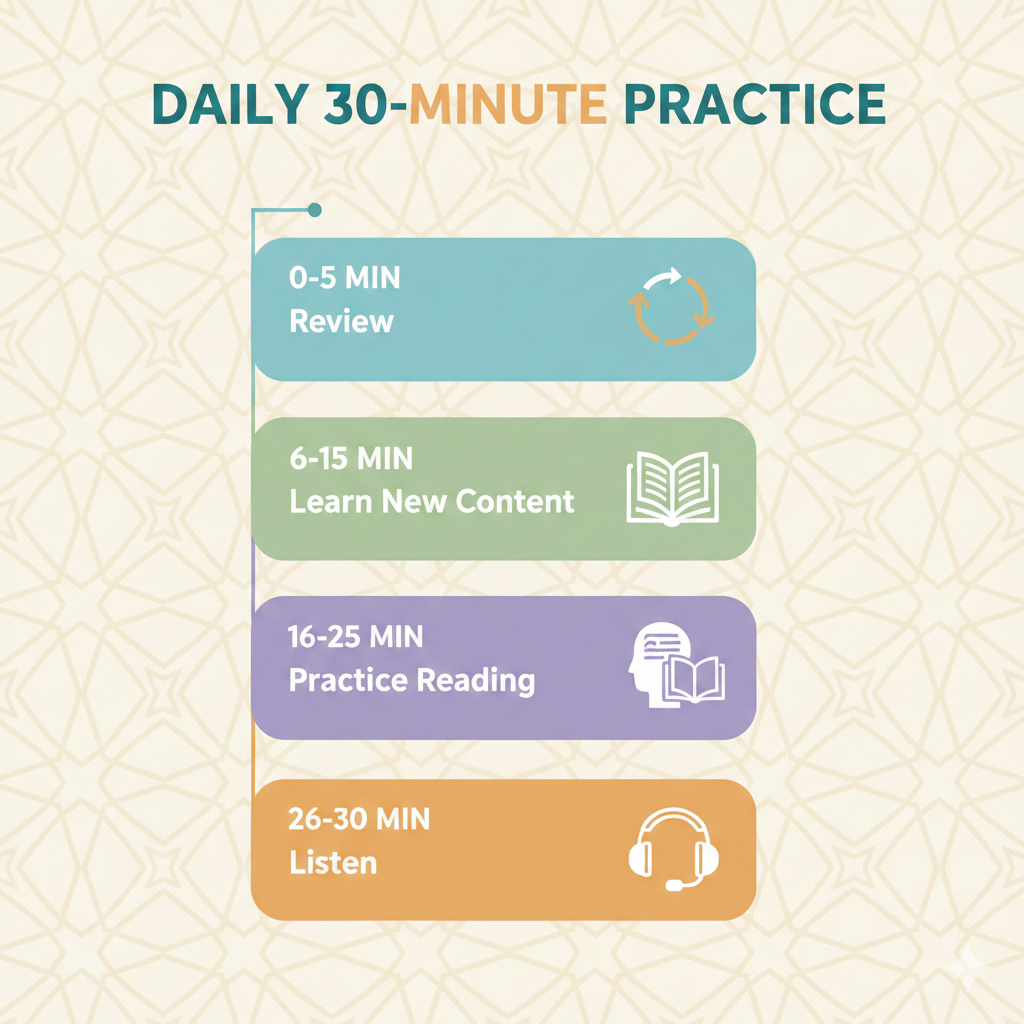
Consistency matters more than duration. Twenty minutes daily outperforms two-hour weekend sessions.
Ideal beginner routine (20-30 minutes):
- Minutes 1-5: Review previously learned letters or words
- Minutes 6-15: Learn new content (new letters, words, or Tajweed rules)
- Minutes 16-25: Practice reading from the Quran (even just one or two verses)
- Minutes 26-30: Listen to professional recitation of what you practiced
Early morning after Fajr prayer provides mental clarity and minimal distractions. According to cognitive research from the University of Michigan, language learning activities performed in the morning show 25% better retention than evening sessions.
If mornings don’t work, choose the same time daily. Your brain forms stronger neural pathways with temporal consistency.
Keep a simple journal noting:
- Which Surah and verses you practiced
- Difficult words or rules that challenged you
- New Tajweed concepts learned
- Questions for your teacher
Reviewing this journal monthly reveals patterns in your learning and celebrates progress that might feel slow day-to-day.
Step 7: Practice Proper Pronunciation with Listening
Your ears must become familiar with correct recitation before your mouth can reproduce it.
Begin with slow, clear reciters who emphasize Tajweed rules:
- Sheikh Mahmoud Khalil Al-Hussary (Mu’allim recitation)
- Sheikh Muhammad Ayyub
- Sheikh Ibrahim Al-Akhdar
These reciters pronounce each letter distinctly, making them ideal for beginners learning proper articulation.
Don’t just play recitation in the background. Practice active listening:
- Read the verse text while listening
- Pause after each word and repeat it
- Record yourself and compare to the professional recitation
- Note which letters or sounds you struggle with most
Listen to the same verse 10-15 times before moving forward. Repetition builds the muscle memory your mouth needs for accurate pronunciation.
Step 8: Find a Qualified Teacher or Study Partner
Learning alone limits your progress. Even online students benefit enormously from teacher interaction and peer support.
Look for instructors with:
- Ijazah certification: A chain of authorization tracing back to the Prophet Muhammad (peace be upon him)
- Tajweed expertise: Not just Quran reading, but specific training in pronunciation rules
- Teaching experience: Skills in instruction, not just personal recitation ability
- Patience and encouragement: Especially important for adult learners
Ask potential teachers about their certification and teaching methodology before committing.
Learning with someone at your level provides:
- Mutual accountability for practice sessions
- Safe space to make mistakes without judgment
- Motivation during difficult phases
- Opportunity to teach concepts, which deepens your understanding
Join Noor-path’s community forums to connect with learners at similar stages. Many students form study groups that meet weekly via video call.
Getting Started Today Your First Action Steps
Reading the Quran begins with a single decision followed by small, consistent actions.
Day 1-2: Learn the first 5 Arabic letters (ا ب ت ث ج) and their sounds. Write each letter 30 times.
Day 3-4: Practice reading simple words using these letters. Learn the three short vowels (fatha, kasra, damma).
Day 5-6: Add the next 5 letters (ح خ د ذ ر). Practice reading words combining old and new letters.
Day 7: Review all ten letters. Read simple phrases. Record yourself and listen for pronunciation accuracy.
Resources to Begin Your Journey
While many resources exist for learning Quran recitation, choosing the right platform matters. Noor-path specializes in teaching English speakers to read the Quran correctly, with a structured curriculum that takes you from a complete beginner to a confident reader.
The platform includes:
- Comprehensive video lessons covering the alphabet through advanced Tajweed
- Live weekly classes with certified instructors holding Ijazah
- Progress quizzes ensure mastery before advancement
- Community forums connecting learners worldwide
- Mobile app for practice anywhere, anytime
Visit Noor-path.com to start your free trial and join thousands of students who have successfully learned to read the Quran with proper pronunciation and understanding.