

Yes, you can memorize Juz Amma in 30 days with the right approach. This requires 1.5 to 2 hours of daily practice, a structured method, and consistent revision. While initial memorization is achievable in one month, long-term retention develops over several additional months of review.
Juz Amma, the 30th section of the Quran, contains 37 short surahs and 564 verses. Many Muslims begin their memorization journey here because these surahs are frequently recited in daily prayers. The compact size makes it more manageable than other sections, yet the spiritual benefits and practical applications make it deeply valuable.
This guide provides a proven framework for 30-day memorization, drawing on educational research and Islamic learning principles used across accredited institutions worldwide.
Understanding the Juz Amma Memorization Timeline
Research from Islamic educational institutions confirms that Juz Amma memorization timelines vary significantly based on several factors. highly motivated learners with prior Arabic exposure can complete initial memorization in as little as one week with intensive daily practice. However, most adult learners achieve better results with a 4 to 8 week timeline that balances new material with adequate review.
The 30-day goal sits in the middle of this spectrum. It’s realistic but requires specific conditions:
- Daily commitment: 90 to 120 minutes of focused practice
- Tajweed foundation: Basic pronunciation rules learned before starting
- Minimal distractions: Dedicated memorization time without interruptions
- High motivation: Clear spiritual or personal goals driving the effort
Educational research on memory retention indicates that initial memorization represents only the first phase. Long-term retention, where verses remain accessible without constant review, typically develops over 3 to 6 months of continued practice.
The Mathematics Behind 30 Days
With 564 verses across 37 surahs, the daily target averages approximately 19 verses. However, the surahs vary dramatically in length. The shortest surahs in Juz Amma contain just 3 verses, while the longest extends to 40 verses.
A realistic 30-day plan front-loads the shorter surahs to build confidence and establish habits during the first week. This psychological advantage, supported by educational research on learning progression, helps maintain motivation when longer surahs appear in weeks 2 through 4.
Pre-Memorization Setup (Tools and Preparation)
Success in Quran memorization depends heavily on the tools and environment you establish before beginning. Research from university-based Islamic studies programs emphasizes that consistency in learning materials significantly improves retention rates.
Choosing Your Mushaf (Quran Text)
Select one Mushaf and use it exclusively throughout your 30-day journey. Educational studies on visual memory indicate that consistent page layouts create spatial anchors that strengthen recall. When you visualize a verse during recitation, you’ll also remember its position on the page.
The Madinah Mushaf remains the global standard, used in approximately 80% of memorization programs worldwide. Its clean layout and standardized formatting make it ideal for beginners and experienced learners alike.
Color-coded Tajweed editions offer an alternative for adult learners who benefit from visual cues. These editions mark pronunciation rules directly in the text using different colors, reducing the cognitive load of remembering multiple rules simultaneously.
Selecting Your Audio Reciter (Qari)
Audio recitation forms the foundation of correct pronunciation and melodic patterns. listening to skilled speakers before attempting independent production significantly reduces error rates.
Choose one primary reciter and listen exclusively to their rendition during your 30-day period. Popular options include:
Sheikh Abdul Rahman Al-Sudais: Known for emotional, accessible recitation that resonates with beginners. His clear pronunciation and moderate pace make him widely recommended for new memorizers.
Al-Husary: Recognized for technical precision and perfect Tajweed execution. Educational institutions often recommend his recitations for learners prioritizing pronunciation accuracy.
Al-Minshawi: Offers a balance between clarity and melodic flow, appealing to learners who appreciate both technical correctness and aesthetic beauty.
Test different reciters using free platforms before committing. Listen to the same surah from multiple reciters and notice which voice helps you focus best and remember patterns most easily.
Creating Your Quran Memorization Environment
Research on cognitive load and learning environments from educational psychology departments reveals that distraction-free spaces dramatically improve memorization outcomes. Designate a specific location for Quran study, free from phones, notifications, and interruptions.
The optimal memorization time, according to surveys of Islamic educational institutions, occurs in the early morning hours after Fajr prayer. Approximately 70% of experienced memorizers report peak focus during this window. However, individual chronotypes vary. Some learners achieve better results in late evening when household activity quiets down.
Week-by-Week Breakdown Your 30-Day Schedule
This schedule balances new memorization with cumulative review, following principles established in memory research from cognitive science departments at major universities.
Week 1: Building Foundation and Confidence
Surahs: An-Nas through Al-Kafirun (the shortest surahs)
Daily target: 2 to 3 new surahs
Revision focus: Review all Week 1 material daily
Week 1 establishes your routine and builds early momentum. The shortest surahs in Juz Amma appear at the end, making them psychologically accessible. Most learners already know several of these from daily prayer, which provides familiar anchors.
Focus on perfecting your methodology this week rather than speed. The habits you establish now will carry through the entire month.
Week 2: Introducing Longer Verses
Surahs: Al-Kawthar through Al-Asr
Daily target: 2 to 3 surahs plus 50% of session time for revision
Revision focus: Cumulative review of Weeks 1 and 2
Surah length increases during Week 2, requiring adjustment to your pacing. Educational research on spaced repetition indicates that review should now occupy approximately half of your study time. This prevents the rapid forgetting that occurs when learners focus exclusively on new material.
Introduce linking techniques this week. After memorizing a new surah, recite it immediately following the previous surah without pause. This creates mental connections between surahs that strengthen recall during prayer or testing.
Week 3: Managing Complexity
Surahs: At-Takathur through Al-Bayyinah
Daily target: 1 to 2 surahs plus 60% revision time
Revision focus: All previous material plus new verses
Week 3 presents the steepest challenge. Surahs grow longer and your accumulated material requires substantial review time. Many learners experience plateaus during this week as cognitive load peaks.
Monitor error patterns closely. If you consistently stumble on the same verses or confuse similar phrases between surahs, reduce new memorization and increase targeted review. According to research on learning progression from educational psychology, pushing through errors without correction embeds mistakes that require weeks to unlearn.
Week 4: Intensive Review and Consolidation
Surahs: Al-Qadr through An-Naba, plus full Juz review
Daily target: 1 surah plus 80% revision time
Revision focus: Complete Juz Amma playthrough multiple times
The final week shifts toward consolidation. New memorization slows significantly while review intensity increases. Plan multiple complete recitations of all 37 surahs, either in formal testing with a tutor or through self-recording and comparison against your chosen reciter.
This intensive review period prepares you for the maintenance phase that follows your 30-day sprint. Research on memory consolidation from neuroscience departments indicates that frequent, complete rehearsals during this phase transition short-term memorization into more durable long-term retention.
Proven Memorization Methods
Educational research on Quranic pedagogy has identified several effective memorization techniques. Choose the method that aligns with your learning style and available time.
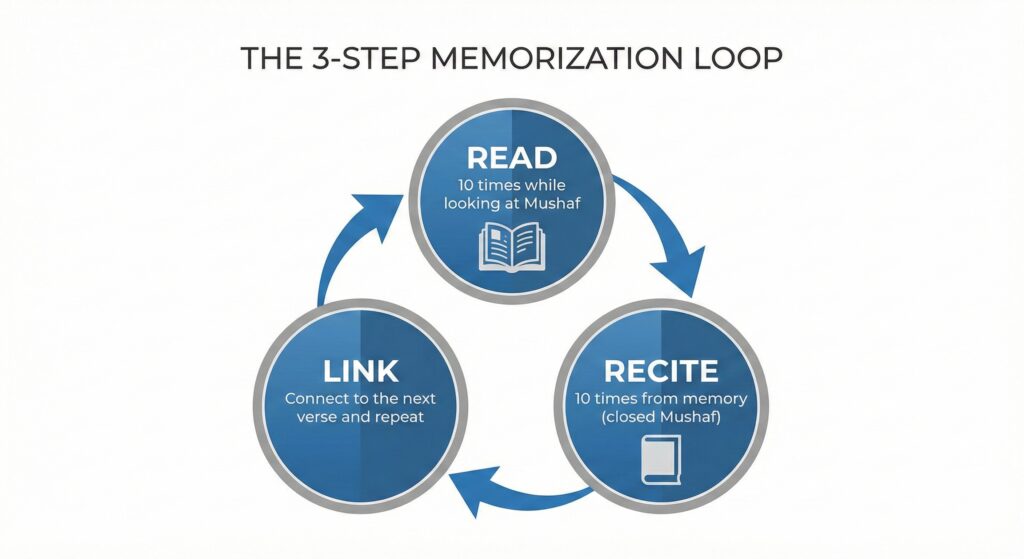
The Three-Step Technique
This foundational approach appears across Islamic educational institutions worldwide:
- Read the verse 10 times while looking at your Mushaf
- Close the Mushaf and recite from memory 10 times
- Link to the next verse and repeat the process
Best for: Visual learners, beginners, and those prioritizing error minimization
The repetition-based approach builds gradual familiarity while the closed-book recitation tests retention before moving forward. This prevents the common mistake of moving too quickly through material without achieving genuine memorization.
The 3-5-7 Incremental Method
This technique emphasizes connection and progressive difficulty:
- Memorize 3 new lines using the basic repetition approach
- Repeat those 3 lines 5 times consecutively without stopping
- Connect to 7 previously memorized lines and recite the entire section
Best for: Fast learners, intermediate memorizers, and retention optimization
Research on memory chunking from cognitive psychology departments suggests this method leverages natural grouping patterns. The progressive expansion from 3 to 5 to 7 units aligns with working memory capacity limits while building stronger neural pathways through varied repetition.
Ayah-by-Ayah Linking
This detailed approach prioritizes deep comprehension:
- Read the first ayah 10 times while looking at the text
- Recite it 10 times from memory
- Repeat the process for the second ayah
- Combine ayahs 1 and 2, reciting them together without stopping
Best for: Adults, deep comprehension seekers, and Tajweed-focused learners
While slower than other methods, ayah-by-ayah linking creates the strongest understanding of verse structure and meaning. Educational research on adult learning indicates that older learners benefit from this analytical approach, which connects new information to existing knowledge frameworks more explicitly.
Daily Practice Your 90 to 120 Minutes
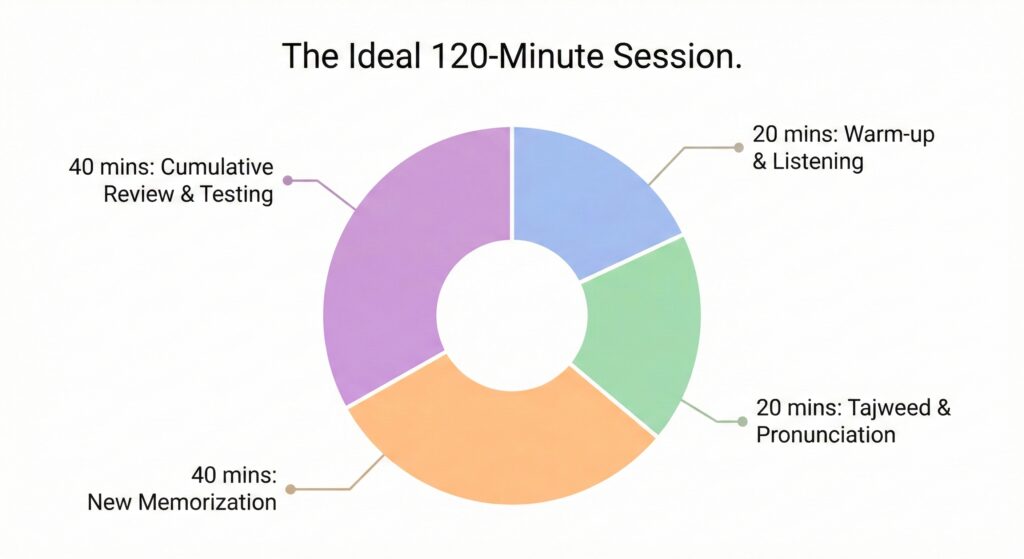
A well-structured practice session balances multiple learning modes. Based on research from educational institutions on optimal study session design, divide your time as follows:
Minutes 0 to 20: Warm-up through passive listening
Listen to yesterday’s memorization while following along in your Mushaf. This activates relevant neural pathways and identifies verses needing extra attention.
Minutes 20 to 40: Tajweed review and pronunciation drills
Focus on 2 to 3 challenging verses that contain difficult pronunciation rules. Embedding correct pronunciation from the beginning prevents weeks of correction later. Never memorize verses you cannot pronounce correctly.
Minutes 40 to 80: New memorization
Apply your chosen method (3-step, 3-5-7, or ayah-by-ayah) to new material. This represents your primary cognitive work and requires complete focus without distractions.
Minutes 80 to 120: Cumulative review and testing
Review all previously memorized material and test yourself without looking at the text. Research on active recall from cognitive science departments shows this testing phase produces stronger long-term retention than passive review alone.
Throughout the day: Passive listening during routine activities
Play your memorization audio during commutes, meal preparation, or household tasks. This additional exposure, even without active attention, reinforces pronunciation patterns and verse rhythm according to studies on incidental learning from educational psychology.
Common Challenges and Evidence-Based Solutions
Research from Islamic educational institutions identifies recurring obstacles in Quran memorization programs. Here’s how to address them:
Rapid Forgetting After Initial Memorization
Root cause: Insufficient revision ratio in your practice sessions
Solution: Educational research on spaced repetition indicates that review should occupy at least 40% of your total study time. If you notice significant forgetting between sessions, immediately increase your revision percentage to 60% or even 70%, temporarily reducing new memorization.
Calculate your current review ratio: if you spend 80 minutes on new verses and only 40 minutes reviewing, you’re at 33% review. Adjust to 50 minutes new, 70 minutes review for better retention.
Embedded Pronunciation Errors
Root cause: Skipping Tajweed preparation or inconsistent audio reference
Solution: According to Islamic linguistics research from accredited universities, pronunciation errors that become habitual require approximately three times longer to correct than initial learning. If you discover embedded errors, pause new memorization immediately.
Work with a qualified tutor to identify and correct mistakes, then rebuild those verses with proper pronunciation. Prevention remains more efficient than correction. Always verify pronunciation with your chosen reciter before memorizing independently.
Loss of Motivation and Momentum
Root cause: Isolation, unclear progress markers, or unrealistic expectations
Solution: Educational research on learning motivation emphasizes the importance of visible progress and social accountability. Create a physical tracking chart where you mark each memorized surah. The visual representation of advancement provides psychological reinforcement.
Consider joining an online memorization group or finding a memorization partner. Studies on collaborative learning from educational institutions show that social structures significantly improve persistence rates in long-term educational goals.
Confusion Between Similar Verses
Root cause: Inadequate attention to verse transitions and contextual differences
Solution: Research on memory interference from cognitive psychology departments suggests that similar information stored close together creates confusion. When you encounter verses with parallel structure or repeated phrases, create deliberate contrast in your mind.
Focus extra attention on the unique elements of each verse. Listen specifically to the transitions between surahs, where one ends and the next begins. Some learners benefit from understanding the basic meaning or context of verses, which provides additional retrieval cues beyond pure memorization.
The Role of Comprehension in Memorization
While pure memorization remains possible without understanding Arabic, educational research from Islamic studies programs consistently shows that comprehension accelerates retention. According to studies on meaningful learning from cognitive science departments, information connected to existing knowledge networks requires fewer repetitions and resists forgetting more effectively.
You don’t need fluency in Arabic to benefit from basic comprehension. Even understanding the general theme of each surah or the meaning of frequently repeated words creates additional mental anchors. Educational institutions recommend learning key vocabulary alongside memorization, focusing on words that appear multiple times across different surahs.
Consider using basic Tafsir resources that explain surah themes and contexts in English. Research on elaborative encoding indicates that multiple types of information (sound, visual position, meaning) create redundant retrieval pathways, making recall easier under various conditions.
Maintenance and Long-Term Retention (Beyond 30 Days)
Initial memorization represents the beginning, not the end, of your relationship with Juz Amma. Research from Islamic educational institutions on Hifz (complete Quran memorization) programs reveals that maintenance review determines long-term retention more than initial memorization speed.
After completing your 30-day intensive period, transition to a maintenance schedule:
Months 2 to 3: Review complete Juz Amma twice weekly
Months 4 to 6: Weekly complete review
Months 7 to 12: Bi-weekly complete review
After one year: Monthly complete review
Educational research on long-term memory consolidation shows that gradually increasing intervals between review sessions, rather than stopping review entirely, produces the most durable retention. Each review session should take less time as verses become more firmly established.
Integrate memorized surahs into your daily prayers whenever possible. According to studies on contextual learning from educational psychology, using memorized material in its intended context (prayer) strengthens retention beyond isolated review sessions.
What 30 Days Actually Achieve?
Transparency about outcomes matters. According to research from Islamic educational institutions, “memorization” exists on a spectrum from initial recognition to permanent, effortless recall.
After 30 days of dedicated practice, most learners achieve:
- Ability to recite all 37 surahs with occasional hesitations or prompting
- Recognition memory where they can identify correct verses when heard
- Functional prayer use for familiar, frequently-recited surahs
- Foundation for continued strengthening through regular review
What typically requires additional months:
- Confident, fluid recitation without any hesitation or mental searching
- Permanent retention that survives months without review
- Automatic recall where verses flow without conscious effort
- Deep familiarity with verse order, transitions, and subtleties
Educational research on expertise development indicates that true mastery of any complex skill requires sustained practice over years, not weeks. Your 30-day intensive creates the foundation, but treating it as complete memorization sets unrealistic expectations that lead to discouragement.
When to Seek a Qualified Teacher
Research from Islamic educational institutions consistently identifies qualified instruction as the most significant predictor of accurate Quran memorization. While self-study remains possible, certain situations require professional guidance:
- No prior Quranic study: Beginners benefit enormously from foundational Tajweed instruction before memorizing
- Persistent pronunciation uncertainty: If you frequently question whether your recitation matches the audio, live feedback prevents embedding errors
- Plateau or decline: When progress stalls despite consistent effort, teachers identify overlooked issues
- Preparation for teaching others: Anyone planning to teach Quran or lead prayers should have their memorization verified by qualified instructors
Many accredited Islamic educational institutions now offer online instruction, removing geographical barriers. According to research on online learning effectiveness from educational technology departments, one-on-one video instruction produces outcomes comparable to in-person teaching when students maintain discipline and follow structured curricula.
Noor Path’s Approach to Structured Memorization
At Noor Path, we’ve developed comprehensive memorization resources based on established educational principles and Islamic pedagogical traditions. Our structured programs guide learners through proven methodologies while providing accountability and expert support.
Our 30-day Juz Amma intensive includes daily schedules, progress tracking, and access to qualified instructors who provide pronunciation feedback and encouragement. We’ve helped many students across the USA, the UK, and Australia achieve their memorization goals through evidence-based techniques and personalized support.
Whether you’re beginning your Quranic journey or strengthening existing knowledge, Noor-Path’s Quran memorization programs provide the structure, accountability, and expertise that research shows produces the best outcomes.
Taking Your First Step
Memorizing Juz Amma in 30 days represents an ambitious but achievable goal when you combine realistic expectations with proven methods. Begin with these immediate actions:
- Select your Mushaf and commit to using only that edition for the next 30 days
- Choose your reciter after listening to several options and identifying which voice helps you focus best
- Create your memorization space free from distractions and interruptions
- Schedule your daily practice time at the same hour each day to build habit strength
- Start with the shortest surahs to build confidence and establish your routine
Remember that this journey extends beyond 30 days. The intensive month launches a long-term relationship with these verses that will enrich your prayers, deepen your connection to the Quran, and provide spiritual benefits for years to come.
Educational research on goal-setting and achievement indicates that sustainable success comes from balanced expectations. Push yourself during the 30-day intensive, but treat it as the beginning of a longer journey rather than a complete destination. Every verse you memorize, even imperfectly, represents progress worth celebrating.
May your efforts be accepted and may these verses become a source of light and guidance throughout your life.