

Memorizing the entire Quran in 6 months is possible for highly committed students who can dedicate 3 to 4 hours daily with strong Tajweed skills and consistent teacher support.
This intensive timeline requires memorizing 3 to 5 pages per day alongside structured revision, making it suitable only for those with minimal external commitments and exceptional discipline. Most students achieve better long-term retention with 1 to 3 year plans, but the 6-month path has been successfully completed by dedicated learners worldwide.
Is Memorizing Quran in 6 Months Really Possible?
The short answer is yes, but with important conditions. Research from Islamic education institutions shows that completing Hifz in 6 months demands an intensity level that goes far beyond typical memorization programs. Students attempting this timeline typically follow a 4-page daily schedule, resulting in approximately 24 pages per week and roughly 5 juz per month.
The mathematics works out clearly. The Quran contains 604 pages in most standard Mushafs. Divided across 180 days (6 months), this equals approximately 3.4 pages daily. However, this calculation assumes perfect consistency with zero missed days, which rarely reflects reality.
What makes this timeline challenging is not just the volume but the retention requirement. Unlike academic memorization, where you might study for an exam and forget afterward, Quranic memorization demands lifelong retention. Students who rush through pages without proper revision often find themselves unable to recall earlier portions by the time they reach the end.
The Reality Check: Who Actually Succeeds?
Analysis from multiple Hifz programs reveals a consistent profile among successful 6-month students. They typically share several characteristics:
Strong foundational skills: Fluent Quran reading with proper Tajweed rules already mastered. Students who still struggle with basic recitation rules will find the pace overwhelming.
Significant daily availability: A minimum of 3 to 4 hours of focused study time, often more. This excludes students with full-time jobs, intensive academic programs, or substantial family responsibilities.
Previous memorization experience: Many successful 6-month students have already memorized Juz Amma or other portions, giving them proven techniques and confidence.
Dedicated teacher access: Regular feedback from a qualified instructor who can correct mistakes before they become permanent habits.
Minimal life disruptions: No major life events, travel, or competing priorities during the 6-month period.
Students without these advantages should consider longer timelines. Most traditional Islamic schools recommend 2 to 3 years for full-time students and 3 to 5 years for part-time memorizers, timelines that allow for deeper retention and less burnout.
Who Should Attempt a 6-Month Hifz Plan?
This accelerated timeline suits a narrow group of people. The ideal candidate is typically a gap-year student, someone on sabbatical, or a full-time Hifz program enrollee who can structure their entire day around memorization.
Young adults between ages 15 and 25 often have the mental flexibility and fewer competing obligations that make this timeline possible. However, age alone doesn’t guarantee success. A motivated 35-year-old with a clear schedule and strong discipline can outperform a distracted teenager.
Warning signs that suggest a longer timeline would be better:
- Currently employed full-time or enrolled in demanding academic programs
- Responsibilities as a primary caregiver for children or elderly family members
- Ongoing health issues that affect energy and concentration
- Still learning basic Tajweed rules or struggling with fluent recitation
- History of starting projects intensely but losing motivation after a few weeks
There’s no shame in choosing a 12-month, 18-month, or even longer plan. The goal is lifelong retention and a strong relationship with the Quran, not simply racing to a finish line. As Quran Sheikh emphasizes in their methodology guide, memorizing with poor Tajweed or weak retention creates problems that are extremely difficult to fix later.
Core Principles Before You Start
Before attempting any Hifz program, especially an intensive 6-month schedule, three foundational pillars must be firmly in place.
Pillar 1: Sincerity of Intention
Your motivation for memorizing the Quran will be tested repeatedly during difficult days. Students who memorize primarily to impress others, fulfill family expectations, or add credentials to their resume often struggle when the initial excitement fades. Those who memorize seeking Allah’s pleasure and a deeper connection with His words tend to keep going through challenges.
Pillar 2: Unwavering Consistency
Motivation changes day to day, but systems stay strong. Data from Quran Grace’s study of successful memorizers shows that consistency matters more than peak performance. A student who memorizes 3 pages daily for 180 consecutive days will outperform someone who memorizes 6 pages some days but frequently skips others.
This means memorizing on days you feel inspired and days you don’t. It means maintaining your schedule during holidays, family visits, and minor illnesses. The 6-month timeline has no room for extended breaks.
Pillar 3: Correct Recitation Verified by a Teacher
Perhaps the most critical principle: never memorize incorrectly. Every page you commit to memory with Tajweed errors becomes much harder to correct later. students who memorize without regular teacher verification spend months or even years later trying to unlearn mistakes.
A qualified teacher doesn’t just correct your recitation. They ensure you’re applying proper Makharij (articulation points), following rules of Ghunna and Idgham, and maintaining consistent pronunciation across similar words throughout the Quran.
Pre-Hifz Preparation Checklist
Before day one of your 6-month plan, complete these preparation steps:
Choose one Mushaf and stick with it: Visual memorization is powerful. Using the same page layout throughout your journey helps your mind photograph the text placement. Most students prefer the Madani Mushaf due to its widespread availability.
Establish fixed daily time slots: Identify your peak mental clarity hours. For most people, this is early morning after Fajr prayer, but honor your own energy patterns.
Eliminate predictable distractions: Notify family and friends about your schedule. Set up a dedicated study space. Consider temporarily deactivating social media or using app blockers during study hours.
Test your current memorization capacity: Before committing to 3 to 4 pages daily, spend a week memorizing 1 to 2 pages to measure your realistic pace.
How Many Pages Per Day for 6-Month Hifz?
Different programs recommend varying daily targets, each with distinct advantages and challenges.
The 4-Page Model (Shaykhi Academy Method)
This approach divides your week into 6 days of new memorization and 1 full revision day:
- Monday through Saturday: Memorize 4 new pages daily
- Sunday: Complete revision of the entire week’s 24 pages
This model produces approximately 96 to 100 pages per month, completing the Quran in roughly 6 months. The weekly revision day helps strengthen recent memorization before moving forward.
The 3 to 4 Hour Daily Model (Quran Grace Method)
This intensive schedule eliminates rest days entirely:
- Daily target: 3.4 pages with no days off
- Time commitment: 3 to 4 hours of focused study
- Completion: Exactly 180 days for 604 pages
Students following this model often split their daily quota into morning and evening sessions to maintain concentration quality.
The 5-Page Model (Riwaq Al Quran Method)
This ambitious schedule divides the Quran into 6 equal monthly portions:
- Daily target: 5 pages
- Monthly completion: Approximately 5 juz (one-sixth of the Quran)
- Revision structure: Paired with spaced repetition system
This model works best for students who have previously memorized portions of the Quran and are comfortable with higher daily volumes.
Which Model Should You Choose?
Your choice depends on honest self-assessment. Consider:
Current reading speed: Time yourself reading 4 pages of Quran with proper Tajweed. If this takes more than 30 minutes, a 4 or 5-page daily target will be extremely challenging.
Previous memorization experience: First-time memorizers should consider the lower end (3 to 4 pages), while those who have completed Juz Amma might handle 4 to 5 pages.
Daily schedule flexibility: The model with a weekly revision day offers more adaptability if unexpected events arise.
Remember that these targets include only new memorization. Your total daily study time will be significantly higher when including revision of previous portions.
Month-by-Month 6-Month Memorization Roadmap
Breaking the journey into monthly phases helps maintain focus and allows for strategic adjustments.
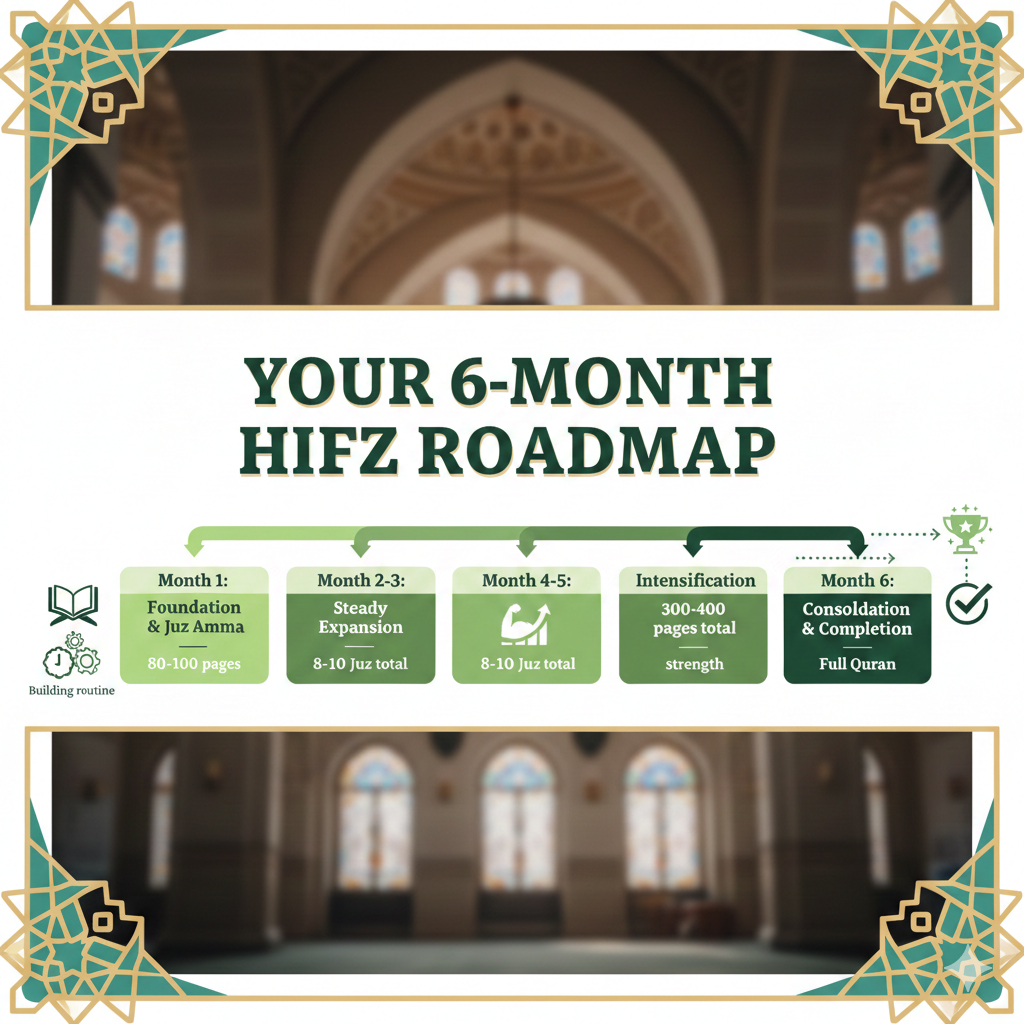
Month 1: Foundation and Momentum Building
Primary goal: Establish a strong daily routine while building confidence.
Start from Juz Amma (the 30th Juz) even though you’ll eventually memorize the entire Quran in order. Why? The shorter Surahs in Juz Amma allow you to complete full chapters, creating psychological wins that fuel motivation. Starting with Juz Amma also reinforces Tajweed rules with relatively simpler vocabulary before tackling longer Surahs.
Week 1 to 2: Memorize Surah An-Nas through Surah Al-Qadr (approximately 20 to 24 pages) Week 3 to 4: Continue through Surah Al-Bayyinah to Surah Ad-Duha (approximately 20 to 24 pages)
By month’s end, you should have memorized roughly 80 to 100 pages and solidified your daily schedule. More importantly, you’ve proven to yourself that you can maintain consistency.
Months 2 to 3: Steady Expansion and Pattern Recognition
Primary goal: Build substantial volume while refining your personal memorization technique.
Transition to sequential memorization from Surah Al-Baqarah. These months are where you’ll cover the most ground, completing approximately 8 to 10 Juz total.
Your routine should now feel automatic. You wake up, you memorize. The question isn’t whether you’ll study today but rather how efficiently you can optimize your technique.
Pattern recognition speeds up memorization: As you encounter repeated phrases, similar sentence structures, and recurring themes, your brain begins organizing information. Verses about prayer, charity, or patience follow recognizable patterns. This familiarity speeds up later memorization.
Daily structure for months 2 to 3:
- Morning session (2 hours): 2 to 3 new pages
- Midday session (30 to 45 minutes): Review same pages plus yesterday’s portion
- Evening session (1 to 1.5 hours): Long-term revision of older Juz
Months 4 to 5: Intensification and Endurance Testing
Primary goal: Push through the difficult middle period when novelty has worn off but the finish line still seems distant.
These months test your commitment. The initial excitement has faded. You’ve likely encountered several challenging passages that required extra repetition. Tiredness becomes a real factor.
This is precisely when many students abandon the 6-month timeline and extend their deadline. Those who continue typically do so by reconnecting with their original intention and adjusting their technique based on lessons learned.
Strategic adjustments for months 4 to 5:
Increase revision time proportionally as your memorized volume grows. By month 4, you might have 300 to 400 pages memorized, requiring more detailed revision systems.
Focus on your weakest Juz. Identify which sections you struggle to recall and give them concentrated attention before they become chronic weak spots.
Engage with the meaning more deeply. Understanding context and translation (even basic understanding) creates additional memory hooks beyond pure audio-visual memorization.
Month 6: Consolidation and Final Push
Primary goal: Complete remaining pages while ensuring retention of earlier portions.
The final month balances two competing demands. You need to finish memorizing the last 80 to 100 pages while ensuring you haven’t forgotten the first portions you learned six months ago.
Strategic approach for month 6:
Reduce new memorization volume slightly if needed. Better to finish in 195 days with solid retention than rush through day 180 with shaky recall.
Implement full Quran revision cycles. By week 3 or 4 of month 6, attempt to recite large portions (several Juz) from memory in single sittings.
Schedule regular recitation sessions with your teacher, demonstrating longer connected passages rather than isolated pages.
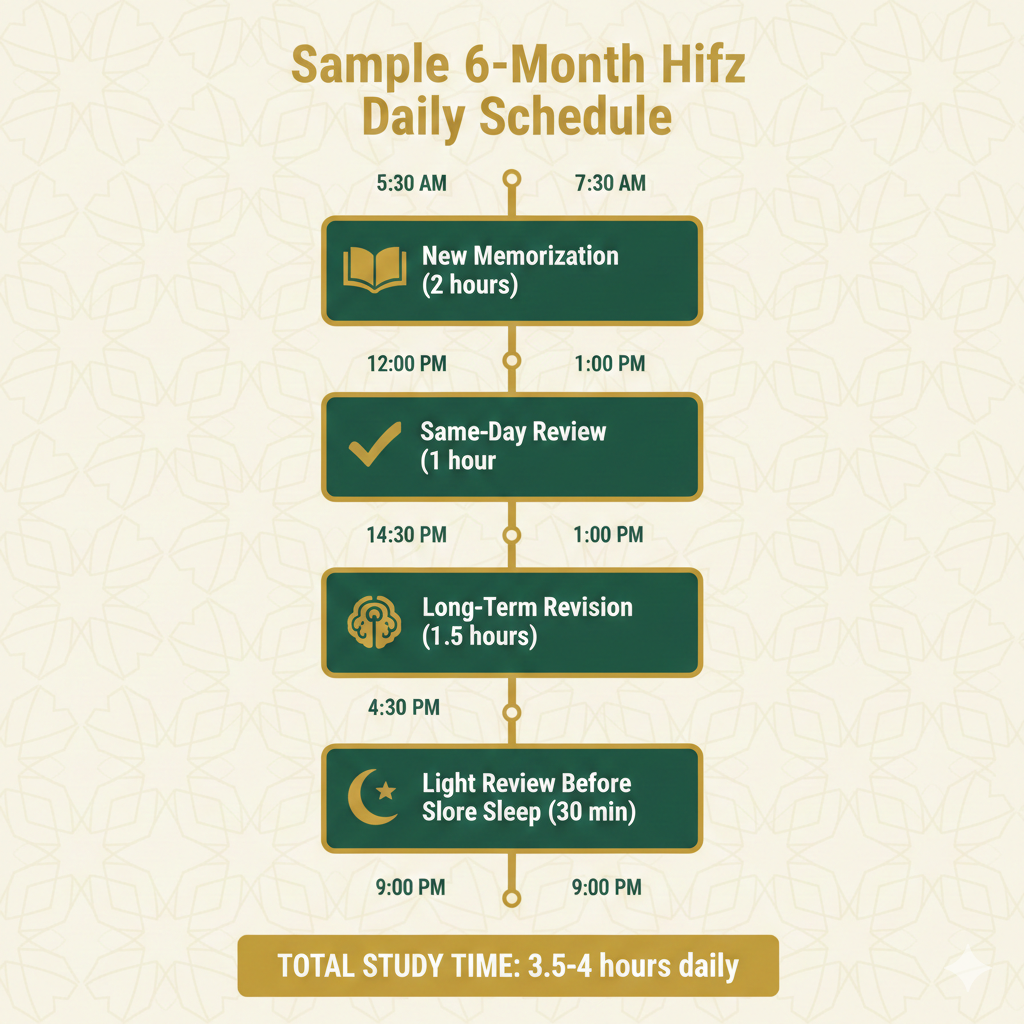
Sample Daily Schedule (3 to 4 Hours)
A realistic daily breakdown for the 4-page model might look like this:
5:30 AM to 7:30 AM: New Memorization (2 hours)
- Perform Fajr prayer
- Begin in a state of mental freshness
- Memorize 2 to 3 new pages using repetitive recitation
- First, read each line 10 to 15 times while looking at the Mushaf
- Then, recite from memory, checking against the text
- Continue until the page is solid
12:00 PM to 1:00 PM: Same-Day Review (1 hour)
- After Dhuhr prayer
- Review the pages memorized this morning
- Recite yesterday’s portion from memory
- Note any stumbling points for extra attention
4:30 PM to 6:00 PM: Long-Term Revision (1.5 hours)
- After Asr prayer
- Revise older Juz using spaced repetition
- Recite to a family member, study partner, or teacher if possible
- Listen to a skilled reciter (always the same voice for consistency)
Evening: Light Review Before Sleep (20 to 30 minutes)
- Quick recitation of today’s new pages
- Studies show that reviewing before sleep enhances memory strengthening
Total focused study time: Approximately 3.5 to 4 hours, distributed across the day to prevent mental tiredness.
Some students prefer condensing their study into one longer 4-hour block, typically in the morning. This works if you can maintain concentration, but distributed practice often produces better long-term retention.
Revision Strategy: Keeping What You Memorize
The Quran famously slips from memory faster than any other text. The Prophet Muhammad (peace be upon him) compared it to a camel that will escape if not firmly tied. This makes revision absolutely necessary, especially on an accelerated timeline.
The Three-Layer Revision System
Layer 1: Recent memorization (last 1 to 3 days)
Review daily. These pages are still fresh but haven’t moved into long-term memory. Recite them multiple times each day until they feel effortless.
Layer 2: Current week/month (last 7 to 30 days)
Review every 2 to 3 days. These pages are transitioning into medium-term memory. You should be able to recite them with minimal prompting.
Layer 3: Older portions (30+ days ago)
Review weekly using spaced repetition intervals. For example, review a Juz on day 1, day 3, day 7, day 14, day 30, then monthly. Research on spaced repetition, pioneered by cognitive psychologists like Hermann Ebbinghaus, shows this pattern fights the forgetting curve most effectively.
Practical Revision Techniques That Work
Repetitive recitation cycles: Recite the same page or passage 5 to 10 times in a row. First while reading, then from memory, alternating until recall is automatic.
Visual memorization: Study the page layout. Notice where lines begin and end, where Ayah numbers appear, any unique calligraphy features. Your brain will photograph these visual cues.
Single reciter consistency: Choose one Qari whose recitation you’ll listen to exclusively. This creates consistent audio memory. Switching between different reciters can cause confusion in pronunciation and rhythm.
Teaching and reciting to others: Explaining or reciting to a study partner forces active recall, the strongest form of memory reinforcement. Even reciting to a family member who follows along in a Mushaf helps.
Connection to meaning: While memorizing the Arabic text is the priority, understanding basic translation creates mental memory hooks. You remember not just sounds but meanings.
Techniques to Maximize Memorization Quality
Beyond revision strategies, specific memorization techniques dramatically impact your success rate.
The Chunk and Chain Method
Don’t try to memorize an entire page as one unit. Break it into manageable chunks:
- Memorize the first 2 to 3 lines until perfect
- Memorize the next 2 to 3 lines until perfect
- Chain them together, reciting lines 1 through 6
- Continue this pattern down the page
- Finally, recite the entire page from start to finish multiple times
The Write-and-Recite Technique
Some students benefit from writing what they’re memorizing, engaging both visual and physical memory. After reciting a section 10 times, write it from memory, then check against the Mushaf. This multi-sensory approach works especially well for difficult passages.
The Context Connection Strategy
Understanding where each Surah was revealed (Makkah or Madinah), its central themes, and its position in the Quran creates a mental framework. When you forget a specific verse, you can sometimes reconstruct it by remembering its context and theme.
The Pre-Sleep Review Advantage
Neuroscience research consistently shows that memory strengthening happens during sleep. Reviewing your newest memorization in the 30 minutes before sleeping significantly improves next-day retention. Your brain will literally process and strengthen these neural pathways while you rest.
Common Mistakes and Risks of a 6-Month Plan
Even dedicated students make predictable errors that derail their progress.
Mistake 1: Prioritizing Speed Over Accuracy
The single most damaging mistake is memorizing with incorrect Tajweed. Every mispronounced word, every skipped rule, every approximated articulation point becomes much harder to correct later. Students who memorize the entire Quran in 6 months with errors often spend the next year or longer trying to fix those mistakes.
Always verify pronunciation with a qualified teacher before moving to the next section. If your teacher identifies a recurring error, pause new memorization until it’s corrected.
Mistake 2: Inconsistent Schedule and Missed Days
Missing one day doesn’t seem disastrous, but it breaks the chain of consistency that makes daily memorization automatic. Missing sessions makes later sessions harder to start. The mental resistance increases.
If you must miss a day due to illness or emergency, resume immediately the next day without trying to “make up” the missed pages. Attempting to memorize 6 to 8 pages to compensate usually results in poor retention across all pages.
Mistake 3: Neglecting Structured Revision
Some students become so focused on covering new pages that they treat revision as optional or secondary. This creates a house of cards. By month 3 or 4, they discover they’ve forgotten much of what they memorized in month 1.
Revision must be scheduled with the same non-negotiable status as new memorization. A good rule: if you have time for only one activity today, choose revision over new pages.
Mistake 4: Attempting This Timeline With Full-Time Obligations
The 6-month plan requires 3 to 4 hours of focused daily study. Students who try to complete this while working full-time jobs, raising young children, or managing intensive academic programs almost universally report burnout or failure.
Be honest about your capacity. A 12-month or 18-month plan that you complete successfully is infinitely better than a 6-month plan you abandon at month 3.
Mistake 5: Isolating Yourself From Teacher Support
Some students view memorization as a solo task, checking in with a teacher only occasionally. This leads to reinforced errors and missed learning opportunities. Regular teacher sessions (ideally 3 to 5 times weekly) keep you accountable, correct mistakes early, and provide encouragement during difficult periods.
6 Months vs Longer Paths: Which Should You Choose?
Let’s examine the advantages and disadvantages objectively.
Advantages of the 6-Month Timeline
Intense focus period: Your entire life revolves around one goal, creating powerful momentum.
Minimal life disruption: Six months is short enough that you might arrange a focused break from other obligations.
Rapid completion: Finishing in half a year means you achieve Hafiz status while the initial motivation is still strong.
Immersive experience: The intensity creates a transformation that some students find spiritually powerful.
Disadvantages of the 6-Month Timeline
Extreme daily commitment: 3 to 4 hours is incompatible with most people’s lifestyles.
Higher forgetting risk: Rushing through pages can mean weaker long-term retention if revision isn’t equally intense.
Burnout potential: The relentless pace exhausts many students, sometimes creating negative associations with Quran study.
Limited flexibility: No room for life events, travel, illness, or natural motivation changes.
Advantages of 12-Month to 3-Year Timelines
Sustainable pace: 1 to 2 pages daily fits more realistically around work, school, and family.
Deeper retention: More time per page means stronger initial memorization and more revision cycles.
Lower stress: You can maintain other life responsibilities without constant tension.
Better Tajweed mastery: More time to perfect pronunciation before moving forward.
Making Your Decision
Ask yourself these questions:
- Can I honestly commit 3 to 4 hours daily for 180 consecutive days?
- Do I have proven track record of maintaining intense goals for months?
- Is my Tajweed already strong enough that I need minimal correction?
- Will the people depending on me support (not just tolerate) this commitment?
- What happens if I don’t finish in 6 months? Will I view it as failure or adjust the timeline?
If you answered “no” or “uncertain” to several questions, a longer timeline serves you better. Remember that the Sahaba (may Allah be pleased with them) often spent years memorizing the Quran, and their retention and understanding surpassed what we can imagine.
How Noor-path Can Support Your Hifz Journey
Whether you choose a 6-month intensive program or a more gradual path, structured guidance transforms your success rate.
At Noor-path, we offer personalized Hifz programs that adapt to your unique situation. Our experienced teachers provide daily feedback through one-on-one sessions, ensuring you never memorize incorrectly. We’ve guided students through both intensive 6 to 12-month programs and comfortable 2 to 3-year journeys, always prioritizing retention quality over completion speed.
Our approach includes:
Daily teacher verification: Every page you memorize is checked by a qualified instructor before you proceed, preventing the single biggest problem in self-directed memorization.
Customized pacing: We adjust your daily targets based on your actual performance, not theoretical schedules, ensuring sustainable progress.
Systematic revision plans: Our structured revision system uses spaced repetition tailored to your retention patterns.
Flexible scheduling: Online sessions accommodate different time zones and busy schedules, making Hifz accessible even with work or school commitments.
Community support: Connect with other students on similar journeys for accountability and encouragement.
We’ve seen countless students achieve their Hifz goals, and we understand that everyone’s path looks different. The question isn’t whether you can memorize the Quran in 6 months versus 2 years. The real question is which timeline allows you to build a lasting relationship with Allah’s words while achieving strong retention.
Your Next Steps
If you’re seriously considering a 6-month Hifz program, take these immediate actions:
Assess your Tajweed honestly: Schedule an evaluation with a qualified teacher to identify any pronunciation issues that need correction before you begin.
Test your capacity: Spend two weeks memorizing 1 to 2 pages daily with structured revision. Track how long it takes and how well you retain the material.
Clear your schedule: Look at the next 6 months realistically. Identify potential conflicts and decide whether you can truly commit.
Build your support system: Discuss your plan with family and friends. Their understanding and encouragement will matter during difficult weeks.
Choose your program: Whether with Noor-path or another reputable Hifz program, don’t attempt this journey alone. Teacher guidance and accountability make the difference between success and abandonment.
The Quran is a trust and a treasure. However long your memorization journey takes, approach it with sincerity, patience, and excellence. The goal is not merely to finish quickly but to carry Allah’s words in your heart for a lifetime.